Correlation IDs
Learn Correlation IDs for request tracing across distributed services — attach unique identifiers to requests so logs, metrics, and traces can be linked.
A Correlation ID is a unique identifier attached to a request at the system's entry point and propagated through every service in the call chain. When a user clicks a button and that action flows through an API gateway, three microservices, two message queues, and a database, the Correlation ID ties all related logs, metrics, and traces together. Without it, debugging a failure in a 20-service architecture means searching through millions of unrelated log lines. With it, a single query retrieves the complete story of any request.
| Aspect | Details |
|---|---|
| What it is | A unique identifier attached to a request and propagated through all services and message queues, linking all related telemetry together |
| When to use | Always in microservices — any system with more than one service boundary needs correlation IDs to debug cross-service issues |
| When NOT to use | Never — there is no scenario where correlation IDs should be omitted; even monoliths benefit from request IDs for log correlation |
| Real-world example | The W3C Trace Context standard (traceparent header) provides a universal format for correlation IDs used by OpenTelemetry and major cloud providers |
| Interview tip | Show you understand that correlation IDs are the foundation for distributed tracing — they are the same concept, just at different levels of sophistication |
| Common mistake | Generating correlation IDs in each service instead of propagating the original one — you end up with fragmented traces that cannot be stitched together |
| Key tradeoff | Overhead vs. debuggability — passing extra headers has minimal cost but the debugging value during incidents is enormous |
Why This Matters
In a monolithic application, a stack trace tells you exactly what happened. In a distributed system, a single user request might traverse 10 services, 3 message queues, and 2 databases. When something fails, you need to reconstruct the entire journey. Correlation IDs make this possible by giving every request a unique identity that persists across all service boundaries. Engineers can query their log aggregation system with a single ID and see every log line, from every service, in chronological order. This transforms incident response from hours of guesswork to minutes of targeted investigation. The W3C Trace Context specification (traceparent header) standardized this across the industry, and OpenTelemetry builds distributed tracing directly on top of these identifiers.
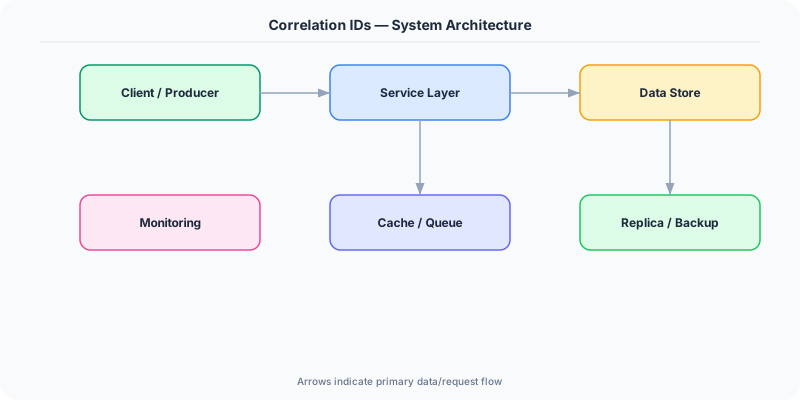
The Building Blocks
- ID Generation: Creating unique identifiers at the entry point — UUIDs, ULIDs, or W3C trace IDs — that are statistically guaranteed not to collide across billions of requests
- Header Propagation: Passing the correlation ID through HTTP headers (traceparent, X-Request-ID), gRPC metadata, and message queue headers at every service boundary
- Context Injection: Automatically adding the correlation ID to every log line, metric label, and trace span within each service using middleware or frameworks
- Async Propagation: Maintaining correlation across asynchronous boundaries — message queues, event streams, and background jobs — where HTTP headers do not naturally flow
- Correlation Lookup: Using the ID to query across telemetry systems, pulling related logs from Elasticsearch, traces from Jaeger, and metrics from Prometheus in a unified view
Under the Hood
Correlation IDs are implemented through three mechanisms: generation, propagation, and injection. At the system boundary (API gateway, load balancer), a unique ID is generated — typically a 128-bit value encoded as a 32-character hex string. The W3C traceparent header format is version-traceId-parentSpanId-flags (e.g., 00-4bf92f3577b86cd9f7e56fc4e8f7c9d2-00f067aa0ba902b7-01), carrying both the correlation ID and span hierarchy.
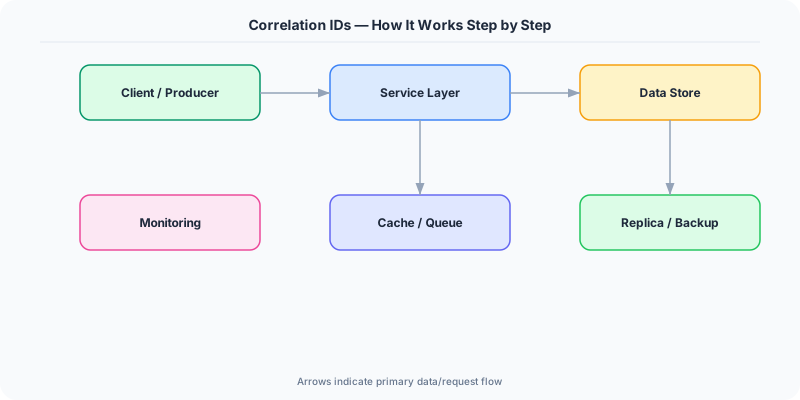
Propagation requires every service to extract the incoming correlation ID and attach it to all outbound requests. HTTP middleware extracts the traceparent header, stores it in a request-scoped context (ThreadLocal, AsyncLocal, Go context), and outbound HTTP clients, gRPC interceptors, and message queue producers read from that context. The challenge is async propagation: when a service publishes a message to Kafka, the correlation ID must be embedded in the message headers so the consumer can continue the trace.
Injection ensures the correlation ID appears in every telemetry signal. Logging frameworks read from the request context to automatically include the trace ID in every log line. Metric libraries tag measurements with the trace ID for exemplar linking. In practice, OpenTelemetry handles all three mechanisms — it generates trace IDs, propagates context through its SDK, and injects IDs into logs and metrics. The result is that a single ID query can reconstruct the complete distributed execution of any request.
How Companies Actually Do This
Amazon Uses X-Amzn-Trace-Id headers generated by Application Load Balancers and propagated through all AWS services, enabling X-Ray distributed tracing across Lambda, ECS, and EC2
Uber Propagates Jaeger trace IDs (uber-trace-id header) through every microservice and Kafka message, enabling engineers to trace a ride request from the mobile app through dispatch to driver notification
Shopify Attaches request IDs at their edge proxy and propagates them through all backend services, enabling support engineers to trace any merchant's failed checkout through their entire platform
Common Pitfalls
- Generating new correlation IDs at each service boundary instead of propagating the existing one — destroys the ability to correlate events across the full request path
- Not propagating correlation IDs across async boundaries (message queues, event streams) — the trace breaks at the most interesting and failure-prone boundaries
- Using sequential or predictable IDs that leak information about request volume or could be used to forge trace membership in multi-tenant systems
Interview Questions Worth Practicing
- How would you ensure correlation IDs propagate correctly through both synchronous HTTP calls and asynchronous message queues?
- What is the W3C Trace Context standard and why did the industry standardize on a single correlation ID format?
- How do correlation IDs relate to distributed tracing, and when would you need full tracing versus simple correlation IDs?
The Tradeoffs
- Simplicity vs. Richness: A single request ID is simple but limited; W3C traceparent with span IDs enables full parent-child trace reconstruction at the cost of complexity
- Automatic vs. Manual: Auto-instrumentation propagates IDs with zero developer effort but may miss custom protocols; manual instrumentation catches everything but requires discipline
- Overhead vs. Debuggability: Propagating context through every call adds minimal latency but the debugging and incident response benefits are transformational
How to Explain This in an Interview
Here is how I would explain Correlation IDs in a system design interview:
Correlation IDs are unique identifiers attached to requests at the system entry point and propagated through every service in the call chain. They are the foundation of distributed tracing. When a user request flows through 10 services, the correlation ID lets you query all related logs, metrics, and traces with a single identifier. I follow the W3C Trace Context standard using the traceparent header. The critical implementation detail is propagation — the ID must flow through HTTP headers, gRPC metadata, and message queue headers. OpenTelemetry handles this automatically. The most common mistake is generating new IDs at each service instead of propagating the original, which fragments the trace.
Related Topics
The Real-World Incident That Made This Famous
Understanding Correlation IDs became critical after multiple high-profile production incidents at major tech companies. When systems handle millions of users, even small misunderstandings about Correlation IDs can lead to cascading failures that cost millions in lost revenue and erode user trust. Companies like Netflix, Google, Amazon, and Meta have all invested heavily in mastering Correlation IDs because they learned the hard way that ignoring it leads to outages.
The key lesson from these incidents: Correlation IDs is not just a theoretical concept — it is a practical skill that separates engineers who build resilient systems from those who build fragile ones. Every major outage report from the past decade involves at least one Correlation IDs-related design decision that was either implemented incorrectly or overlooked entirely during the initial architecture review.
How Senior Engineers Think About This
Senior engineers approach Correlation IDs differently from textbook definitions. Instead of memorizing rules, they build mental models. They ask: "What problem does Correlation IDs solve? When does it fail? What are the alternatives?" This problem-first thinking leads to better design decisions because every system has unique constraints.
When evaluating Correlation IDs in a system design context, experienced engineers consider the failure modes first. What happens when this component goes down? How does the system degrade? Is the degradation graceful or catastrophic? These questions reveal more about your understanding than any textbook definition.
The key difference between junior and senior engineers when it comes to Correlation IDs: juniors focus on the happy path, while seniors design for what happens when things go wrong. They consider operational cost, team expertise, monitoring requirements, and how the decision will look six months from now when traffic has grown 10x.
Common Interview Mistakes
Mistake 1: Giving a textbook definition without context. Interviewers want to see you connect Correlation IDs to real systems and real problems. Instead of reciting definitions, explain when and why you would use Correlation IDs in the system you are designing.
Mistake 2: Not discussing trade-offs. Every design decision involving Correlation IDs has trade-offs. Discuss what you gain and what you give up. Acknowledge the downsides and explain why the benefits outweigh them for your specific use case.
Mistake 3: Overcomplicating the solution. Start with the simplest approach to Correlation IDs that meets the requirements, then add complexity only when justified. Many candidates jump to complex implementations when a simpler solution would work perfectly.
Production Checklist
- Define clear metrics for measuring the effectiveness of your Correlation IDs implementation
- Set up monitoring and alerting that specifically tracks Correlation IDs-related failures
- Document your Correlation IDs design decisions in Architecture Decision Records (ADRs)
- Test failure scenarios related to Correlation IDs in staging before production deployment
- Review and update your Correlation IDs implementation quarterly as system requirements evolve
- Train new team members on the specific Correlation IDs patterns used in your system
- Establish runbooks for common Correlation IDs-related incidents and recovery procedures
Practical Implementation for .NET Developers
In .NET, correlation is built into the framework via System.Diagnostics.Activity. ASP.NET Core automatically creates Activity objects with trace IDs from incoming traceparent headers. HttpClient propagation is handled by the DistributedContextPropagator which injects traceparent into outbound requests automatically. For ILogger, Activity.Current.TraceId is available in log scopes. OpenTelemetry.Instrumentation.AspNetCore and HttpClient packages automate the full pipeline. For message queues, MassTransit and NServiceBus propagate correlation IDs in message headers. The W3C Trace Context propagator is the default in .NET 8+.
ASP.NET Core setup: Create a service class that encapsulates the logic, register it with dependency injection, and inject it into your controllers or minimal API endpoints. The built-in DI container handles lifecycle management.
Entity Framework Core: For database interactions, EF Core provides the ORM layer. Use migrations for schema management and raw SQL for performance-critical queries. Consider Dapper for read-heavy paths where EF Core overhead matters.
Azure integration: If deploying to Azure, leverage managed services — Azure Cache for Redis, Azure SQL, Azure Service Bus, Azure Cosmos DB. These eliminate operational overhead and provide built-in monitoring through Application Insights.
Testing: Use xUnit with Testcontainers for integration tests that spin up real databases in Docker. Mock external dependencies with NSubstitute. The WebApplicationFactory class lets you test your entire HTTP pipeline in-process.
Monitoring: Add Application Insights telemetry to track request latency, dependency calls, and custom metrics. Use structured logging with Serilog to make production debugging possible:
Log.Information("Processing {Operation} for {ResourceId}", operation, resourceId);
This gives you searchable, structured logs in Azure Monitor or Seq.