Service Mesh
Learn Service Mesh architecture with Istio, Linkerd, and sidecar proxies — handle service-to-service communication, security, observability, and traffic.
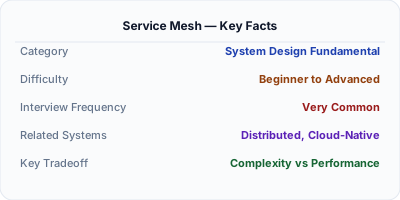
A service mesh is a dedicated infrastructure layer that handles service-to-service communication in a microservices architecture. Instead of each service implementing its own retry logic, circuit breaking, TLS, and tracing, a sidecar proxy (like Envoy) is deployed alongside every service instance and transparently intercepts all network traffic. The control plane (Istio, Linkerd) configures these proxies centrally, providing uniform security (mutual TLS), observability (automatic metrics and traces), and traffic management (canary deployments, fault injection) without changing application code.
| Aspect | Details |
|---|---|
| What it is | A dedicated infrastructure layer of sidecar proxies that transparently handles service-to-service communication, security, and observability |
| When to use | When operating 20+ microservices where implementing consistent retry, TLS, tracing, and traffic routing in every service is unsustainable |
| When NOT to use | When you have fewer than 10 services and the operational complexity of running a mesh exceeds the communication complexity it solves |
| Real-world example | Lyft created Envoy proxy to handle cross-cutting communication concerns across their microservices fleet, which became the foundation for Istio |
| Interview tip | Explain the data plane (sidecar proxies) vs. control plane (Istio/Linkerd) architecture and why this separation matters |
| Common mistake | Adopting a service mesh for a small number of services — the operational overhead of running Istio outweighs benefits for fewer than 15-20 services |
| Key tradeoff | Transparency vs. complexity — the mesh removes communication logic from services but adds significant infrastructure complexity and resource overhead |
Why This Matters
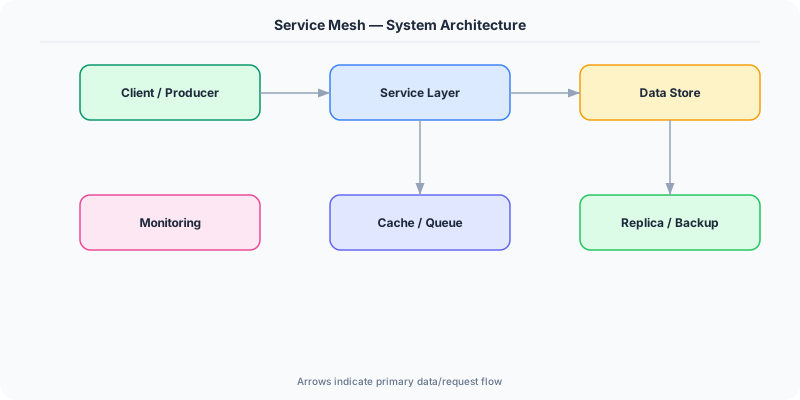
As microservices architectures grow, every service needs retry logic, circuit breaking, mutual TLS, distributed tracing, and traffic routing. Implementing these in every service — often written in different languages by different teams — leads to inconsistency, bugs, and duplication. A service mesh moves these cross-cutting concerns into the infrastructure layer. Each service gets a sidecar proxy that intercepts all inbound and outbound traffic. The proxy handles retries, timeouts, circuit breaking, mTLS encryption, and telemetry emission without the application knowing. The control plane provides centralized configuration, certificate management, and traffic policies. This separation means teams focus on business logic while the platform team manages communication infrastructure uniformly across all services.
The Building Blocks
- Data Plane: The fleet of sidecar proxies (Envoy, Linkerd-proxy) deployed alongside every service instance, handling all actual network traffic between services
- Control Plane: The management layer (Istio's istiod, Linkerd's control plane) that configures proxy behavior, distributes certificates, and manages traffic policies
- Mutual TLS: Automatic encryption and authentication between all services — each proxy has a certificate, and the mesh verifies identity on every connection without application code changes
- Traffic Management: Fine-grained control over request routing — canary deployments sending 5% of traffic to a new version, A/B testing, traffic mirroring for shadow testing
- Observability Integration: Automatic generation of metrics (request rate, error rate, latency), distributed traces, and access logs for every service call without instrumentation code
Under the Hood
A service mesh consists of two planes. The data plane is a network of lightweight proxies deployed as sidecar containers alongside every application pod. In Kubernetes, a mutating admission webhook automatically injects the sidecar proxy into every pod. All inbound and outbound traffic is redirected through the proxy using iptables rules, making the interception transparent to the application.
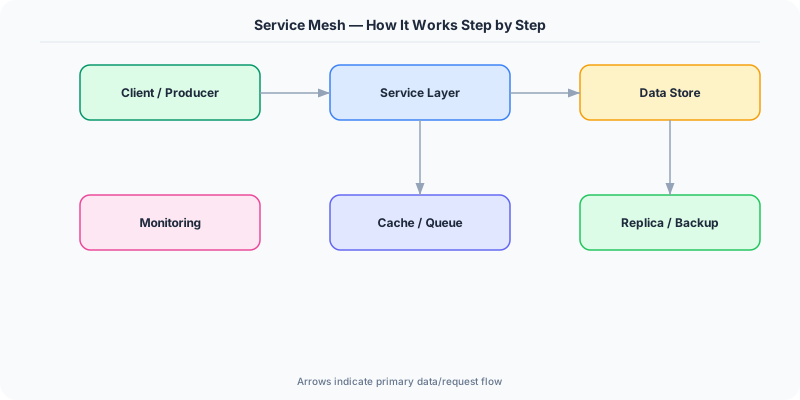
The control plane manages proxy configuration and certificate distribution. Istio's istiod component watches Kubernetes for service changes, compiles routing rules and security policies, and pushes xDS (discovery service) configuration updates to all Envoy proxies. It also runs a certificate authority that issues short-lived mTLS certificates to every proxy, rotated automatically. This means every service-to-service call is encrypted and mutually authenticated without any application code changes.
Traffic management is the most powerful service mesh capability. Virtual services define routing rules: send requests with header canary:true to version v2, mirror 1% of production traffic to a shadow environment, inject 500ms latency into 5% of requests to test resilience. Destination rules configure load balancing algorithms, connection pool sizes, and outlier detection per service. The challenge is operational complexity — running Istio adds 100-200MB of memory per sidecar proxy, increases tail latency by 1-3ms per hop, and requires a dedicated platform team for upgrades and troubleshooting.
How Companies Actually Do This
Lyft Created Envoy proxy to solve cross-cutting service communication challenges, which became the standard sidecar proxy used in Istio, AWS App Mesh, and most service mesh implementations
Airbnb Adopted Istio to enforce mutual TLS between all services, automatically encrypting service-to-service traffic and eliminating an entire class of internal network security vulnerabilities
Shopify Uses a service mesh to manage traffic routing during deployments, enabling canary releases that gradually shift traffic to new versions with automatic rollback on error rate increases
Common Pitfalls
- Adopting a full service mesh (Istio) when simpler alternatives suffice — a lightweight library-based approach may work better for smaller fleets with a single programming language
- Underestimating resource overhead — Envoy sidecars consume 100-200MB RAM per pod and add 1-3ms P99 latency per hop, which compounds in deep call chains
- Not investing in mesh observability — when the mesh itself has issues (misconfigured routes, certificate expiry), debugging requires understanding the mesh's own telemetry and configuration
Interview Questions Worth Practicing
- What is the difference between the data plane and control plane in a service mesh?
- When would you recommend adopting a service mesh versus using a library-based approach for service communication?
- How does mutual TLS in a service mesh work, and why is it better than application-level TLS?
The Tradeoffs
- Transparency vs. Overhead: The mesh removes communication logic from applications but adds latency, memory, and operational complexity per service instance
- Consistency vs. Flexibility: Uniform policies across all services reduce bugs but may be too restrictive for services with unique communication requirements
- Istio vs. Linkerd: Istio is feature-rich but complex and resource-heavy; Linkerd is simpler, lighter, and faster but has fewer traffic management features
How to Explain This in an Interview
Here is how I would explain Service Mesh in a system design interview:
A service mesh is a dedicated infrastructure layer for handling service-to-service communication. It consists of a data plane — sidecar proxies like Envoy deployed alongside every service — and a control plane like Istio that configures them centrally. The mesh transparently handles retries, circuit breaking, mutual TLS, traffic routing, and observability without application code changes. Key capabilities include automatic mTLS encryption between all services, canary deployment traffic splitting, and uniform metrics collection. I would recommend a service mesh when operating 20+ microservices where consistent cross-cutting concerns become unsustainable. The main tradeoff is transparency versus overhead — each sidecar adds memory and latency, and the mesh itself requires operational expertise.
Related Topics
The Real-World Incident That Made This Famous
Understanding Service Mesh became critical after multiple high-profile production incidents at major tech companies. When systems handle millions of users, even small misunderstandings about Service Mesh can lead to cascading failures that cost millions in lost revenue and erode user trust. Companies like Netflix, Google, Amazon, and Meta have all invested heavily in mastering Service Mesh because they learned the hard way that ignoring it leads to outages.
The key lesson from these incidents: Service Mesh is not just a theoretical concept — it is a practical skill that separates engineers who build resilient systems from those who build fragile ones. Every major outage report from the past decade involves at least one Service Mesh-related design decision that was either implemented incorrectly or overlooked entirely during the initial architecture review.
How Senior Engineers Think About This
Senior engineers approach Service Mesh differently from textbook definitions. Instead of memorizing rules, they build mental models. They ask: "What problem does Service Mesh solve? When does it fail? What are the alternatives?" This problem-first thinking leads to better design decisions because every system has unique constraints.
When evaluating Service Mesh in a system design context, experienced engineers consider the failure modes first. What happens when this component goes down? How does the system degrade? Is the degradation graceful or catastrophic? These questions reveal more about your understanding than any textbook definition.
The key difference between junior and senior engineers when it comes to Service Mesh: juniors focus on the happy path, while seniors design for what happens when things go wrong. They consider operational cost, team expertise, monitoring requirements, and how the decision will look six months from now when traffic has grown 10x.
Common Interview Mistakes
Mistake 1: Giving a textbook definition without context. Interviewers want to see you connect Service Mesh to real systems and real problems. Instead of reciting definitions, explain when and why you would use Service Mesh in the system you are designing.
Mistake 2: Not discussing trade-offs. Every design decision involving Service Mesh has trade-offs. Discuss what you gain and what you give up. Acknowledge the downsides and explain why the benefits outweigh them for your specific use case.
Mistake 3: Overcomplicating the solution. Start with the simplest approach to Service Mesh that meets the requirements, then add complexity only when justified. Many candidates jump to complex implementations when a simpler solution would work perfectly.
Production Checklist
- Define clear metrics for measuring the effectiveness of your Service Mesh implementation
- Set up monitoring and alerting that specifically tracks Service Mesh-related failures
- Document your Service Mesh design decisions in Architecture Decision Records (ADRs)
- Test failure scenarios related to Service Mesh in staging before production deployment
- Review and update your Service Mesh implementation quarterly as system requirements evolve
- Train new team members on the specific Service Mesh patterns used in your system
- Establish runbooks for common Service Mesh-related incidents and recovery procedures
Practical Implementation for .NET Developers
In .NET, service mesh integration is transparent — since the mesh operates at the network layer, .NET applications require no code changes. However, YARP (Yet Another Reverse Proxy) can serve as a lightweight application-level mesh proxy written in .NET. For Kubernetes, Istio and Linkerd inject Envoy/Linkerd-proxy sidecars alongside .NET pods automatically. .NET's HttpClient works seamlessly through sidecar proxies. Dapr (Distributed Application Runtime) from Microsoft provides a mesh-like experience with service invocation, pub/sub, and state management via sidecar processes, with first-class .NET SDK support via Dapr.AspNetCore.
ASP.NET Core setup: Create a service class that encapsulates the logic, register it with dependency injection, and inject it into your controllers or minimal API endpoints. The built-in DI container handles lifecycle management.
Entity Framework Core: For database interactions, EF Core provides the ORM layer. Use migrations for schema management and raw SQL for performance-critical queries. Consider Dapper for read-heavy paths where EF Core overhead matters.
Azure integration: If deploying to Azure, leverage managed services — Azure Cache for Redis, Azure SQL, Azure Service Bus, Azure Cosmos DB. These eliminate operational overhead and provide built-in monitoring through Application Insights.
Testing: Use xUnit with Testcontainers for integration tests that spin up real databases in Docker. Mock external dependencies with NSubstitute. The WebApplicationFactory class lets you test your entire HTTP pipeline in-process.
Monitoring: Add Application Insights telemetry to track request latency, dependency calls, and custom metrics. Use structured logging with Serilog to make production debugging possible:
Log.Information("Processing {Operation} for {ResourceId}", operation, resourceId);
This gives you searchable, structured logs in Azure Monitor or Seq.