Observability
Learn Observability in distributed systems — understand how logs, metrics, and traces work together to provide deep insight into system behavior and.
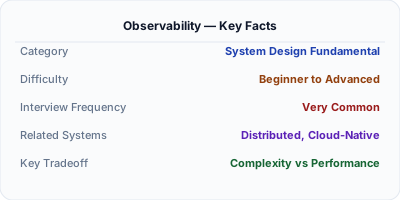
Observability is the ability to understand a system's internal state by examining its external outputs — logs, metrics, and traces. While monitoring tells you when something is wrong, observability helps you understand why. In distributed systems with dozens of interconnected services, observability is essential for debugging issues that span multiple service boundaries. The three pillars of observability — logs, metrics, and traces — provide complementary views that together enable engineers to diagnose any problem without deploying new code.
| Aspect | Details |
|---|---|
| What it is | The ability to infer a system's internal state from its external telemetry outputs — logs, metrics, and traces |
| When to use | Always in distributed systems — you cannot debug what you cannot see, and microservices create emergent behaviors no single team predicts |
| When NOT to use | When running a single-process monolith in development where a debugger and printf statements suffice for troubleshooting |
| Real-world example | Uber built their own observability platform (M3 for metrics, Jaeger for traces) to diagnose issues across thousands of microservices |
| Interview tip | Define the three pillars clearly and explain how they complement each other — logs give detail, metrics give trends, traces give causality |
| Common mistake | Collecting massive volumes of telemetry without indexing or sampling — raw data is expensive to store and impossible to query at scale |
| Key tradeoff | Cost vs. insight — comprehensive observability is expensive in storage and compute, but blind spots during incidents cost more |
Why This Matters
Distributed systems exhibit emergent behavior — failures arise from interactions between services that are individually healthy. A 50ms latency increase in one service might cause timeouts in another, triggering retries that overload a third. Traditional monitoring dashboards cannot explain these cascading interactions. Observability provides the tools to ask arbitrary questions about system behavior: which user IDs experienced errors, what percentage of requests to endpoint X touched slow database Y, why did latency spike for only one availability zone. Without observability, debugging incidents in production becomes guesswork. OpenTelemetry has emerged as the industry standard for collecting and correlating all three pillars.
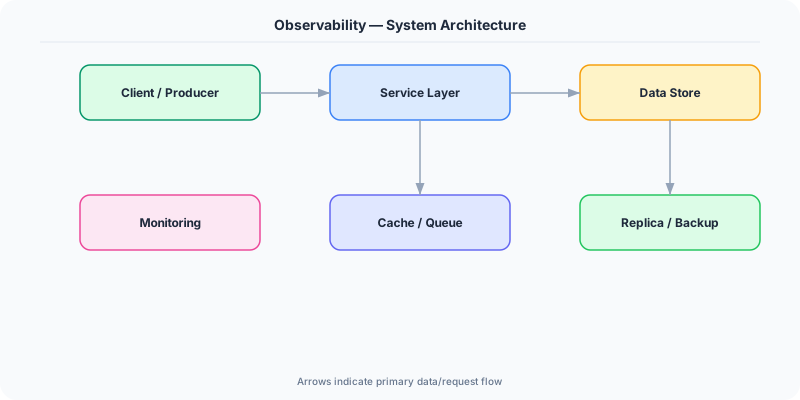
The Building Blocks
- Logs: Discrete timestamped event records with structured fields, providing detailed context about what happened at specific moments in each service
- Metrics: Numeric time-series measurements (counters, gauges, histograms) aggregated over time, revealing trends and enabling alerting on system health
- Traces: End-to-end request paths through distributed services, showing the causal chain and timing of every operation a request triggers
- Correlation: Linking logs, metrics, and traces together via shared identifiers (trace IDs, span IDs) so engineers can pivot between telemetry types during investigation
- Instrumentation: The code and libraries that generate telemetry data — auto-instrumentation captures common patterns while manual instrumentation covers business-specific signals
Under the Hood
Observability rests on generating, collecting, and correlating three complementary signal types. Logs record discrete events — a user logged in, a query failed, a cache missed. Structured logging formats events as JSON with consistent fields, making them queryable. Metrics aggregate numeric values over time — request count, error rate, p99 latency. They are cheap to store and excellent for dashboards and alerts. Traces record the journey of a single request across service boundaries, creating a directed acyclic graph of spans that reveals where time was spent.
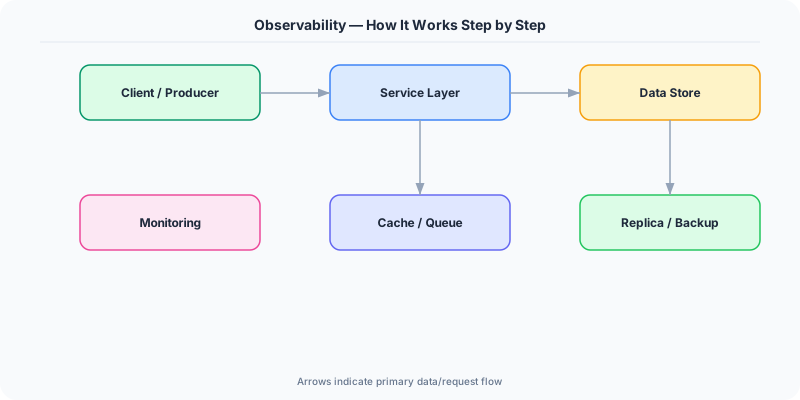
The key innovation in modern observability is correlation. When a trace ID is embedded in every log line and tagged on every metric, an engineer investigating a latency spike can go from a dashboard (metrics) to the specific slow traces, then drill into the detailed logs for the offending spans. OpenTelemetry standardizes this by providing a single SDK that emits all three signals with consistent context propagation.
Achieving cost-effective observability requires intelligent sampling and aggregation. Head-based sampling decides at ingress whether to trace a request (simple but misses interesting failures). Tail-based sampling buffers trace data and only persists traces that exhibit anomalies — high latency, errors, or unusual patterns. This dramatically reduces storage costs while preserving the most valuable diagnostic data.
How Companies Actually Do This
Uber Built Jaeger for distributed tracing and M3 for metrics aggregation, processing billions of spans and metrics daily across thousands of microservices to debug rider-driver matching issues
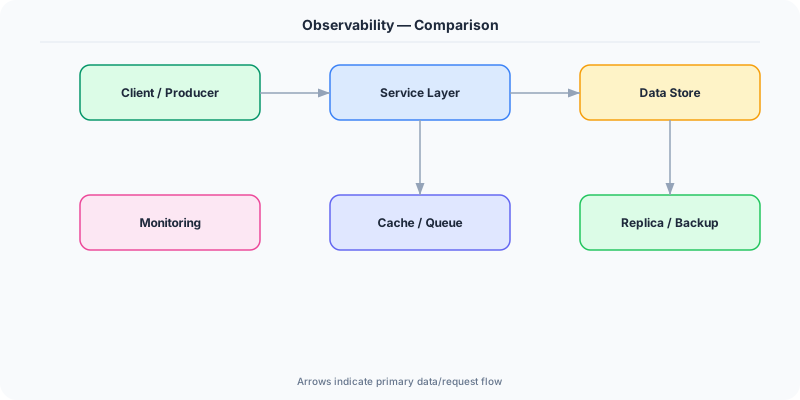
Netflix Developed Edgar, an observability platform that correlates logs, traces, and metrics per request, enabling engineers to debug streaming issues from a single pane of glass
Honeycomb Pioneered high-cardinality observability, allowing engineers to query across any combination of dimensions without pre-defined dashboards to find novel failure patterns
Common Pitfalls
- Treating observability as just monitoring with more data — the value is in the ability to ask novel questions, not in building more static dashboards
- Insufficient context propagation — if trace IDs do not flow through async queues and batch jobs, you lose visibility at the boundaries that matter most
- Over-instrumenting everything at maximum verbosity crushes storage budgets; under-instrumenting misses critical signals — start with RED metrics and expand
Interview Questions Worth Practicing
- How do the three pillars of observability complement each other when debugging a production incident?
- What is the difference between monitoring and observability, and when does monitoring fall short?
- How would you design an observability strategy for a new microservices platform with a limited budget?
The Tradeoffs
- Depth vs. Cost: Comprehensive telemetry provides deep insight but generates enormous data volumes that are expensive to store, index, and query
- Sampling vs. Completeness: Sampling reduces cost dramatically but may miss rare edge-case failures that only appear in unsampled requests
- Standardization vs. Flexibility: OpenTelemetry provides vendor-neutral standards but may not expose vendor-specific features of tools like Datadog or Honeycomb
How to Explain This in an Interview
Here is how I would explain Observability in a system design interview:
Observability is the ability to understand a distributed system's internal state from its external outputs. It rests on three pillars: logs provide event-level detail, metrics provide aggregated trends and alerting, and traces show the end-to-end journey of requests across services. The key is correlation — embedding trace IDs in logs and metric tags so you can pivot from a dashboard anomaly to the specific traces and log lines that explain it. OpenTelemetry has become the industry standard for instrumentation. I would start with RED metrics (Rate, Errors, Duration) for every service, add distributed tracing with tail-based sampling to control costs, and use structured logging with trace context for deep debugging.
Related Topics
The Real-World Incident That Made This Famous
Understanding Observability became critical after multiple high-profile production incidents at major tech companies. When systems handle millions of users, even small misunderstandings about Observability can lead to cascading failures that cost millions in lost revenue and erode user trust. Companies like Netflix, Google, Amazon, and Meta have all invested heavily in mastering Observability because they learned the hard way that ignoring it leads to outages.
The key lesson from these incidents: Observability is not just a theoretical concept — it is a practical skill that separates engineers who build resilient systems from those who build fragile ones. Every major outage report from the past decade involves at least one Observability-related design decision that was either implemented incorrectly or overlooked entirely during the initial architecture review.
How Senior Engineers Think About This
Senior engineers approach Observability differently from textbook definitions. Instead of memorizing rules, they build mental models. They ask: "What problem does Observability solve? When does it fail? What are the alternatives?" This problem-first thinking leads to better design decisions because every system has unique constraints.
When evaluating Observability in a system design context, experienced engineers consider the failure modes first. What happens when this component goes down? How does the system degrade? Is the degradation graceful or catastrophic? These questions reveal more about your understanding than any textbook definition.
The key difference between junior and senior engineers when it comes to Observability: juniors focus on the happy path, while seniors design for what happens when things go wrong. They consider operational cost, team expertise, monitoring requirements, and how the decision will look six months from now when traffic has grown 10x.
Common Interview Mistakes
Mistake 1: Giving a textbook definition without context. Interviewers want to see you connect Observability to real systems and real problems. Instead of reciting definitions, explain when and why you would use Observability in the system you are designing.
Mistake 2: Not discussing trade-offs. Every design decision involving Observability has trade-offs. Discuss what you gain and what you give up. Acknowledge the downsides and explain why the benefits outweigh them for your specific use case.
Mistake 3: Overcomplicating the solution. Start with the simplest approach to Observability that meets the requirements, then add complexity only when justified. Many candidates jump to complex implementations when a simpler solution would work perfectly.
Production Checklist
- Define clear metrics for measuring the effectiveness of your Observability implementation
- Set up monitoring and alerting that specifically tracks Observability-related failures
- Document your Observability design decisions in Architecture Decision Records (ADRs)
- Test failure scenarios related to Observability in staging before production deployment
- Review and update your Observability implementation quarterly as system requirements evolve
- Train new team members on the specific Observability patterns used in your system
- Establish runbooks for common Observability-related incidents and recovery procedures
Practical Implementation for .NET Developers
In .NET, observability is built around OpenTelemetry's dotnet SDK. The OpenTelemetry.Extensions.Hosting package wires up TracerProvider, MeterProvider, and LoggerProvider. ASP.NET Core auto-instrumentation (AddAspNetCoreInstrumentation) captures HTTP traces; HttpClient, EF Core, and gRPC have similar packages. System.Diagnostics.ActivitySource powers distributed tracing natively, while System.Diagnostics.Metrics provides the metrics API. ILogger integrates with OpenTelemetry to export structured logs with trace context. Exporters send data to Jaeger, Prometheus, OTLP collectors, or Azure Monitor via Azure.Monitor.OpenTelemetry.AspNetCore.
ASP.NET Core setup: Create a service class that encapsulates the logic, register it with dependency injection, and inject it into your controllers or minimal API endpoints. The built-in DI container handles lifecycle management.
Entity Framework Core: For database interactions, EF Core provides the ORM layer. Use migrations for schema management and raw SQL for performance-critical queries. Consider Dapper for read-heavy paths where EF Core overhead matters.
Azure integration: If deploying to Azure, leverage managed services — Azure Cache for Redis, Azure SQL, Azure Service Bus, Azure Cosmos DB. These eliminate operational overhead and provide built-in monitoring through Application Insights.
Testing: Use xUnit with Testcontainers for integration tests that spin up real databases in Docker. Mock external dependencies with NSubstitute. The WebApplicationFactory class lets you test your entire HTTP pipeline in-process.
Monitoring: Add Application Insights telemetry to track request latency, dependency calls, and custom metrics. Use structured logging with Serilog to make production debugging possible:
Log.Information("Processing {Operation} for {ResourceId}", operation, resourceId);
This gives you searchable, structured logs in Azure Monitor or Seq.