Sidecar Pattern
Learn the Sidecar Pattern for distributed systems — deploy companion containers alongside application services to handle cross-cutting concerns like.
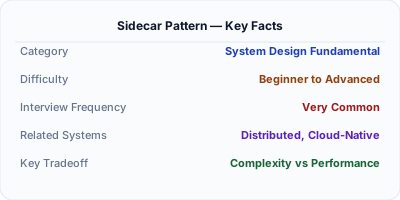
The Sidecar Pattern deploys a companion process or container alongside every application instance to handle cross-cutting concerns — logging, monitoring, networking, security — without modifying the application itself. Just as a motorcycle sidecar extends functionality without changing the motorcycle, a sidecar container extends a service with capabilities like TLS termination, log forwarding, or health checking. In Kubernetes, sidecar containers share a pod with the main application, accessing the same network namespace and local storage. This pattern is the foundation of service meshes and modern cloud-native architectures.
| Aspect | Details |
|---|---|
| What it is | A companion container or process deployed alongside every service instance to handle cross-cutting operational concerns transparently |
| When to use | When multiple services written in different languages need consistent logging, monitoring, TLS, or proxy behavior without duplicating code in each |
| When NOT to use | When the cross-cutting concern is language-specific or tightly coupled to business logic, making a separate process impractical or inefficient |
| Real-world example | Envoy sidecar proxies are used in Istio, AWS App Mesh, and Google Cloud service mesh to handle networking for millions of production pods |
| Interview tip | Explain how sidecars enable polyglot architectures — the same sidecar handles TLS for Java, Go, and Python services identically |
| Common mistake | Overusing sidecars for every concern — each sidecar adds memory, CPU, and startup latency overhead; consolidate related concerns into fewer sidecars |
| Key tradeoff | Transparency vs. resource cost — sidecars decouple concerns cleanly but multiply resource usage by running an additional process per service instance |
Why This Matters
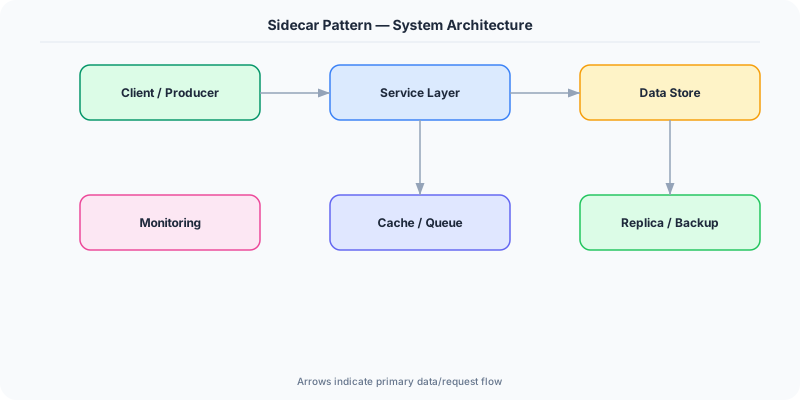
In a microservices architecture, cross-cutting concerns like TLS termination, structured logging, metrics collection, and circuit breaking must be implemented consistently across every service. If services are written in Java, Go, Python, and Node.js, implementing these in each language means maintaining four separate libraries, each potentially inconsistent. The Sidecar Pattern solves this by extracting these concerns into a separate process that runs alongside every service. The application communicates with the sidecar via localhost, and the sidecar handles external communication. This provides language-agnostic consistency, independent deployability (update the sidecar without redeploying the application), and clean separation of concerns between business logic and operational infrastructure.
The Building Blocks
- Sidecar Container: A separate container within the same pod (Kubernetes) or process group that shares network and storage with the primary application container
- Localhost Communication: The application and sidecar communicate via localhost or shared volumes, avoiding network latency and simplifying security since traffic never leaves the pod
- Lifecycle Management: The sidecar starts before and stops after the main container, ensuring that operational capabilities are available throughout the application's lifecycle
- Transparent Interception: The sidecar intercepts traffic using iptables rules or port binding so the application is unaware of the sidecar's presence — no code changes required
- Independent Deployment: Sidecars can be upgraded independently of the application, allowing platform teams to roll out security patches or feature updates without application team involvement
Under the Hood
The Sidecar Pattern is implemented primarily in container orchestration platforms like Kubernetes. A pod definition includes two or more containers: the primary application container and one or more sidecar containers. All containers in a pod share the same network namespace (they see the same localhost), the same IP address, and can mount shared volumes for file-based communication.
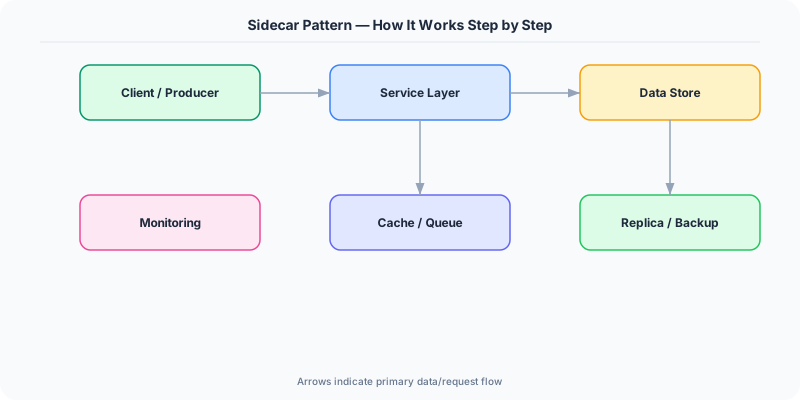
In the Envoy sidecar model, init containers configure iptables rules that redirect all inbound and outbound pod traffic through the Envoy proxy on specific ports. The application listens on its normal port (e.g., 8080), but external traffic hits the Envoy sidecar first. Envoy handles TLS termination, applies retry policies, emits metrics, and forwards the request to localhost:8080. Outbound traffic follows the reverse path — the application connects to a remote service, but iptables redirects the connection through Envoy, which applies routing rules and circuit breaking.
Kubernetes 1.28 introduced native sidecar support via the restartPolicy: Always field on init containers. This ensures sidecars start before and terminate after the main container, solving the longstanding problem of race conditions where the main container starts before the sidecar proxy is ready, or the sidecar terminates before the main container finishes draining connections. For resource management, sidecars should have their own CPU and memory requests/limits separate from the application to prevent resource contention.
How Companies Actually Do This
Google Uses Envoy sidecar proxies across their cloud platform, with GKE's Traffic Director configuring millions of sidecar instances for service-to-service communication
Datadog Deploys their monitoring agent as a sidecar container alongside customer applications in Kubernetes, collecting metrics, traces, and logs without requiring any application code changes
HashiCorp Consul Connect uses Envoy sidecar proxies for service mesh connectivity, providing mTLS and authorization between services across Kubernetes and VM-based infrastructure
Common Pitfalls
- Not accounting for sidecar startup ordering — the application may start making requests before the sidecar proxy is ready, causing connection failures during pod initialization
- Running too many sidecars per pod — each sidecar adds memory overhead (50-200MB typically), and three sidecars in every pod can double overall cluster resource consumption
- Debugging failures through sidecars is harder — when a request fails, you must determine whether the failure is in the application, the sidecar, or the interaction between them
Interview Questions Worth Practicing
- How does the Sidecar Pattern enable polyglot microservices architectures to maintain consistent cross-cutting behavior?
- What are the resource and complexity implications of deploying sidecar containers alongside every application pod?
- How does Kubernetes native sidecar support (1.28+) improve upon the previous workaround patterns for sidecar lifecycle management?
The Tradeoffs
- Decoupling vs. Overhead: Sidecars cleanly separate concerns and enable independent deployment but add memory, CPU, and latency overhead per instance
- Consistency vs. Flexibility: A standard sidecar ensures uniform behavior across all services but may not accommodate service-specific customization needs
- Transparency vs. Debuggability: Transparent traffic interception requires no code changes but makes it harder to understand and debug the complete request path
How to Explain This in an Interview
Here is how I would explain Sidecar Pattern in a system design interview:
The Sidecar Pattern deploys a companion container alongside each application instance to handle cross-cutting concerns — TLS, logging, metrics, circuit breaking — without modifying the application. In Kubernetes, both containers share a pod, communicating via localhost with near-zero latency. This is the foundation of service meshes: Envoy sidecars intercept all traffic transparently via iptables rules, handling retries and mTLS without application code changes. The key benefit is polyglot consistency — the same sidecar serves Java, Go, and Python services identically. The main tradeoff is resource overhead: each sidecar consumes 50-200MB RAM. Kubernetes 1.28 native sidecar support solved the critical startup-ordering problem where applications launched before their sidecars were ready.
Related Topics
The Real-World Incident That Made This Famous
Understanding Sidecar Pattern became critical after multiple high-profile production incidents at major tech companies. When systems handle millions of users, even small misunderstandings about Sidecar Pattern can lead to cascading failures that cost millions in lost revenue and erode user trust. Companies like Netflix, Google, Amazon, and Meta have all invested heavily in mastering Sidecar Pattern because they learned the hard way that ignoring it leads to outages.
The key lesson from these incidents: Sidecar Pattern is not just a theoretical concept — it is a practical skill that separates engineers who build resilient systems from those who build fragile ones. Every major outage report from the past decade involves at least one Sidecar Pattern-related design decision that was either implemented incorrectly or overlooked entirely during the initial architecture review.
How Senior Engineers Think About This
Senior engineers approach Sidecar Pattern differently from textbook definitions. Instead of memorizing rules, they build mental models. They ask: "What problem does Sidecar Pattern solve? When does it fail? What are the alternatives?" This problem-first thinking leads to better design decisions because every system has unique constraints.
When evaluating Sidecar Pattern in a system design context, experienced engineers consider the failure modes first. What happens when this component goes down? How does the system degrade? Is the degradation graceful or catastrophic? These questions reveal more about your understanding than any textbook definition.
The key difference between junior and senior engineers when it comes to Sidecar Pattern: juniors focus on the happy path, while seniors design for what happens when things go wrong. They consider operational cost, team expertise, monitoring requirements, and how the decision will look six months from now when traffic has grown 10x.
Common Interview Mistakes
Mistake 1: Giving a textbook definition without context. Interviewers want to see you connect Sidecar Pattern to real systems and real problems. Instead of reciting definitions, explain when and why you would use Sidecar Pattern in the system you are designing.
Mistake 2: Not discussing trade-offs. Every design decision involving Sidecar Pattern has trade-offs. Discuss what you gain and what you give up. Acknowledge the downsides and explain why the benefits outweigh them for your specific use case.
Mistake 3: Overcomplicating the solution. Start with the simplest approach to Sidecar Pattern that meets the requirements, then add complexity only when justified. Many candidates jump to complex implementations when a simpler solution would work perfectly.
Production Checklist
- Define clear metrics for measuring the effectiveness of your Sidecar Pattern implementation
- Set up monitoring and alerting that specifically tracks Sidecar Pattern-related failures
- Document your Sidecar Pattern design decisions in Architecture Decision Records (ADRs)
- Test failure scenarios related to Sidecar Pattern in staging before production deployment
- Review and update your Sidecar Pattern implementation quarterly as system requirements evolve
- Train new team members on the specific Sidecar Pattern patterns used in your system
- Establish runbooks for common Sidecar Pattern-related incidents and recovery procedures
Practical Implementation for .NET Developers
In .NET, sidecar patterns are leveraged at the deployment level rather than in code. Dapr (Distributed Application Runtime) is Microsoft's sidecar framework, providing service invocation, state management, pub/sub, and secrets management through a sidecar process with a .NET SDK (Dapr.AspNetCore, Dapr.Client). YARP (Yet Another Reverse Proxy) can function as a .NET-native sidecar proxy for traffic management. For Kubernetes deployments, .NET applications work transparently with Envoy sidecars. The .NET Aspire project provides built-in orchestration for local development with sidecars like Redis, RabbitMQ, and observability collectors.
ASP.NET Core setup: Create a service class that encapsulates the logic, register it with dependency injection, and inject it into your controllers or minimal API endpoints. The built-in DI container handles lifecycle management.
Entity Framework Core: For database interactions, EF Core provides the ORM layer. Use migrations for schema management and raw SQL for performance-critical queries. Consider Dapper for read-heavy paths where EF Core overhead matters.
Azure integration: If deploying to Azure, leverage managed services — Azure Cache for Redis, Azure SQL, Azure Service Bus, Azure Cosmos DB. These eliminate operational overhead and provide built-in monitoring through Application Insights.
Testing: Use xUnit with Testcontainers for integration tests that spin up real databases in Docker. Mock external dependencies with NSubstitute. The WebApplicationFactory class lets you test your entire HTTP pipeline in-process.
Monitoring: Add Application Insights telemetry to track request latency, dependency calls, and custom metrics. Use structured logging with Serilog to make production debugging possible:
Log.Information("Processing {Operation} for {ResourceId}", operation, resourceId);
This gives you searchable, structured logs in Azure Monitor or Seq.