Retry Patterns
Learn Retry Patterns including exponential backoff with jitter — handle transient failures gracefully in distributed systems without overwhelming.
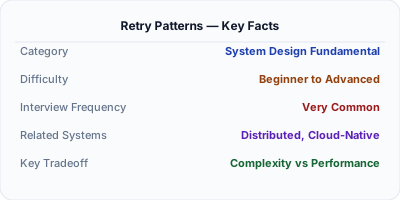
Retry Patterns define how a system automatically re-attempts failed operations that are likely to succeed on a subsequent try. Transient failures — brief network glitches, temporary service unavailability, or throttled requests — are inevitable in distributed systems. Strategies like exponential backoff with jitter prevent retry storms from overwhelming recovering services. Choosing the right retry policy is crucial for building reliable yet well-behaved distributed applications.
| Aspect | Details |
|---|---|
| What it is | Strategies for automatically re-attempting failed operations caused by transient faults in distributed systems |
| When to use | When failures are transient — network timeouts, 503 responses, connection resets, or rate-limit throttles |
| When NOT to use | When failures are permanent (400 bad request, 404 not found) or when the operation is not idempotent and duplicates cause harm |
| Real-world example | AWS SDKs use exponential backoff with full jitter on all API calls to avoid thundering herd problems during outages |
| Interview tip | Always mention idempotency — retries are only safe when the operation can be repeated without side effects |
| Common mistake | Retrying without backoff or jitter — all clients retry at the same instant, creating a thundering herd that worsens the outage |
| Key tradeoff | Reliability vs. latency — more retries improve success rates but increase tail latency and downstream load |
Why This Matters
In any distributed system, transient failures are not exceptional — they are expected. Networks drop packets, services restart during deployments, and load balancers briefly return errors. Without retries, every transient failure becomes a user-visible error. But naive retries are equally dangerous: if a service goes down and 10,000 clients all retry simultaneously, the thundering herd of requests prevents recovery. Exponential backoff spreads retries over increasing time intervals, and adding random jitter ensures clients do not synchronize their retry attempts. Combined with idempotency guarantees, retry patterns make distributed systems both resilient and well-behaved.
The Building Blocks
- Retry Policy: Rules defining which errors are retryable, how many attempts to make, and the delay strategy between attempts
- Exponential Backoff: Doubling the wait time between retries (1s, 2s, 4s, 8s) to give failing services time to recover before the next attempt
- Jitter: Adding randomness to backoff delays so that many clients retrying the same service do not synchronize and create load spikes
- Idempotency Keys: Unique request identifiers ensuring that retried operations produce the same result, preventing duplicate charges or records
- Retry Budget: A system-wide limit on the fraction of requests that can be retries, preventing retry amplification from cascading through the system
Under the Hood
Retry patterns operate at the client side, wrapping outbound calls with logic that catches specific failure signals and re-executes the request. The simplest form is immediate retry, but this rarely works well in production. Exponential backoff calculates delay as baseDelay * 2^attempt, capped at a maximum. Full jitter randomizes the delay between 0 and the exponential value, while equal jitter uses half the exponential value plus a random portion — both prevent synchronized retry storms.
The critical design consideration is distinguishing retryable from non-retryable errors. HTTP 429 (Too Many Requests) and 503 (Service Unavailable) are retryable; 400 (Bad Request) and 401 (Unauthorized) are not. TCP connection resets and DNS resolution timeouts are retryable; TLS certificate errors are not. Retrying non-retryable errors wastes resources and delays meaningful error reporting.
Google's SRE practice introduces retry budgets: each service tracks what percentage of its outbound requests are retries. If retries exceed a threshold (typically 10%), additional retries are suppressed. This prevents retry amplification, where service A retries to B, B retries to C, and the multiplicative effect overwhelms the entire call chain. Combining per-client retry limits with circuit breakers creates a robust defense against cascade failures.
How Companies Actually Do This
AWS All AWS SDKs implement exponential backoff with full jitter by default, and services like DynamoDB return specific error codes indicating whether the client should retry or back off
Google gRPC's built-in retry policy supports configurable backoff, retryable status codes, and hedged requests for latency-sensitive paths across Google Cloud services
Stripe Uses idempotency keys with automatic retries in their payment APIs, ensuring that a retried charge request never results in a double charge to the customer
Common Pitfalls
- Retrying non-idempotent operations like payment charges without idempotency keys can result in duplicate transactions and financial discrepancies
- Retry amplification across service layers — if each of 5 layers retries 3 times, a single user request can generate 3^5 = 243 downstream calls
- Using fixed-interval retries without jitter causes all clients to retry in lockstep after a shared failure, creating periodic load spikes that prevent recovery
Interview Questions Worth Practicing
- How does exponential backoff with jitter prevent thundering herd problems during a service recovery?
- When should you use a retry versus a circuit breaker, and how do they work together?
- How do retry budgets prevent retry amplification in a deep microservices call chain?
The Tradeoffs
- Reliability vs. Latency: More retries increase the chance of eventual success but add to tail latency, especially with exponential backoff delays
- Retries vs. Load: Each retry adds load to downstream services; without budgets, retries during partial failures can worsen outages
- Simplicity vs. Correctness: Simple retry-on-any-error is easy to implement but wastes resources on permanent failures and risks non-idempotent duplicates
How to Explain This in an Interview
Here is how I would explain Retry Patterns in a system design interview:
Retry patterns let distributed systems handle transient failures — network glitches, brief outages, throttling — by automatically re-attempting failed operations. The standard approach is exponential backoff with jitter: each retry waits longer (1s, 2s, 4s) and adds randomness so thousands of clients don't retry simultaneously in a thundering herd. Critical considerations include only retrying transient errors (503, timeouts) not permanent ones (400, 401), ensuring operations are idempotent so duplicates are safe, and implementing retry budgets to prevent amplification across service layers. I always pair retries with circuit breakers — retries handle brief glitches while circuit breakers protect against prolonged outages.
Related Topics
The Real-World Incident That Made This Famous
Understanding Retry Patterns became critical after multiple high-profile production incidents at major tech companies. When systems handle millions of users, even small misunderstandings about Retry Patterns can lead to cascading failures that cost millions in lost revenue and erode user trust. Companies like Netflix, Google, Amazon, and Meta have all invested heavily in mastering Retry Patterns because they learned the hard way that ignoring it leads to outages.
The key lesson from these incidents: Retry Patterns is not just a theoretical concept — it is a practical skill that separates engineers who build resilient systems from those who build fragile ones. Every major outage report from the past decade involves at least one Retry Patterns-related design decision that was either implemented incorrectly or overlooked entirely during the initial architecture review.
How Senior Engineers Think About This
Senior engineers approach Retry Patterns differently from textbook definitions. Instead of memorizing rules, they build mental models. They ask: "What problem does Retry Patterns solve? When does it fail? What are the alternatives?" This problem-first thinking leads to better design decisions because every system has unique constraints.
When evaluating Retry Patterns in a system design context, experienced engineers consider the failure modes first. What happens when this component goes down? How does the system degrade? Is the degradation graceful or catastrophic? These questions reveal more about your understanding than any textbook definition.
The key difference between junior and senior engineers when it comes to Retry Patterns: juniors focus on the happy path, while seniors design for what happens when things go wrong. They consider operational cost, team expertise, monitoring requirements, and how the decision will look six months from now when traffic has grown 10x.
Common Interview Mistakes
Mistake 1: Giving a textbook definition without context. Interviewers want to see you connect Retry Patterns to real systems and real problems. Instead of reciting definitions, explain when and why you would use Retry Patterns in the system you are designing.
Mistake 2: Not discussing trade-offs. Every design decision involving Retry Patterns has trade-offs. Discuss what you gain and what you give up. Acknowledge the downsides and explain why the benefits outweigh them for your specific use case.
Mistake 3: Overcomplicating the solution. Start with the simplest approach to Retry Patterns that meets the requirements, then add complexity only when justified. Many candidates jump to complex implementations when a simpler solution would work perfectly.
Production Checklist
- Define clear metrics for measuring the effectiveness of your Retry Patterns implementation
- Set up monitoring and alerting that specifically tracks Retry Patterns-related failures
- Document your Retry Patterns design decisions in Architecture Decision Records (ADRs)
- Test failure scenarios related to Retry Patterns in staging before production deployment
- Review and update your Retry Patterns implementation quarterly as system requirements evolve
- Train new team members on the specific Retry Patterns patterns used in your system
- Establish runbooks for common Retry Patterns-related incidents and recovery procedures
Practical Implementation for .NET Developers
In .NET, retry patterns are implemented with Polly via Microsoft.Extensions.Http.Resilience. The AddStandardResilienceHandler on IHttpClientBuilder configures exponential backoff with jitter out of the box. For custom policies, Polly v8's ResiliencePipelineBuilder lets you chain AddRetry with configurable BackoffType.ExponentialWithJitter, ShouldHandle predicates filtering retryable HttpStatusCodes, and MaxRetryAttempts. For database operations, Entity Framework Core has built-in EnableRetryOnFailure for SqlServer transient fault handling. Azure SDK clients use Azure.Core's RetryOptions with exponential backoff by default.
ASP.NET Core setup: Create a service class that encapsulates the logic, register it with dependency injection, and inject it into your controllers or minimal API endpoints. The built-in DI container handles lifecycle management.
Entity Framework Core: For database interactions, EF Core provides the ORM layer. Use migrations for schema management and raw SQL for performance-critical queries. Consider Dapper for read-heavy paths where EF Core overhead matters.
Azure integration: If deploying to Azure, leverage managed services — Azure Cache for Redis, Azure SQL, Azure Service Bus, Azure Cosmos DB. These eliminate operational overhead and provide built-in monitoring through Application Insights.
Testing: Use xUnit with Testcontainers for integration tests that spin up real databases in Docker. Mock external dependencies with NSubstitute. The WebApplicationFactory class lets you test your entire HTTP pipeline in-process.
Monitoring: Add Application Insights telemetry to track request latency, dependency calls, and custom metrics. Use structured logging with Serilog to make production debugging possible:
Log.Information("Processing {Operation} for {ResourceId}", operation, resourceId);
This gives you searchable, structured logs in Azure Monitor or Seq.