Backpressure
Backpressure is a flow control mechanism where a slow consumer signals upstream producers to slow down, preventing memory exhaustion and cascading.
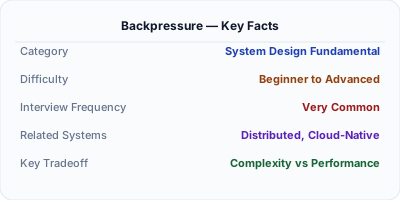
Backpressure is a flow control mechanism: when a consumer cannot keep up with the rate of incoming data, it signals the producer to slow down. Without backpressure, a fast producer overwhelms a slow consumer — memory fills up, the process crashes, and the system fails. In reactive programming (RxJava, Project Reactor) and streaming systems (Kafka, gRPC streams), backpressure is a first-class concept. TCP itself implements backpressure through its flow control window. In system design, backpressure prevents the "fast producer, slow consumer" problem that causes outages.
| Aspect | Details |
|---|---|
| What it is | A flow control mechanism where overwhelmed consumers signal producers to reduce their sending rate |
| When to use | Streaming pipelines, message queue consumers, reactive systems, any producer-consumer pair with rate mismatch |
| When NOT to use | Batch processing where all data is available upfront, or fire-and-forget systems where data loss is acceptable |
| Real-world example | Kafka uses consumer lag metrics and partition-based consumption to provide natural backpressure |
| Interview tip | Explain that TCP flow control is backpressure — the receive window shrinks when the consumer is slow |
| Common mistake | Ignoring backpressure and relying on unbounded buffers — memory eventually runs out and the process OOMs |
| Key tradeoff | Responsiveness vs throughput — backpressure slows the producer to protect the consumer, reducing overall throughput |
Why This Matters
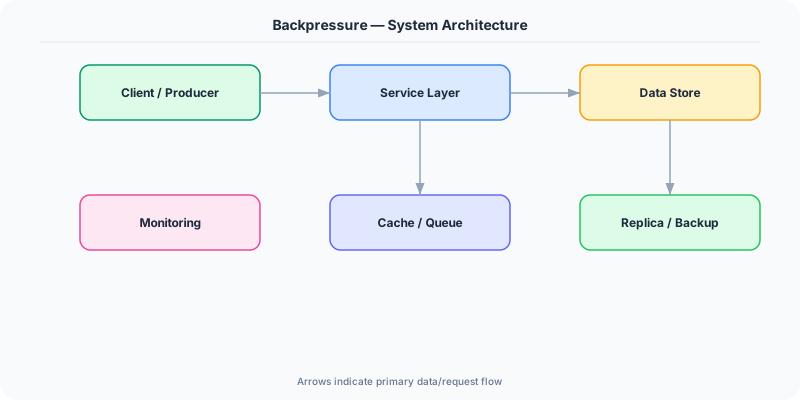
Without backpressure, a microservice that receives 10,000 messages/sec but can only process 5,000 will buffer the excess in memory. Within minutes, the heap fills, garbage collection pauses spike, latency increases, and the service crashes. Now the backlog is larger and the recovering service faces an even bigger wave. This cascading pattern is one of the most common causes of distributed system outages. Backpressure breaks this cycle by telling the producer: slow down, I cannot keep up.
The Building Blocks
- Bounded Buffers: Limit the queue size. When the buffer is full, the producer blocks or drops messages. This is the simplest form of backpressure — memory is bounded by design.
- Rate Limiting at Source: The consumer publishes its current processing rate, and the producer throttles to match. Pull-based consumers (Kafka) naturally achieve this by only fetching what they can handle.
- Credit-Based Flow Control: The consumer sends credits (permits) to the producer. The producer can only send as many messages as it has credits. Used in AMQP and Reactive Streams (Java).
- TCP Flow Control Window: TCP's receive window is backpressure at the transport layer. When the receiver's buffer is full, it advertises a zero window, causing the sender to pause.
- Load Shedding: When backpressure is insufficient, the system drops excess work intentionally — returning 503 or dropping low-priority messages to protect high-priority traffic.
Under the Hood
In a Kafka consumer group, backpressure works naturally: consumers poll for messages at their own pace. If a consumer slows down, its partition lag increases but it does not crash — it simply falls behind. The producer continues publishing to the topic, and the broker stores messages on disk. The consumer catches up when it recovers capacity. This pull-based model is inherently backpressure-aware.
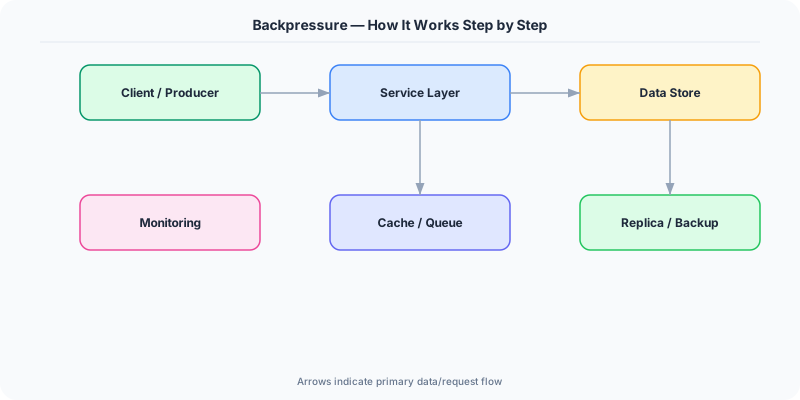
In reactive programming (RxJava, Project Reactor), backpressure is explicit. A Subscriber requests N items from the Publisher. The Publisher sends at most N items and waits for more requests. If the Subscriber is slow, it requests fewer items, and the Publisher naturally throttles. Strategies for when the buffer is full include: drop newest, drop oldest, buffer with timeout, or signal an error.
In gRPC bidirectional streaming, HTTP/2 flow control provides backpressure. Each stream has a flow control window (default 64KB). When the receiver has not consumed the window, the sender blocks. This prevents a fast server from overwhelming a slow client.
How Companies Actually Do This
Netflix uses reactive streams with Project Reactor for their API gateway. When downstream services slow down, backpressure propagates through the reactive pipeline, preventing the gateway from accepting more requests than it can handle.
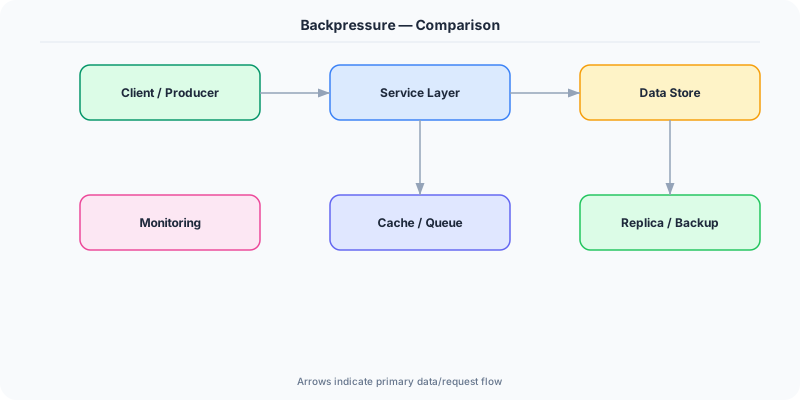
Kafka ecosystem provides natural backpressure through consumer-driven polling. Uber's Kafka pipelines process trillions of messages daily — consumer lag dashboards alert when consumers fall behind, triggering scaling.
Node.js streams implement backpressure via the readable/writable stream contract. When pipe() connects a fast reader to a slow writer, the readable stream pauses automatically until the writable stream drains.
Common Pitfalls
- Using unbounded in-memory queues between producers and consumers — works in testing, OOMs in production when the consumer slows down
- Applying backpressure at the wrong layer — throttling the HTTP load balancer when the real bottleneck is a slow database query three services deep
- Not monitoring consumer lag — backpressure only works if you can detect when consumers are falling behind, otherwise you discover the problem when the system crashes
Interview Questions Worth Practicing
- How would you handle a situation where a microservice receives 10x more messages than it can process?
- What is the relationship between backpressure and TCP flow control?
- When would you choose to drop messages versus slow down the producer?
The Tradeoffs
- Throughput vs Stability: Backpressure reduces overall throughput by slowing the producer, but prevents crashes and cascading failures. Without it, you get higher throughput until the system collapses.
- Buffering vs Dropping: Bounded buffers absorb temporary spikes but add latency. Dropping excess messages maintains latency but loses data. The right choice depends on whether data loss is acceptable.
- Push vs Pull: Push-based systems need explicit backpressure mechanisms (credit-based, bounded buffers). Pull-based systems (Kafka consumers) have natural backpressure but may increase end-to-end latency.
How to Explain This in an Interview
Here is how I would explain Backpressure in a system design interview:
Backpressure is how a slow consumer tells a fast producer to slow down. Without it, the consumer's buffer fills up and the process crashes. I would explain three approaches: bounded buffers (simplest — when the queue hits 10,000, block the producer), pull-based consumption (like Kafka — the consumer only fetches what it can handle), and credit-based flow control (like Reactive Streams — the consumer grants permits to the producer). The key insight is that TCP itself implements backpressure via the receive window. In a system design, I would use Kafka for inter-service messaging (natural backpressure) and bounded in-memory queues for in-process pipelines. I would monitor consumer lag and auto-scale consumers when lag exceeds a threshold.
Related Topics
The Real-World Incident That Made This Famous
Understanding Backpressure became critical after multiple high-profile production incidents at major tech companies. When systems handle millions of users, even small misunderstandings about Backpressure can lead to cascading failures that cost millions in lost revenue and erode user trust. Companies like Netflix, Google, Amazon, and Meta have all invested heavily in mastering Backpressure because they learned the hard way that ignoring it leads to outages.
The key lesson from these incidents: Backpressure is not just a theoretical concept — it is a practical skill that separates engineers who build resilient systems from those who build fragile ones. Every major outage report from the past decade involves at least one Backpressure-related design decision that was either implemented incorrectly or overlooked entirely during the initial architecture review.
How Senior Engineers Think About This
Senior engineers approach Backpressure differently from textbook definitions. Instead of memorizing rules, they build mental models. They ask: "What problem does Backpressure solve? When does it fail? What are the alternatives?" This problem-first thinking leads to better design decisions because every system has unique constraints.
When evaluating Backpressure in a system design context, experienced engineers consider the failure modes first. What happens when this component goes down? How does the system degrade? Is the degradation graceful or catastrophic? These questions reveal more about your understanding than any textbook definition.
The key difference between junior and senior engineers when it comes to Backpressure: juniors focus on the happy path, while seniors design for what happens when things go wrong. They consider operational cost, team expertise, monitoring requirements, and how the decision will look six months from now when traffic has grown 10x.
Common Interview Mistakes
Mistake 1: Giving a textbook definition without context. Interviewers want to see you connect Backpressure to real systems and real problems. Instead of reciting definitions, explain when and why you would use Backpressure in the system you are designing.
Mistake 2: Not discussing trade-offs. Every design decision involving Backpressure has trade-offs. Discuss what you gain and what you give up. Acknowledge the downsides and explain why the benefits outweigh them for your specific use case.
Mistake 3: Overcomplicating the solution. Start with the simplest approach to Backpressure that meets the requirements, then add complexity only when justified. Many candidates jump to complex implementations when a simpler solution would work perfectly.
Production Checklist
- Define clear metrics for measuring the effectiveness of your Backpressure implementation
- Set up monitoring and alerting that specifically tracks Backpressure-related failures
- Document your Backpressure design decisions in Architecture Decision Records (ADRs)
- Test failure scenarios related to Backpressure in staging before production deployment
- Review and update your Backpressure implementation quarterly as system requirements evolve
- Train new team members on the specific Backpressure patterns used in your system
- Establish runbooks for common Backpressure-related incidents and recovery procedures
Practical Implementation for .NET Developers
In .NET, System.Threading.Channels.Channel<T> provides a bounded producer-consumer queue with built-in backpressure. Use Channel.CreateBounded<T>(capacity) — when full, the producer's WriteAsync awaits until the consumer reads. For reactive streams, use System.Reactive with Buffer, Sample, or Throttle operators. For Kafka, the Confluent .NET client's consumer loop (Consume()) is pull-based — natural backpressure. For HTTP endpoints, use System.Threading.RateLimiting to apply backpressure at the API layer.
ASP.NET Core setup: Create a service class that encapsulates the logic, register it with dependency injection, and inject it into your controllers or minimal API endpoints. The built-in DI container handles lifecycle management.
Entity Framework Core: For database interactions, EF Core provides the ORM layer. Use migrations for schema management and raw SQL for performance-critical queries. Consider Dapper for read-heavy paths where EF Core overhead matters.
Azure integration: If deploying to Azure, leverage managed services — Azure Cache for Redis, Azure SQL, Azure Service Bus, Azure Cosmos DB. These eliminate operational overhead and provide built-in monitoring through Application Insights.
Testing: Use xUnit with Testcontainers for integration tests that spin up real databases in Docker. Mock external dependencies with NSubstitute. The WebApplicationFactory class lets you test your entire HTTP pipeline in-process.
Monitoring: Add Application Insights telemetry to track request latency, dependency calls, and custom metrics. Use structured logging with Serilog to make production debugging possible:
Log.Information("Processing {Operation} for {ResourceId}", operation, resourceId);
This gives you searchable, structured logs in Azure Monitor or Seq.