Secrets Management
Learn Secrets Management for distributed systems — securely store, distribute, and rotate credentials, API keys, and certificates using tools like.
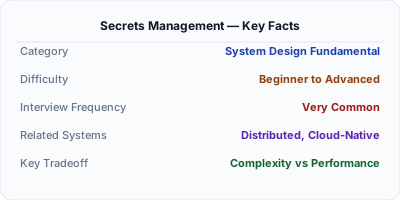
Secrets management is the practice of securely storing, distributing, accessing, and rotating sensitive credentials — database passwords, API keys, TLS certificates, encryption keys — in distributed systems. Hardcoding secrets in source code or configuration files is a critical vulnerability: leaked repositories expose production credentials within minutes. Modern secrets management systems like HashiCorp Vault, AWS Secrets Manager, and Azure Key Vault provide centralized, encrypted storage with fine-grained access control, automatic rotation, and comprehensive audit logging for every secret access.
| Aspect | Details |
|---|---|
| What it is | The secure lifecycle management of credentials, keys, and certificates — storage, access control, distribution, rotation, and auditing across distributed services |
| When to use | Always — every system with secrets needs a management strategy; the question is only which tool and architecture to use |
| When NOT to use | Never — there is no scenario where secrets should be unmanaged; even development environments need secret isolation from production |
| Real-world example | GitHub scans every public push for accidentally committed secrets and found over 5 million exposed credentials in a single year |
| Interview tip | Discuss the secret lifecycle (creation, storage, distribution, rotation, revocation) and explain dynamic secrets — shows you understand beyond basic key-value storage |
| Common mistake | Storing secrets in environment variables without encryption — they appear in process listings, crash dumps, and container inspection; use injected secrets instead |
| Key tradeoff | Security vs. developer experience — complex secret management creates friction that causes developers to work around it; simple workflows increase adoption |
Why This Matters
A single leaked database password can lead to a complete data breach. In distributed systems, the attack surface multiplies: dozens of services each need credentials for databases, APIs, message queues, and other services. Without centralized secrets management, secrets end up in Git repositories, Docker images, CI/CD configs, and environment variables — all insecure. HashiCorp Vault pioneered the modern approach: a centralized encrypted store with identity-based access control, dynamic secrets that are created on demand and automatically revoked, and comprehensive audit logs. The zero-trust principle applies: no service inherently trusts another, and every secret access is authenticated, authorized, and logged. Automatic rotation eliminates the risk of long-lived credentials being compromised.
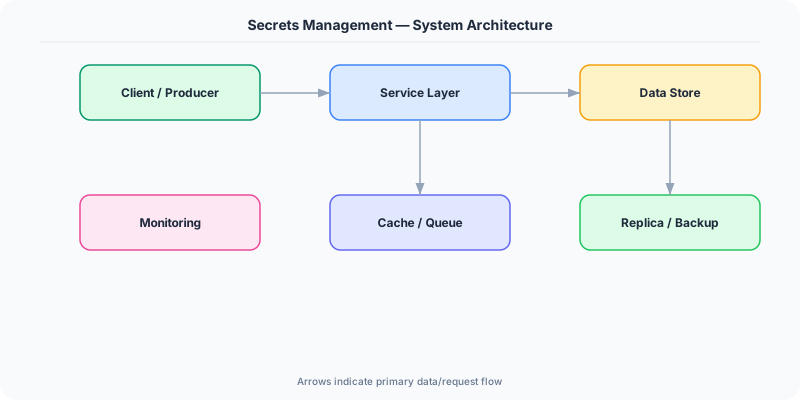
The Building Blocks
- Encrypted Storage: Centralized secret store with encryption at rest (AES-256-GCM), protecting secrets even if the storage backend is compromised
- Access Control: Identity-based policies defining which services, roles, or users can read which secrets, enforcing least-privilege access across the organization
- Dynamic Secrets: On-demand generation of short-lived credentials (database users, cloud tokens) that are automatically revoked after a TTL, eliminating long-lived static secrets
- Automatic Rotation: Scheduled credential rotation that updates both the secret store and the downstream system (database password change) without manual intervention or downtime
- Audit Logging: Immutable records of every secret access — who accessed what secret, when, and from where — enabling security investigations and compliance reporting
Under the Hood
Secrets management systems operate on the principle of encrypt, authenticate, authorize, and audit. At the core, a secrets engine encrypts secrets with a master key that is itself protected — Vault uses Shamir's Secret Sharing to split the master key into shares requiring a quorum to unseal. Secrets are stored in an encrypted backend (Consul, etcd, DynamoDB) where even database administrators cannot read plaintext values.
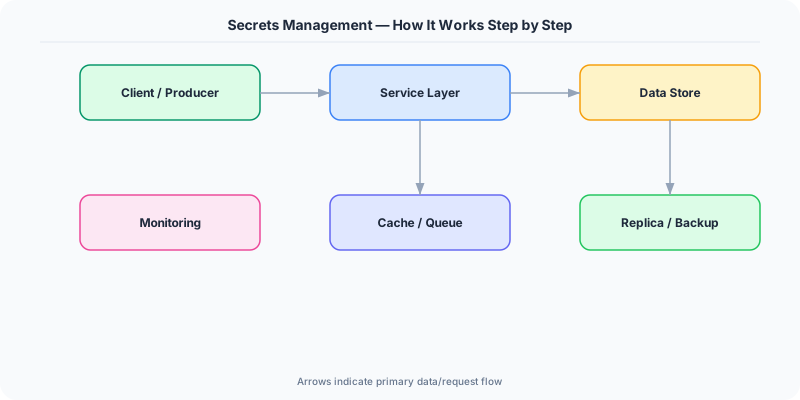
Authentication determines identity. Services prove who they are through platform-native methods — Kubernetes service account tokens, AWS IAM roles, TLS certificates, or OIDC tokens. Once authenticated, authorization policies (written in HCL or JSON) determine which secrets paths the identity can access. A payment service might read secrets/data/database/payments but not secrets/data/database/analytics.
Dynamic secrets are the most powerful feature. Instead of storing a static database password, Vault connects to the database with admin credentials, creates a temporary user with minimal permissions and a short TTL (e.g., 1 hour), and returns those credentials to the requesting service. When the TTL expires, Vault automatically drops the user. If credentials are compromised, the exposure window is limited to the TTL. For PKI, Vault acts as a certificate authority, issuing short-lived TLS certificates on demand. This eliminates the operational burden of certificate management and reduces the blast radius of any single credential compromise.
How Companies Actually Do This
HashiCorp Created Vault, the industry-standard secrets management platform, used by thousands of organizations to manage dynamic secrets, encryption as a service, and PKI across cloud and on-premise infrastructure
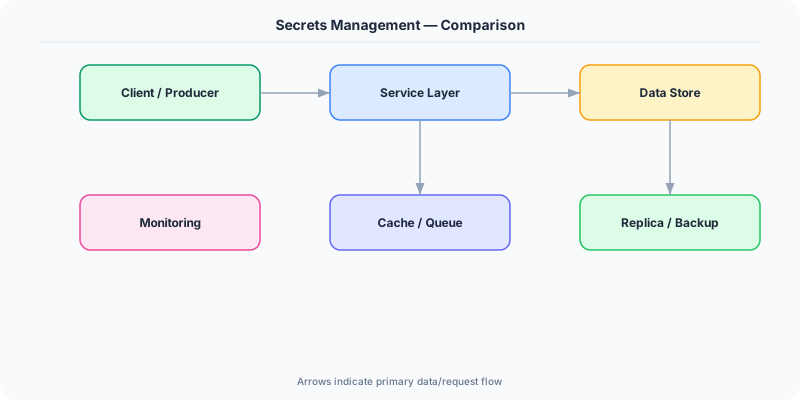
Netflix Built their own secrets management system that integrates with AWS IAM and provides per-application encrypted secret envelopes, ensuring no service can access another service's credentials
Spotify Uses Vault with Kubernetes authentication to inject secrets into pods at startup, with automatic rotation for database credentials and API keys across their microservices fleet
Common Pitfalls
- Storing secrets in Git repositories, Docker images, or CI/CD configs — automated scanners find these within minutes of exposure; use .gitignore and pre-commit hooks as safety nets
- Using long-lived static credentials that never rotate — if compromised, attackers have indefinite access; dynamic secrets with short TTLs limit the blast radius
- Making the secrets management system a single point of failure — if Vault goes down and services cannot retrieve secrets, the entire platform fails; cache secrets with encrypted local fallback
Interview Questions Worth Practicing
- How do dynamic secrets reduce the blast radius of a credential compromise compared to static secrets?
- How would you design secrets management for a Kubernetes-based microservices platform with 50 services?
- What is Shamir's Secret Sharing and how does Vault use it to protect the master encryption key?
The Tradeoffs
- Security vs. Availability: Strict access controls and short TTLs maximize security but create operational risk if the secrets manager itself becomes unavailable
- Dynamic vs. Static: Dynamic secrets eliminate long-lived credential risk but require the secrets manager to be always-available and connected to every credential backend
- Centralized vs. Distributed: Centralized management provides unified audit and policy but creates a critical dependency; distributed approaches are resilient but harder to audit
How to Explain This in an Interview
Here is how I would explain Secrets Management in a system design interview:
Secrets management is the secure lifecycle handling of credentials, keys, and certificates in distributed systems. I would use HashiCorp Vault with platform-native authentication — Kubernetes service accounts, AWS IAM roles — so services prove their identity without static tokens. The most impactful feature is dynamic secrets: instead of storing a database password, Vault creates a temporary user with a 1-hour TTL and auto-revokes it. This limits the blast radius of any compromise. Access policies enforce least privilege — each service reads only its own secrets. Automatic rotation updates credentials on schedule without downtime. Every access is audit-logged. The main tradeoff is that the secrets manager becomes a critical dependency, so it needs high availability and local caching for resilience.
Related Topics
The Real-World Incident That Made This Famous
Understanding Secrets Management became critical after multiple high-profile production incidents at major tech companies. When systems handle millions of users, even small misunderstandings about Secrets Management can lead to cascading failures that cost millions in lost revenue and erode user trust. Companies like Netflix, Google, Amazon, and Meta have all invested heavily in mastering Secrets Management because they learned the hard way that ignoring it leads to outages.
The key lesson from these incidents: Secrets Management is not just a theoretical concept — it is a practical skill that separates engineers who build resilient systems from those who build fragile ones. Every major outage report from the past decade involves at least one Secrets Management-related design decision that was either implemented incorrectly or overlooked entirely during the initial architecture review.
How Senior Engineers Think About This
Senior engineers approach Secrets Management differently from textbook definitions. Instead of memorizing rules, they build mental models. They ask: "What problem does Secrets Management solve? When does it fail? What are the alternatives?" This problem-first thinking leads to better design decisions because every system has unique constraints.
When evaluating Secrets Management in a system design context, experienced engineers consider the failure modes first. What happens when this component goes down? How does the system degrade? Is the degradation graceful or catastrophic? These questions reveal more about your understanding than any textbook definition.
The key difference between junior and senior engineers when it comes to Secrets Management: juniors focus on the happy path, while seniors design for what happens when things go wrong. They consider operational cost, team expertise, monitoring requirements, and how the decision will look six months from now when traffic has grown 10x.
Common Interview Mistakes
Mistake 1: Giving a textbook definition without context. Interviewers want to see you connect Secrets Management to real systems and real problems. Instead of reciting definitions, explain when and why you would use Secrets Management in the system you are designing.
Mistake 2: Not discussing trade-offs. Every design decision involving Secrets Management has trade-offs. Discuss what you gain and what you give up. Acknowledge the downsides and explain why the benefits outweigh them for your specific use case.
Mistake 3: Overcomplicating the solution. Start with the simplest approach to Secrets Management that meets the requirements, then add complexity only when justified. Many candidates jump to complex implementations when a simpler solution would work perfectly.
Production Checklist
- Define clear metrics for measuring the effectiveness of your Secrets Management implementation
- Set up monitoring and alerting that specifically tracks Secrets Management-related failures
- Document your Secrets Management design decisions in Architecture Decision Records (ADRs)
- Test failure scenarios related to Secrets Management in staging before production deployment
- Review and update your Secrets Management implementation quarterly as system requirements evolve
- Train new team members on the specific Secrets Management patterns used in your system
- Establish runbooks for common Secrets Management-related incidents and recovery procedures
Practical Implementation for .NET Developers
In .NET, Azure Key Vault is the most common secrets backend, accessed via Azure.Security.KeyVault.Secrets and integrated with configuration through Azure.Extensions.AspNetCore.Configuration.Secrets. This allows app.Configuration["DbPassword"] to resolve from Key Vault transparently. For HashiCorp Vault, the VaultSharp NuGet package provides the .NET client. ASP.NET Core's Secret Manager (dotnet user-secrets) handles development secrets. Microsoft.Extensions.Configuration supports layered providers — user secrets in development, Key Vault in production. For Kubernetes, secrets can be mounted as volumes or injected via the Secrets Store CSI Driver with Azure Key Vault provider.
ASP.NET Core setup: Create a service class that encapsulates the logic, register it with dependency injection, and inject it into your controllers or minimal API endpoints. The built-in DI container handles lifecycle management.
Entity Framework Core: For database interactions, EF Core provides the ORM layer. Use migrations for schema management and raw SQL for performance-critical queries. Consider Dapper for read-heavy paths where EF Core overhead matters.
Azure integration: If deploying to Azure, leverage managed services — Azure Cache for Redis, Azure SQL, Azure Service Bus, Azure Cosmos DB. These eliminate operational overhead and provide built-in monitoring through Application Insights.
Testing: Use xUnit with Testcontainers for integration tests that spin up real databases in Docker. Mock external dependencies with NSubstitute. The WebApplicationFactory class lets you test your entire HTTP pipeline in-process.
Monitoring: Add Application Insights telemetry to track request latency, dependency calls, and custom metrics. Use structured logging with Serilog to make production debugging possible:
Log.Information("Processing {Operation} for {ResourceId}", operation, resourceId);
This gives you searchable, structured logs in Azure Monitor or Seq.