Bulkhead Pattern
Learn the Bulkhead Pattern for isolating failures in distributed systems — prevent cascading outages by partitioning resources into independent.
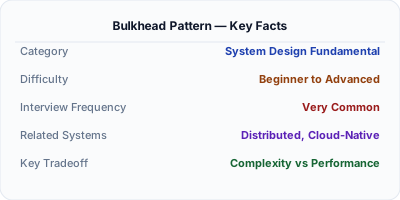
The Bulkhead Pattern isolates components of a distributed system into independent pools so that a failure in one cannot cascade and bring down others. Named after the watertight compartments in a ship's hull, bulkheads partition thread pools, connection pools, or entire service instances. If one partition fails or becomes overloaded, the others continue operating normally. This is a foundational resilience pattern for any microservices architecture handling diverse workloads.
| Aspect | Details |
|---|---|
| What it is | A fault-isolation technique that partitions resources into independent pools to prevent cascading failures |
| When to use | When services share thread pools, connection pools, or downstream dependencies that could cause total outages |
| When NOT to use | When system has a single responsibility with uniform load and adding partitions would add unnecessary complexity |
| Real-world example | Netflix isolates thread pools per downstream dependency so a slow recommendations service cannot starve the playback service |
| Interview tip | Explain bulkheads alongside circuit breakers — they complement each other; bulkheads isolate, circuit breakers cut off |
| Common mistake | Using a single shared thread pool for all downstream calls — one slow dependency exhausts all threads |
| Key tradeoff | Resource utilization vs. isolation — more bulkheads mean better isolation but lower overall resource efficiency |
Why This Matters
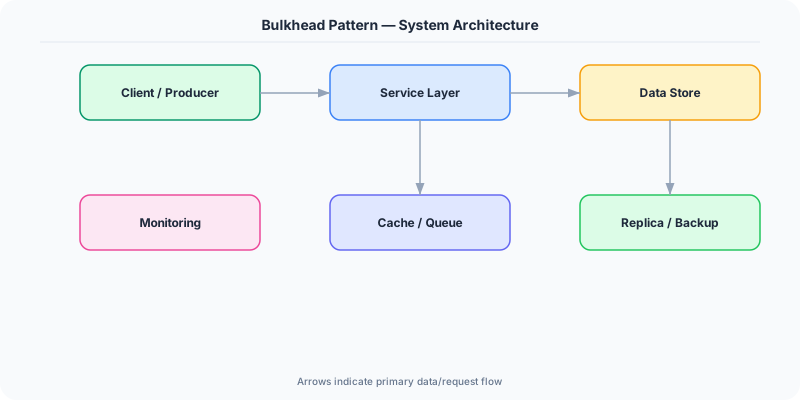
In a microservices architecture, services share resources like thread pools, connection pools, and CPU. Without isolation, a single slow or failing dependency can exhaust shared resources, causing a cascading failure that takes down the entire system. The Bulkhead Pattern prevents this by assigning dedicated resource pools to each dependency or workload class. Even if one pool is completely saturated, the others remain unaffected. This is especially critical for systems handling mixed priority traffic — you can ensure critical payment flows never compete with low-priority analytics calls for the same resources.
The Building Blocks
- Resource Pools: Dedicated thread pools, connection pools, or semaphores assigned to each dependency or workload category
- Partition Strategy: The decision of how to divide resources — by downstream service, by criticality tier, or by customer segment
- Pool Sizing: Configuring max concurrency per partition based on expected load and acceptable degradation thresholds
- Rejection Policy: What happens when a bulkhead pool is exhausted — fast-fail, queue briefly, or shed load to protect the system
- Health Monitoring: Tracking pool utilization and rejection rates per bulkhead to detect saturation before it causes user-visible failures
Under the Hood
The Bulkhead Pattern works by creating isolated execution contexts for different categories of work. In a typical implementation, each downstream service call gets its own thread pool or semaphore with a fixed maximum concurrency. When service A's pool has 20 threads and service B's pool has 10 threads, a surge of slow responses from service B can only block those 10 threads — the 20 threads for service A remain available.
There are two primary implementation approaches: thread pool isolation and semaphore isolation. Thread pool isolation provides true separation with dedicated threads and supports timeouts on the calling thread, but introduces context-switching overhead. Semaphore isolation uses lightweight counters to limit concurrent access — it is faster but the calling thread blocks if the downstream call is slow.
More advanced bulkhead implementations partition at the infrastructure level. Kubernetes allows assigning pods to different node pools, so a misbehaving service's resource consumption is physically capped. Service meshes like Istio can enforce connection limits per destination. The key design decision is granularity: too few bulkheads provide insufficient isolation, while too many waste resources sitting idle in underutilized pools.
How Companies Actually Do This
Netflix Uses Hystrix thread pool isolation to assign each downstream microservice its own bulkhead, preventing a slow recommendation engine from blocking video playback API calls
Amazon Partitions services into cells (a form of bulkhead) so that failures in one cell only affect a fraction of customers, not the entire fleet
Spotify Isolates backend service pools per feature domain so that a failing podcast metadata service cannot impact music streaming or search functionality
Common Pitfalls
- Sizing pools too small causes premature rejection of requests even under normal load — always benchmark pool sizes against expected p99 traffic
- Over-partitioning resources leads to low overall utilization because idle capacity in one bulkhead cannot help an overloaded neighbor
- Forgetting to add bulkheads to async or reactive pipelines — isolation only works if every execution path enforces it, including background jobs and event handlers
Interview Questions Worth Practicing
- How do you decide the number and size of bulkhead partitions for a new microservice?
- What is the difference between thread pool isolation and semaphore isolation in the Bulkhead Pattern?
- How do bulkheads interact with circuit breakers and retry policies in a resilience stack?
The Tradeoffs
- Isolation vs. Utilization: More bulkheads provide stronger fault isolation but reduce overall resource efficiency since idle pools cannot share capacity
- Granularity vs. Complexity: Fine-grained per-dependency bulkheads give precise control but increase configuration burden and monitoring surface area
- Thread Pool vs. Semaphore: Thread pools offer true isolation with timeouts but add overhead; semaphores are lightweight but block the calling thread
How to Explain This in an Interview
Here is how I would explain Bulkhead Pattern in a system design interview:
The Bulkhead Pattern isolates system components into independent resource pools to prevent cascading failures. Named after ship compartments, if one fills with water the others stay dry. In practice, you assign separate thread pools or semaphores to each downstream dependency. If the recommendation service becomes slow and saturates its pool of 15 threads, your payment service pool of 20 threads is completely unaffected. I would pair bulkheads with circuit breakers — bulkheads contain the blast radius while circuit breakers cut off failing calls entirely. The key tradeoff is isolation strength versus resource utilization, since idle capacity in one pool cannot help another.
Related Topics
The Real-World Incident That Made This Famous
Understanding Bulkhead Pattern became critical after multiple high-profile production incidents at major tech companies. When systems handle millions of users, even small misunderstandings about Bulkhead Pattern can lead to cascading failures that cost millions in lost revenue and erode user trust. Companies like Netflix, Google, Amazon, and Meta have all invested heavily in mastering Bulkhead Pattern because they learned the hard way that ignoring it leads to outages.
The key lesson from these incidents: Bulkhead Pattern is not just a theoretical concept — it is a practical skill that separates engineers who build resilient systems from those who build fragile ones. Every major outage report from the past decade involves at least one Bulkhead Pattern-related design decision that was either implemented incorrectly or overlooked entirely during the initial architecture review.
How Senior Engineers Think About This
Senior engineers approach Bulkhead Pattern differently from textbook definitions. Instead of memorizing rules, they build mental models. They ask: "What problem does Bulkhead Pattern solve? When does it fail? What are the alternatives?" This problem-first thinking leads to better design decisions because every system has unique constraints.
When evaluating Bulkhead Pattern in a system design context, experienced engineers consider the failure modes first. What happens when this component goes down? How does the system degrade? Is the degradation graceful or catastrophic? These questions reveal more about your understanding than any textbook definition.
The key difference between junior and senior engineers when it comes to Bulkhead Pattern: juniors focus on the happy path, while seniors design for what happens when things go wrong. They consider operational cost, team expertise, monitoring requirements, and how the decision will look six months from now when traffic has grown 10x.
Common Interview Mistakes
Mistake 1: Giving a textbook definition without context. Interviewers want to see you connect Bulkhead Pattern to real systems and real problems. Instead of reciting definitions, explain when and why you would use Bulkhead Pattern in the system you are designing.
Mistake 2: Not discussing trade-offs. Every design decision involving Bulkhead Pattern has trade-offs. Discuss what you gain and what you give up. Acknowledge the downsides and explain why the benefits outweigh them for your specific use case.
Mistake 3: Overcomplicating the solution. Start with the simplest approach to Bulkhead Pattern that meets the requirements, then add complexity only when justified. Many candidates jump to complex implementations when a simpler solution would work perfectly.
Production Checklist
- Define clear metrics for measuring the effectiveness of your Bulkhead Pattern implementation
- Set up monitoring and alerting that specifically tracks Bulkhead Pattern-related failures
- Document your Bulkhead Pattern design decisions in Architecture Decision Records (ADRs)
- Test failure scenarios related to Bulkhead Pattern in staging before production deployment
- Review and update your Bulkhead Pattern implementation quarterly as system requirements evolve
- Train new team members on the specific Bulkhead Pattern patterns used in your system
- Establish runbooks for common Bulkhead Pattern-related incidents and recovery procedures
Practical Implementation for .NET Developers
In .NET, the Bulkhead Pattern is implemented using Polly's BulkheadPolicy or the newer Microsoft.Extensions.Resilience library built on Polly v8. You configure a ResiliencePipeline with AddConcurrencyLimiter specifying maxConcurrentCalls and a queue depth. For HTTP clients, HttpClientFactory combined with Polly policies lets you assign per-named-client bulkheads. .NET's SemaphoreSlim is the underlying primitive. In ASP.NET Core, you can also use rate limiting middleware with ConcurrencyLimiter to enforce bulkheads at the endpoint level.
ASP.NET Core setup: Create a service class that encapsulates the logic, register it with dependency injection, and inject it into your controllers or minimal API endpoints. The built-in DI container handles lifecycle management.
Entity Framework Core: For database interactions, EF Core provides the ORM layer. Use migrations for schema management and raw SQL for performance-critical queries. Consider Dapper for read-heavy paths where EF Core overhead matters.
Azure integration: If deploying to Azure, leverage managed services — Azure Cache for Redis, Azure SQL, Azure Service Bus, Azure Cosmos DB. These eliminate operational overhead and provide built-in monitoring through Application Insights.
Testing: Use xUnit with Testcontainers for integration tests that spin up real databases in Docker. Mock external dependencies with NSubstitute. The WebApplicationFactory class lets you test your entire HTTP pipeline in-process.
Monitoring: Add Application Insights telemetry to track request latency, dependency calls, and custom metrics. Use structured logging with Serilog to make production debugging possible:
Log.Information("Processing {Operation} for {ResourceId}", operation, resourceId);
This gives you searchable, structured logs in Azure Monitor or Seq.