BFF Pattern
Backend for Frontend (BFF) creates dedicated backend services for each frontend type (web, mobile, TV), tailoring API responses to each client's specific.
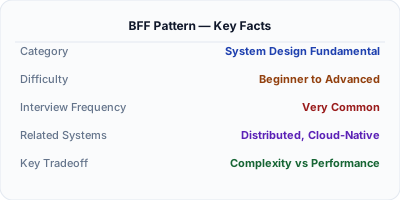
The BFF (Backend for Frontend) pattern creates a separate backend service for each type of frontend client — one for web, one for mobile, one for TV. Each BFF aggregates data from downstream microservices and shapes the response specifically for its client's needs. A mobile BFF returns compact payloads with only essential fields; a web BFF returns richer data for larger screens. This eliminates the "one API fits all" problem where a single API either over-fetches for mobile or under-fetches for web.
| Aspect | Details |
|---|---|
| What it is | A pattern where each frontend type (web, mobile, TV) gets its own dedicated backend service that tailors API responses to that client's needs |
| When to use | When different frontends need different data shapes, aggregation patterns, or performance characteristics from the same backend services |
| When NOT to use | When you have a single frontend type or when GraphQL's field selection eliminates the need for different response shapes |
| Real-world example | Netflix has separate BFFs for TV, mobile, and web — each optimized for the device's screen size, bandwidth, and interaction patterns |
| Interview tip | Explain that BFF is NOT just an API gateway — it contains client-specific business logic and data aggregation that the gateway should not own |
| Common mistake | Putting too much business logic in the BFF — it should aggregate and transform data from downstream services, not implement core domain logic |
| Key tradeoff | Client optimization vs service duplication — each BFF is tailored perfectly but you maintain multiple backend services with overlapping functionality |
Why This Matters
A single generic API serving all clients leads to two problems: mobile apps receive unnecessary data (over-fetching wastes bandwidth and battery), and web apps need multiple API calls (under-fetching increases latency). BFFs solve this by putting a thin, client-aware layer between frontends and microservices. Each BFF team owns the full stack for their client type, reducing coordination overhead. This pattern is especially powerful for companies like Netflix and SoundCloud where the TV, mobile, and web experiences are fundamentally different.
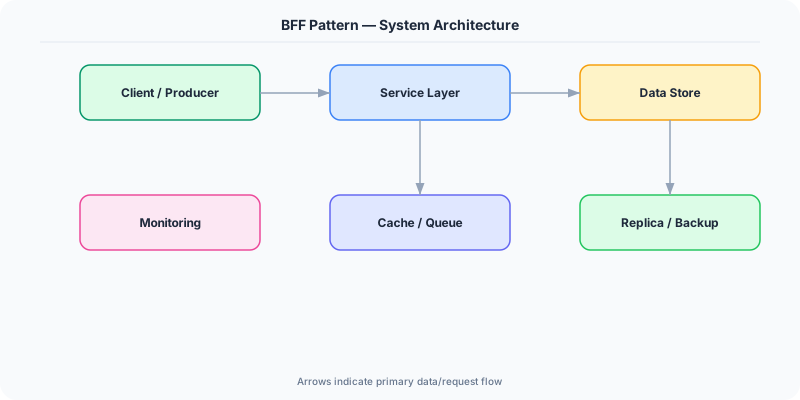
The Building Blocks
- Client-Specific API: Each BFF exposes an API tailored to its frontend. The mobile BFF returns minimal JSON; the web BFF returns richer payloads with precomputed values.
- Data Aggregation: BFFs call multiple downstream microservices and combine results into a single response. One mobile screen might need data from user-service, order-service, and recommendation-service.
- Response Transformation: BFFs transform backend data into frontend-ready shapes: formatting dates for the locale, computing display values, filtering irrelevant fields.
- Ownership Model: Each frontend team owns their BFF, making changes without coordinating with other teams. The mobile team ships their BFF independently of the web team.
- Protocol Translation: BFFs can translate between protocols: frontend speaks REST/GraphQL, BFF speaks gRPC to downstream services, getting the best of both worlds.
Under the Hood
In a typical setup, the web BFF receives a request for a product page. It calls three microservices in parallel: product-service (details, images), pricing-service (current price, discounts), and review-service (ratings, top reviews). It combines the results into a single JSON response with all the data the web page needs — no more, no less. The mobile BFF for the same product page calls the same services but returns only the product name, price, rating, and a single image URL — significantly smaller payload for mobile bandwidth.
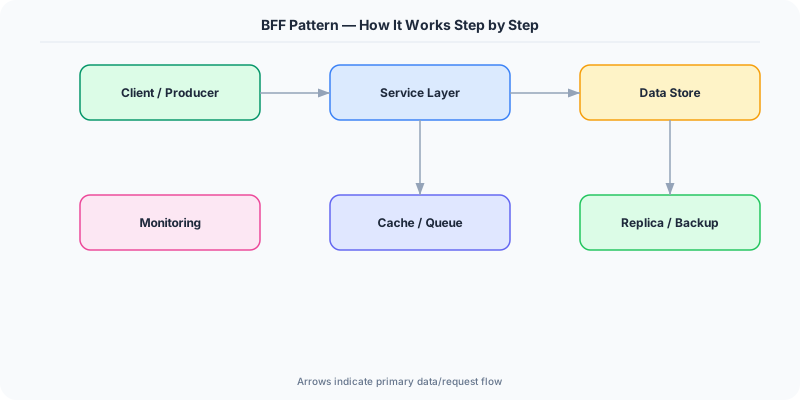
The BFF runs as a separate service, typically deployed alongside its frontend. In Kubernetes, the web BFF and web frontend might share a namespace. The BFF handles authentication token validation, request caching, and error handling specific to its client. If the review-service is down, the web BFF might return the page without reviews (graceful degradation), while the mobile BFF might show a cached rating.
The anti-pattern to avoid is a "super BFF" that serves all clients — that is just an API gateway with extra steps. Each BFF should be independently deployable, owned by the frontend team that uses it, and contain only logic specific to that client's needs.
How Companies Actually Do This
Netflix operates separate BFFs for each device type — TV, iOS, Android, and web — each optimized for the device's capabilities. TV BFFs prebatch data for slow processors, mobile BFFs minimize payload size.
SoundCloud pioneered the BFF pattern. Their mobile BFF aggregates data from 300+ microservices into mobile-optimized responses, reducing the number of API calls per screen from 10+ to 1.
Spotify uses BFFs to serve different clients with tailored responses. The desktop BFF returns richer playlist data with lyrics and social features, while the car BFF returns minimal voice-optimized data.
Common Pitfalls
- Creating a 'God BFF' that serves all clients — this defeats the purpose and becomes a bottleneck. Each client type should have its own BFF
- Duplicating business logic across BFFs — domain rules should live in downstream microservices. BFFs only aggregate, transform, and shape data
- Not setting up shared libraries for common patterns — authentication, logging, and error handling code gets duplicated across BFFs without shared utilities
Interview Questions Worth Practicing
- When would you use a BFF pattern instead of GraphQL for solving the over-fetching problem?
- How do you prevent business logic duplication across multiple BFF services?
- What is the difference between a BFF and an API gateway?
The Tradeoffs
- Client Optimization vs Maintenance Cost: Each client gets perfectly shaped responses, but you maintain N separate backend services that partially overlap in functionality.
- Team Autonomy vs Consistency: Frontend teams own their BFF and move independently, but ensuring consistent behavior (auth, error handling) across BFFs requires shared standards.
- BFF vs GraphQL: BFFs give full server-side control over responses; GraphQL lets clients self-serve. BFFs are better when response shapes are predictable; GraphQL when they are highly variable.
How to Explain This in an Interview
Here is how I would explain BFF Pattern in a system design interview:
The BFF pattern creates a dedicated backend for each frontend type. Instead of one API serving web, mobile, and TV with different needs, each client gets a BFF that aggregates data from downstream microservices and shapes responses specifically for that client. A mobile BFF returns compact payloads; a web BFF returns richer data. This eliminates over-fetching for mobile and under-fetching for web. Each BFF is owned by its frontend team, so they ship independently. The key distinction from an API gateway: a BFF contains client-specific data aggregation logic, not just routing. The tradeoff is maintaining multiple services with some overlap. When asked about alternatives, I mention GraphQL as a single-API solution that lets clients select their fields.
Related Topics
The Real-World Incident That Made This Famous
Understanding BFF Pattern became critical after multiple high-profile production incidents at major tech companies. When systems handle millions of users, even small misunderstandings about BFF Pattern can lead to cascading failures that cost millions in lost revenue and erode user trust. Companies like Netflix, Google, Amazon, and Meta have all invested heavily in mastering BFF Pattern because they learned the hard way that ignoring it leads to outages.
The key lesson from these incidents: BFF Pattern is not just a theoretical concept — it is a practical skill that separates engineers who build resilient systems from those who build fragile ones. Every major outage report from the past decade involves at least one BFF Pattern-related design decision that was either implemented incorrectly or overlooked entirely during the initial architecture review.
How Senior Engineers Think About This
Senior engineers approach BFF Pattern differently from textbook definitions. Instead of memorizing rules, they build mental models. They ask: "What problem does BFF Pattern solve? When does it fail? What are the alternatives?" This problem-first thinking leads to better design decisions because every system has unique constraints.
When evaluating BFF Pattern in a system design context, experienced engineers consider the failure modes first. What happens when this component goes down? How does the system degrade? Is the degradation graceful or catastrophic? These questions reveal more about your understanding than any textbook definition.
The key difference between junior and senior engineers when it comes to BFF Pattern: juniors focus on the happy path, while seniors design for what happens when things go wrong. They consider operational cost, team expertise, monitoring requirements, and how the decision will look six months from now when traffic has grown 10x.
Common Interview Mistakes
Mistake 1: Giving a textbook definition without context. Interviewers want to see you connect BFF Pattern to real systems and real problems. Instead of reciting definitions, explain when and why you would use BFF Pattern in the system you are designing.
Mistake 2: Not discussing trade-offs. Every design decision involving BFF Pattern has trade-offs. Discuss what you gain and what you give up. Acknowledge the downsides and explain why the benefits outweigh them for your specific use case.
Mistake 3: Overcomplicating the solution. Start with the simplest approach to BFF Pattern that meets the requirements, then add complexity only when justified. Many candidates jump to complex implementations when a simpler solution would work perfectly.
Production Checklist
- Define clear metrics for measuring the effectiveness of your BFF Pattern implementation
- Set up monitoring and alerting that specifically tracks BFF Pattern-related failures
- Document your BFF Pattern design decisions in Architecture Decision Records (ADRs)
- Test failure scenarios related to BFF Pattern in staging before production deployment
- Review and update your BFF Pattern implementation quarterly as system requirements evolve
- Train new team members on the specific BFF Pattern patterns used in your system
- Establish runbooks for common BFF Pattern-related incidents and recovery procedures
Practical Implementation for .NET Developers
In .NET, build BFFs as lightweight ASP.NET Core minimal API services. Use HttpClient with Polly resilience policies to call downstream services. For parallel calls, use Task.WhenAll to fetch from multiple services simultaneously. YARP (Yet Another Reverse Proxy) can handle routing at the gateway level while BFFs handle aggregation. For GraphQL as a BFF alternative, use HotChocolate. Deploy each BFF as a separate containerized service in Kubernetes with its own scaling configuration.
ASP.NET Core setup: Create a service class that encapsulates the logic, register it with dependency injection, and inject it into your controllers or minimal API endpoints. The built-in DI container handles lifecycle management.
Entity Framework Core: For database interactions, EF Core provides the ORM layer. Use migrations for schema management and raw SQL for performance-critical queries. Consider Dapper for read-heavy paths where EF Core overhead matters.
Azure integration: If deploying to Azure, leverage managed services — Azure Cache for Redis, Azure SQL, Azure Service Bus, Azure Cosmos DB. These eliminate operational overhead and provide built-in monitoring through Application Insights.
Testing: Use xUnit with Testcontainers for integration tests that spin up real databases in Docker. Mock external dependencies with NSubstitute. The WebApplicationFactory class lets you test your entire HTTP pipeline in-process.
Monitoring: Add Application Insights telemetry to track request latency, dependency calls, and custom metrics. Use structured logging with Serilog to make production debugging possible:
Log.Information("Processing {Operation} for {ResourceId}", operation, resourceId);
This gives you searchable, structured logs in Azure Monitor or Seq.