Backend Engineer to System Architect Roadmap
A structured roadmap for backend engineers transitioning to system architect roles — covering skills gap, learning path, and practical milestones.
Backend Engineer to System Architect Roadmap
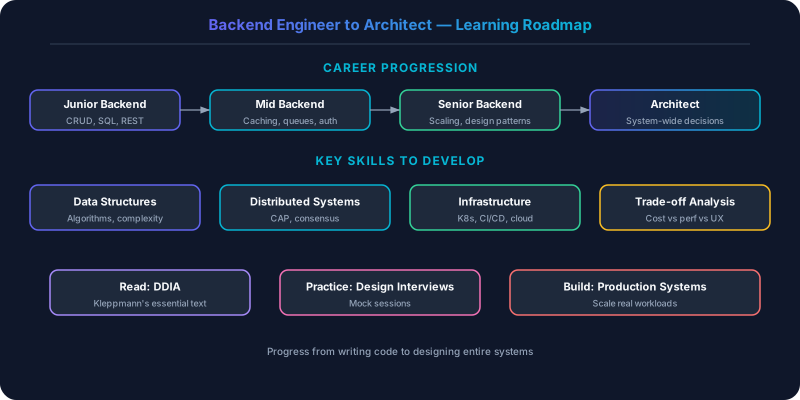
This roadmap is for backend engineers with 3-5+ years of experience who want to transition from building features within an existing architecture to designing the architecture itself. The shift from "how do I implement this?" to "how should this system be structured?" requires a different set of skills, and this roadmap provides a concrete path to build them.
The Skills Gap
Backend engineers are typically strong in:
- Writing production code in one or two languages
- Working with databases (queries, migrations, ORM usage)
- Building APIs (REST, GraphQL)
- Debugging and troubleshooting within a service
- Unit and integration testing
System architects additionally need:
- Reasoning about distributed system tradeoffs (consistency, availability, partition tolerance)
- Estimating system capacity (QPS, storage, bandwidth)
- Designing for failure (redundancy, failover, graceful degradation)
- Understanding cross-cutting concerns (observability, security, cost optimization)
- Communicating design decisions to both technical and non-technical stakeholders
- Evaluating build vs buy vs open-source decisions
Phase 1: Foundations (Weeks 1-8)
Distributed Systems Fundamentals (Weeks 1-4)
| Week | Topics | Resources | Output |
|---|---|---|---|
| 1 | CAP theorem, consistency models, availability patterns | DDIA chapters 5, 7, 9 | Write a 1-page summary of CAP with real examples |
| 2 | Database internals: B-trees, LSM trees, replication, sharding | DDIA chapters 3, 6 | Design a sharding strategy for a 1TB user table |
| 3 | Caching: strategies, eviction, invalidation, distributed caching | System Design Primer caching section | Add a caching layer to a service you own at work |
| 4 | Messaging: Kafka architecture, consumer groups, exactly-once semantics | Kafka documentation + Confluent blog | Set up a local Kafka cluster and build a producer/consumer |
Networking and Infrastructure (Weeks 5-8)
| Week | Topics | Resources | Output |
|---|---|---|---|
| 5 | Load balancing: L4 vs L7, algorithms, health checks, sticky sessions | Cloudflare blog + NGINX docs | Configure NGINX as a reverse proxy with health checks |
| 6 | DNS, CDN, TLS, HTTP/2, QUIC | Cloudflare learning center | Trace a real request from browser to server, documenting every hop |
| 7 | Containers, orchestration, service mesh basics | Kubernetes documentation | Deploy a multi-service application on Kubernetes |
| 8 | Observability: metrics, logs, traces, alerting | Datadog/Grafana tutorials | Set up dashboards for a service you own |
Phase 2: System Design Practice (Weeks 9-16)
Design Exercises (Weeks 9-12)
Practice designing systems end-to-end. For each design, follow this framework:
- Clarify requirements (functional and non-functional)
- Estimate scale (back-of-envelope: users, QPS, storage, bandwidth)
- High-level architecture (draw the major components)
- Deep dive into 2-3 key components
- Address failure modes and scaling bottlenecks
| Week | Design Problem | Key Concepts Tested |
|---|---|---|
| 9 | URL Shortener | Hashing, database choice, redirect caching |
| 10 | Chat Application | WebSockets, message ordering, presence, storage |
| 11 | News Feed | Fanout strategies, caching, ranking |
| 12 | Notification System | Push/pull, rate limiting, multi-channel delivery |
Advanced Design Exercises (Weeks 13-16)
| Week | Design Problem | Key Concepts Tested |
|---|---|---|
| 13 | Rate Limiter (distributed) | Token bucket, sliding window, Redis, edge vs origin |
| 14 | Search Autocomplete | Trie, distributed index, ranking, pre-computation |
| 15 | Video Streaming Platform | CDN, adaptive bitrate, transcoding pipeline, storage tiers |
| 16 | Payment System | Idempotency, exactly-once, reconciliation, ledger design |
For each exercise: spend 45 minutes designing independently, then compare with published solutions (Alex Xu books, System Design Primer).
Phase 3: Production Architecture Skills (Weeks 17-24)
Architecture Decision Records (Weeks 17-18)
Start writing Architecture Decision Records (ADRs) for decisions at your current job. An ADR documents:
- Context: What is the problem or opportunity?
- Decision: What did we decide?
- Consequences: What are the tradeoffs, risks, and follow-up work?
Writing ADRs forces you to articulate the reasoning behind architectural choices. Review ADRs from open-source projects (GitHub's ADR repository, Spotify's engineering blog) to see how experienced architects think.
Cost and Capacity Planning (Weeks 19-20)
Architects must reason about cost. Practice:
- Estimate the AWS bill for a system serving 10M daily active users
- Compare the cost of managed services (RDS, DynamoDB, ElastiCache) vs self-managed (EC2 + PostgreSQL, EC2 + Redis)
- Calculate the cost of over-provisioning vs the risk of under-provisioning
- Model the cost of different storage tiers (hot: SSD, warm: HDD, cold: S3 Glacier)
Security Architecture (Weeks 21-22)
Understand the security concerns that architects own:
- Authentication and authorization patterns (OAuth 2.0, JWT, RBAC, ABAC)
- Data encryption at rest and in transit
- API security (rate limiting, input validation, CORS)
- Secrets management (Vault, AWS Secrets Manager)
- Compliance implications (GDPR, SOC 2, HIPAA) on architecture choices
Reliability Engineering (Weeks 23-24)
- Define SLOs (Service Level Objectives) for a system you own
- Design a disaster recovery plan (RTO, RPO, failover procedures)
- Implement chaos engineering practices (start with a game day, not production chaos)
- Build runbooks for common failure scenarios
Phase 4: Organizational Skills (Ongoing)
Technical Communication
The biggest skill gap between a senior backend engineer and an architect is communication. Architects spend more time in design reviews, writing documents, and aligning stakeholders than writing code.
Practice:
- Write a design document for a feature you are building. Get feedback from a staff+ engineer.
- Present a technical decision to a non-technical stakeholder (product manager, VP).
- Run a design review: present your design, field questions, and incorporate feedback.
- Mentor a junior engineer through a design decision.
Building Your Architecture Toolkit
Maintain a personal library of:
- Patterns: Saga, CQRS, event sourcing, circuit breaker, bulkhead, strangler fig
- Reference architectures: How Netflix, Uber, Stripe, and Slack structure their systems
- Decision frameworks: When to use SQL vs NoSQL, monolith vs microservices, sync vs async
- Anti-patterns: Distributed monolith, God service, premature microservices
Reading List
Essential reading for aspiring architects:
- Designing Data-Intensive Applications — Martin Kleppmann
- System Design Interview (Vol 1 and 2) — Alex Xu
- Building Microservices — Sam Newman
- The Phoenix Project — Gene Kim (for understanding organizational dynamics)
- Staff Engineer — Will Larson (for understanding the staff+ role)
Measuring Progress
You are ready for an architect role when you can:
- Design a system for 10M+ users end-to-end in 45 minutes
- Write a design document that a team can implement without further clarification
- Identify the top 3 risks in someone else's design during a review
- Estimate the cost and capacity requirements for a new system within 20% accuracy
- Explain complex technical decisions to non-technical stakeholders
- Make build-vs-buy decisions with clear cost/benefit analysis