ZooKeeper: Wait-Free Coordination for Internet-Scale Systems
Yahoo's coordination service that provides a simple file-system-like API for distributed synchronization — the backbone of Hadoop, Kafka, and HBase.
Historical Context
Published by Patrick Hunt et al. from Yahoo Research in 2010 (USENIX ATC), ZooKeeper was created because Yahoo's distributed applications — crawlers, messaging systems, and fetch services — all needed coordination primitives (leader election, configuration management, group membership) but kept reimplementing them poorly. Google's Chubby paper (2006) showed a lock-service approach, but ZooKeeper took a different philosophy: instead of providing high-level primitives directly, it offered a minimal, wait-free API that applications could compose into whatever coordination pattern they needed.
Core Problem
How do you provide a general-purpose coordination service for distributed applications that is high-performance for read-heavy workloads, guarantees ordering, and is simple enough to be correct?
Key Innovation
ZooKeeper exposes a hierarchical namespace of znodes (like a file system), where each znode can store a small amount of data (typically <1 MB). Clients perform operations like create, delete, read, and write on znodes, and the service provides two powerful mechanisms.
Watches let a client register for notifications when a znode changes. Instead of polling, clients are asynchronously notified of state changes. Watches are one-time triggers: after firing, the client must re-register. This design avoids the overhead of maintaining persistent subscriptions.
Ephemeral nodes are znodes that automatically disappear when the client session that created them ends (due to disconnect or crash). This makes service discovery and group membership trivial: each server creates an ephemeral znode, and other servers watch the parent to detect joins and departures.
ZooKeeper guarantees linearizable writes (all writes go through the leader and are totally ordered) and FIFO client ordering (each client's operations are processed in the order issued). Reads can be served by any server in the ensemble, making read throughput scale with the number of servers. The tradeoff is that reads may be slightly stale.
Architecture / Algorithm
- Znodes: Data nodes in a hierarchical namespace. Can be persistent or ephemeral.
- Watches: One-time event notifications on znode changes.
- Sessions: Client connections with timeouts; ephemeral nodes are tied to sessions.
- ZAB Protocol: ZooKeeper Atomic Broadcast, a Paxos-like protocol for replicating state changes.
- Leader/Follower: One leader handles writes; followers serve reads and replicate writes.
- Sequential Znodes: Auto-incrementing suffixes for implementing distributed queues and locks.
Strengths
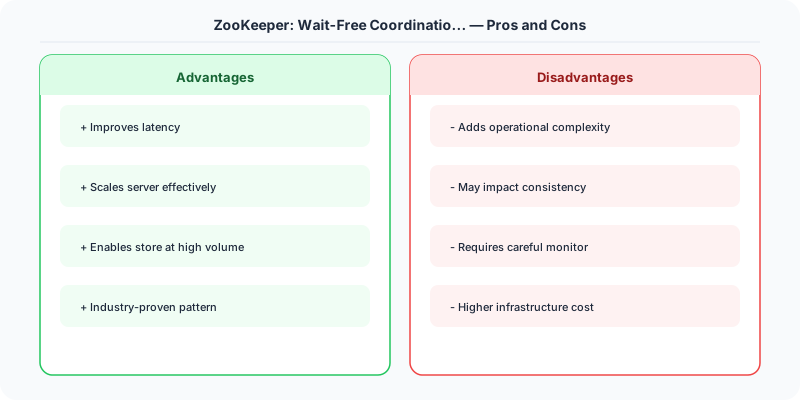
- High read throughput by serving reads from any replica
- Wait-free API: operations do not block on other clients
- Composable primitives: leader election, locks, barriers, queues all built from the same API
- Battle-tested in production at Yahoo, Hadoop, Kafka, HBase, and more
Weaknesses
- Reads can be stale (trade consistency for read performance)
- Not designed for large data storage: znodes should be small
- Watch mechanism requires clients to handle re-registration and potential missed events
- JVM-based: garbage collection pauses can affect leader stability
Modern Systems Influenced
Apache Kafka relied on ZooKeeper for broker coordination until KRaft replaced it. HBase uses ZooKeeper for master election and region server tracking. Hadoop YARN uses it for resource manager HA. etcd (used by Kubernetes) and HashiCorp Consul provide similar functionality with different APIs. The watch-based notification pattern is now standard in service discovery tools.
Interview Relevance
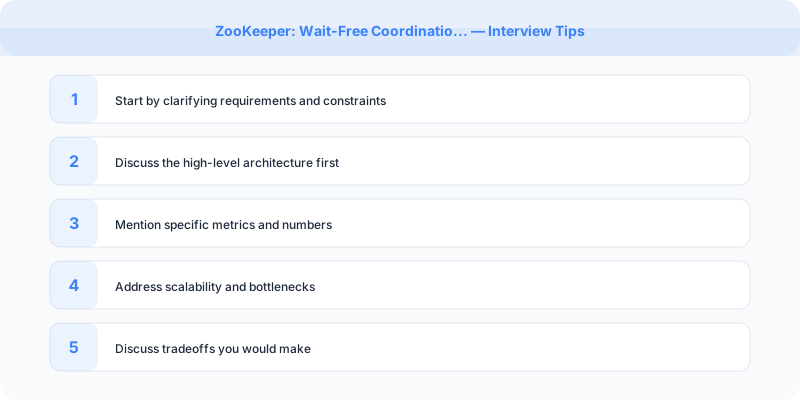
Reference ZooKeeper when designing leader election, distributed locks, configuration management, or service discovery. Know how ephemeral nodes plus watches enable failure detection, how the ZAB protocol ensures write ordering, and the tradeoff of stale reads for throughput. Be ready to sketch how distributed locking works using sequential ephemeral znodes.
Plain-English Summary
ZooKeeper provides a tiny shared "file system" that distributed applications use to coordinate. Servers create small data nodes, watch them for changes, and use ephemeral nodes that vanish when a server disconnects. Writes are serialized through a single leader for consistency, while reads are fast because any server can answer them. This simple API supports leader election, locks, and service discovery.
Practical Implementation for .NET Developers
In a .NET application, you would typically implement this pattern using the following approach:
ASP.NET Core setup: Create a service class that encapsulates the logic, register it with dependency injection, and inject it into your controllers or minimal API endpoints. The built-in DI container handles lifecycle management.
Entity Framework Core: For database interactions, EF Core provides the ORM layer. Use migrations for schema management and raw SQL for performance-critical queries. Consider Dapper for read-heavy paths where EF Core's overhead matters.
Azure integration: If deploying to Azure, leverage managed services — Azure Cache for Redis, Azure SQL, Azure Service Bus, Azure Cosmos DB. These eliminate operational overhead and provide built-in monitoring through Application Insights.
Testing: Use xUnit with Testcontainers for integration tests that spin up real databases in Docker. Mock external dependencies with NSubstitute. The WebApplicationFactory class lets you test your entire HTTP pipeline in-process.
Monitoring: Add Application Insights telemetry to track request latency, dependency calls, and custom metrics. Use structured logging with Serilog to make production debugging possible:
Log.Information("Processing order {OrderId} for {CustomerId}", orderId, customerId);
This gives you searchable, structured logs in Azure Monitor or Seq.
Key Takeaways for Interviews
- Understand the core problem this resource addresses and be able to explain it in 2-3 sentences without jargon
- Know the key trade-offs: what does this approach optimize for, and what does it sacrifice?
- Be ready to compare this with alternative approaches and explain when each is appropriate
- Connect the concepts to real-world systems you have worked with or studied
- Demonstrate depth by discussing failure modes and how they are handled
How This Applies to Modern .NET Systems
The concepts from this resource translate to .NET through several established libraries and patterns:
Azure managed services often abstract away the underlying distributed systems complexity, but understanding the fundamentals helps you configure them correctly, debug issues, and make informed architectural decisions.
NuGet packages in the .NET ecosystem provide production-ready implementations of many patterns described in this resource. Before building custom solutions, check if a well-maintained package already exists.
ASP.NET Core middleware pipeline is where many of these patterns are implemented in practice: caching, rate limiting, health checks, and circuit breaking all fit naturally into the middleware model.