The System Design Primer (Donne Martin)
A review of Donne Martin's System Design Primer — the most starred system design repository on GitHub, providing a structured learning path from.
Overview
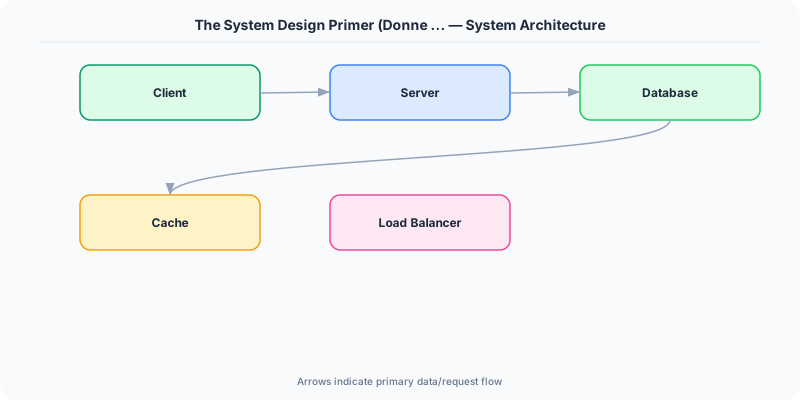
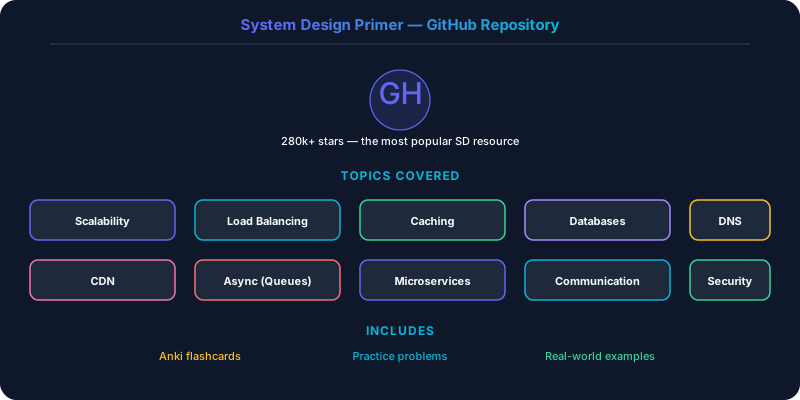
The System Design Primer is a free, open-source repository on GitHub created by Donne Martin, a former engineering manager at Facebook. With over 250,000 stars, it is the most popular system design learning resource on the internet. The repository provides a structured path from system design fundamentals to complete designs of real-world systems.
Unlike books that require sequential reading or video courses that demand hours of passive watching, the Primer is organized as a reference. You can jump directly to the topic you need — whether that is load balancing, database sharding, or designing a web crawler — and find a concise explanation with diagrams.
What It Covers
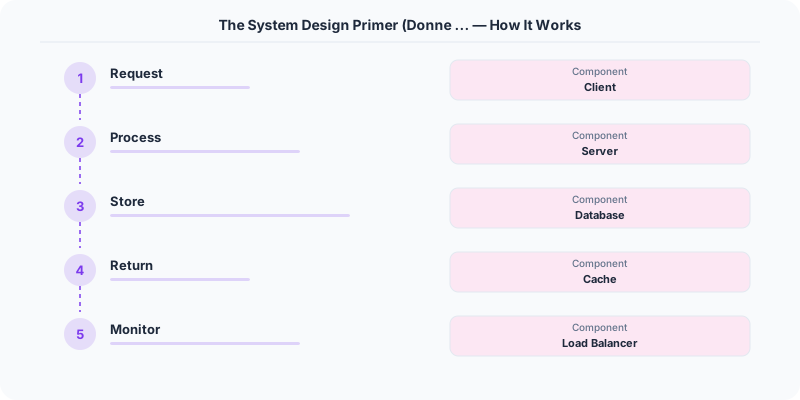
The Primer is organized into several major sections:
System Design Topics
The core of the repository covers individual building blocks of distributed systems. Each topic gets a self-contained explanation with diagrams:
- Scalability: Horizontal vs vertical scaling, load balancing, caching, database replication and partitioning
- Performance vs scalability: The distinction between a system that is fast for one user and a system that stays fast as users increase
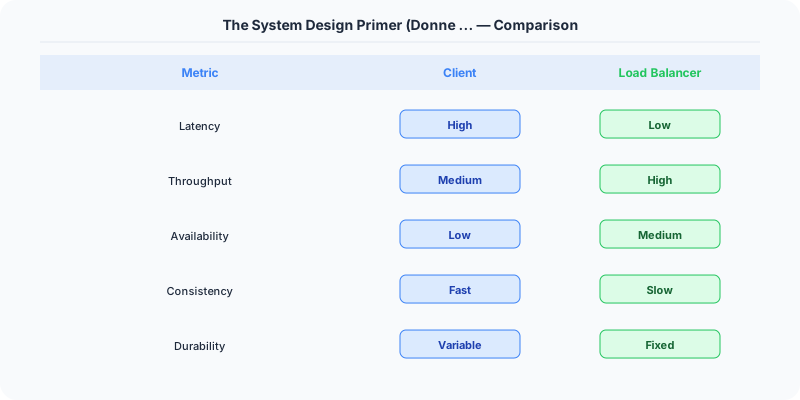
- Latency vs throughput: How these two metrics interact and trade off
- Availability vs consistency: CAP theorem, consistency patterns (weak, eventual, strong), availability patterns (failover, replication)
- DNS, CDN, Load Balancer: Networking fundamentals with diagrams showing request flow
- Application layer: Microservices vs monolith, service discovery
- Database: SQL vs NoSQL, federation, sharding, denormalization, SQL tuning
- Cache: Client caching, CDN caching, web server caching, database caching, application caching, cache invalidation strategies
- Asynchronism: Message queues, task queues, back pressure
- Communication: HTTP, TCP, UDP, RPC, REST
Each topic includes a "sources and further reading" section that links to in-depth blog posts, papers, and talks. This makes the Primer an excellent starting point that connects you to deeper resources when needed.
System Design Interview Questions with Solutions
The Primer includes complete design solutions for common interview questions:
- Design Pastebin (or similar)
- Design the Twitter timeline and search
- Design a web crawler
- Design Mint.com
- Design a social network data store
- Design a key-value store
- Design Amazon's sales ranking
- Design a system that scales to millions of users on AWS
Each solution follows a structured format: constraints and use cases, high-level design, component deep dives, and scaling analysis. The solutions are opinionated (they present one reasonable design, not all possible designs) and include back-of-the-envelope calculations.
Object-Oriented Design Interview Questions
Beyond system design, the repository includes object-oriented design problems: design a parking lot, design a call center, design a deck of cards. These are useful for companies that include OOD rounds.
Strengths
Breadth of coverage. The Primer touches on nearly every topic that appears in system design interviews. For engineers who need to quickly survey the landscape, it provides an efficient overview.
Visual explanations. Most topics include diagrams that show data flow, component interactions, and system architecture. These diagrams are clearer than many textbook illustrations.
Practical interview focus. The repository is explicitly designed for interview preparation. The topics are ordered by frequency of appearance in interviews. The solutions to interview questions follow the format that interviewers expect.
Free and open source. No paywall, no subscription. The entire resource is available on GitHub, and the community continuously improves it through pull requests.
Anki flashcards. The Primer includes Anki flashcard decks for spaced repetition learning. Each card covers a key concept or tradeoff. This is a unique feature that no other system design resource offers.
Weaknesses
Lacks depth on individual topics. The Primer covers each topic in 200-500 words. For complex subjects like consensus algorithms, transaction isolation levels, or cache invalidation strategies, this is not enough. You will need supplementary resources (DDIA, specific blog posts) for depth.
Solutions are opinionated without alternatives. The system design solutions present one approach without discussing the tradeoffs of alternative designs. In a real interview, the ability to discuss multiple approaches and compare them is what distinguishes a strong candidate.
No hands-on components. The Primer is entirely text and diagrams. There are no coding exercises, no infrastructure-as-code examples, and no live demos. Engineers who learn best by doing will need to supplement with hands-on labs.
Somewhat dated. Some of the technology references (Memcached over Redis, specific AWS service names) reflect the state of the industry when the Primer was written. The fundamental concepts remain valid, but specific technology recommendations have evolved.
How to Use It
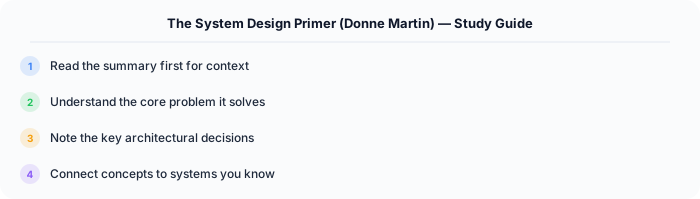
For interview preparation (4-8 weeks): Start with the topic overview section. Read each topic and follow the links to deeper resources for areas where you are weak. Then work through the interview question solutions, spending 45 minutes designing each system before reading the provided solution.
As a reference during study: When you encounter a concept you do not understand while reading DDIA or watching a system design video, check the Primer for a concise visual explanation.
For flashcard-based learning: Download the Anki decks and review them daily during your preparation period. Spaced repetition is one of the most effective study techniques for retaining factual knowledge.
Comparison with Other Resources
The Primer sits between a quick reference (like a cheat sheet) and a deep resource (like DDIA). It is broader than any single YouTube channel but shallower than a book. For most engineers, the optimal approach is to use the Primer as the backbone of their study plan and supplement with deeper resources for their weak areas.
If you have time for only one resource, DDIA provides more lasting value. If you have time for only a free resource and need to prepare quickly, the System Design Primer is the best available option.
Practical Implementation for .NET Developers
In a .NET application, you would typically implement this pattern using the following approach:
ASP.NET Core setup: Create a service class that encapsulates the logic, register it with dependency injection, and inject it into your controllers or minimal API endpoints. The built-in DI container handles lifecycle management.
Entity Framework Core: For database interactions, EF Core provides the ORM layer. Use migrations for schema management and raw SQL for performance-critical queries. Consider Dapper for read-heavy paths where EF Core's overhead matters.
Azure integration: If deploying to Azure, leverage managed services — Azure Cache for Redis, Azure SQL, Azure Service Bus, Azure Cosmos DB. These eliminate operational overhead and provide built-in monitoring through Application Insights.
Testing: Use xUnit with Testcontainers for integration tests that spin up real databases in Docker. Mock external dependencies with NSubstitute. The WebApplicationFactory class lets you test your entire HTTP pipeline in-process.
Monitoring: Add Application Insights telemetry to track request latency, dependency calls, and custom metrics. Use structured logging with Serilog to make production debugging possible:
Log.Information("Processing order {OrderId} for {CustomerId}", orderId, customerId);
This gives you searchable, structured logs in Azure Monitor or Seq.
Key Takeaways for Interviews
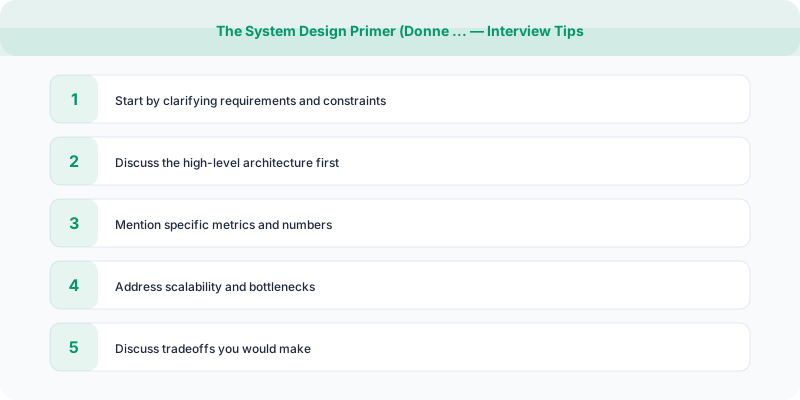
- Start with requirements: Every system design answer should begin with 2-3 minutes of clarifying questions. What are the functional requirements? What are the non-functional requirements (latency, throughput, availability)?
- Back-of-the-envelope estimation: Practice calculating QPS, storage, bandwidth, and memory requirements quickly. Use powers of 2 and round aggressively — the goal is order of magnitude, not precision.
- Trade-offs are the answer: There is no "correct" design. The interviewer wants to see you identify trade-offs (consistency vs. availability, latency vs. throughput, simplicity vs. scalability) and make justified decisions.
- Design for the common case: Start with the simplest architecture that handles the requirements. Add complexity (caching, sharding, message queues) only when you can articulate why it is needed.
- Know your numbers: L1 cache (0.5ns), main memory (100ns), SSD read (16 microseconds), network round trip within datacenter (0.5ms), disk seek (2-10ms). These drive every architecture decision.
How This Applies to Modern .NET Systems
The System Design Primer's patterns map directly to .NET and Azure implementations:
Caching: Use IDistributedCache with Redis (Microsoft.Extensions.Caching.StackExchangeRedis) for application caching. Use Response Caching middleware for HTTP-level caching. Use Azure CDN for static asset caching.
Load Balancing: Azure Application Gateway (L7) or Azure Load Balancer (L4) for cloud deployments. YARP (Yet Another Reverse Proxy) for in-process reverse proxy in ASP.NET Core.
Message Queues: Azure Service Bus (enterprise messaging with transactions and sessions) or Azure Event Hubs (high-throughput event streaming). Both have excellent .NET SDKs with async/await support.
Database Scaling: Start with Azure SQL or PostgreSQL. Add read replicas for read scaling. Use Azure Cosmos DB when you need global distribution or flexible schemas. Use Dapper for performance-critical read paths where EF Core overhead matters.