Designing Stripe's Payments API for 10 Years of Evolution
How Stripe designed an API that evolved over a decade while maintaining backward compatibility — versioning strategies, error conventions, and design.
Company Context
Stripe provides payment infrastructure for millions of businesses. Its REST API is the primary interface — every Stripe integration, from a one-person startup to a Fortune 500 company, depends on the API behaving predictably. Unlike internal APIs where you can coordinate breaking changes, a public API used by millions of integrations must evolve without breaking existing clients. A single breaking change could cause payment failures across thousands of businesses simultaneously.
The Problem at Scale
APIs must evolve — new features, better error messages, improved resource structures — but every change risks breaking integrations that depend on exact response shapes. Stripe needed a system that lets them improve the API continuously while ensuring that a merchant who integrated five years ago can still process payments without code changes. Semantic versioning alone is insufficient because even "minor" changes (adding a field, renaming an enum value) can break brittle client code.
Architecture Solution
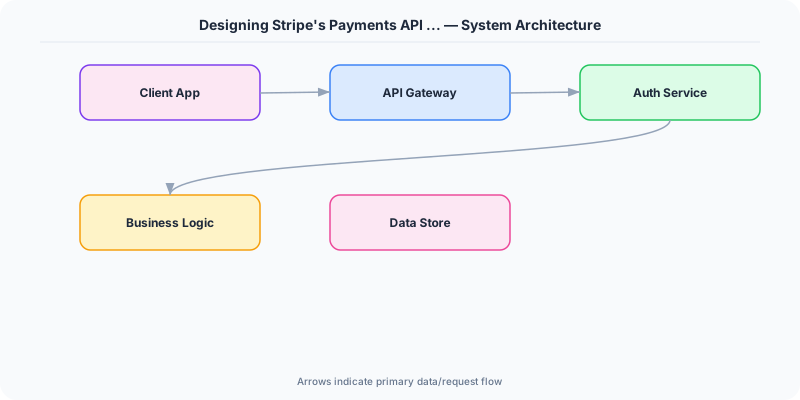
Stripe's core innovation is API version pinning with automatic migration. Every Stripe account is pinned to the API version that existed when the account was created. When Stripe makes a change, they write a version change module that transforms the new internal representation into the shape expected by older versions. These modules chain together: a request from a client on version 2019-05-16 flows through every transformation between that version and the current internal version, like a series of adapters.
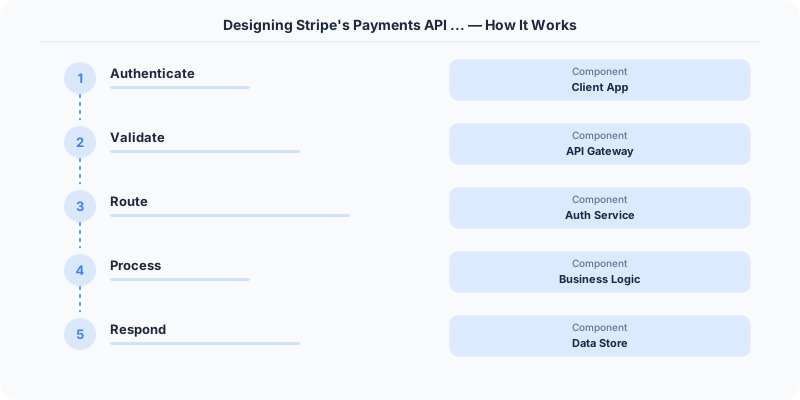
This means Stripe's internal systems only maintain one version of the code (the latest), while a cascade of lightweight transformation functions handle backward compatibility. New accounts automatically get the latest version, and existing accounts can upgrade at their own pace by testing against the new version in Stripe's test mode.
Stripe also established rigorous API design conventions: consistent resource naming (plural nouns, nested resources), predictable pagination (cursor-based), structured error objects with machine-readable error codes alongside human-readable messages, and idempotency keys on every mutating endpoint. These conventions reduce the surface area for breaking changes because clients can rely on structural patterns.
Expanding objects allow clients to request related resources inline (e.g., expanding a payment intent's customer), avoiding the need for multiple API calls without permanently changing the response shape. This pattern lets Stripe add relations without breaking existing response structures.
Key Techniques Used
- Version pinning: Each account uses the API version from its creation date
- Version change modules: Lightweight transformers that adapt responses between versions
- One internal version: Engineering only maintains the latest code; transformers handle legacy
- Cursor-based pagination: Stable pagination even when underlying data changes
- Structured error codes: Machine-readable codes for programmatic handling, separate from messages
- Idempotency keys: Every mutating endpoint supports idempotent retries
- Expanding objects: Inline related resources without changing base response shape
- Test mode: Merchants test against new API versions without affecting production traffic
Lessons for System Design Interviews
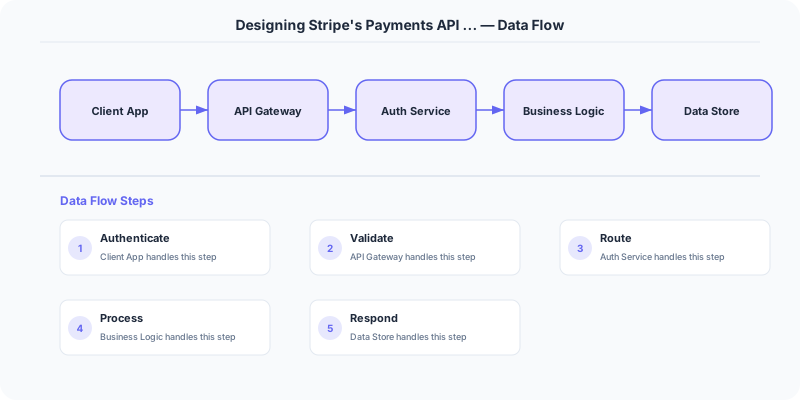
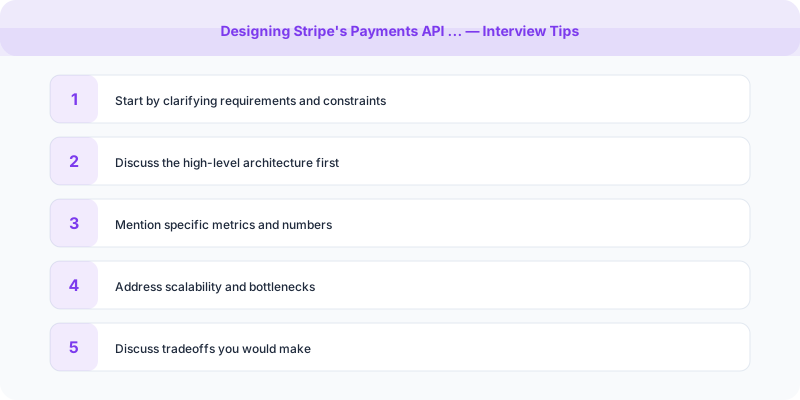
Reference Stripe's approach when discussing API design or evolution. Show awareness that versioning is not just a URL prefix (/v1/, /v2/) — it requires a strategy for transforming data between versions. Discuss the tradeoff between Stripe's per-account versioning (complex to implement, excellent developer experience) and URL-based versioning (simple but forces coordinated migration). Mention idempotency and structured errors as non-negotiable API design principles.
Lessons for Production
Design your API conventions before building the first endpoint — consistency is harder to retrofit than to establish. Version compatibility transformers are an investment that pays off at scale; without them, you either freeze your API or break clients. Always make mutating endpoints idempotent. Structured error responses with stable error codes are far more useful to integrators than freeform error messages. Invest in developer experience (documentation, test mode, client libraries) as a core product feature, not an afterthought.
Practical Implementation for .NET Developers
In a .NET application, you would typically implement this pattern using the following approach:
ASP.NET Core setup: Create a service class that encapsulates the logic, register it with dependency injection, and inject it into your controllers or minimal API endpoints. The built-in DI container handles lifecycle management.
Entity Framework Core: For database interactions, EF Core provides the ORM layer. Use migrations for schema management and raw SQL for performance-critical queries. Consider Dapper for read-heavy paths where EF Core's overhead matters.
Azure integration: If deploying to Azure, leverage managed services — Azure Cache for Redis, Azure SQL, Azure Service Bus, Azure Cosmos DB. These eliminate operational overhead and provide built-in monitoring through Application Insights.
Testing: Use xUnit with Testcontainers for integration tests that spin up real databases in Docker. Mock external dependencies with NSubstitute. The WebApplicationFactory class lets you test your entire HTTP pipeline in-process.
Monitoring: Add Application Insights telemetry to track request latency, dependency calls, and custom metrics. Use structured logging with Serilog to make production debugging possible:
Log.Information("Processing order {OrderId} for {CustomerId}", orderId, customerId);
This gives you searchable, structured logs in Azure Monitor or Seq.
Key Takeaways for Interviews
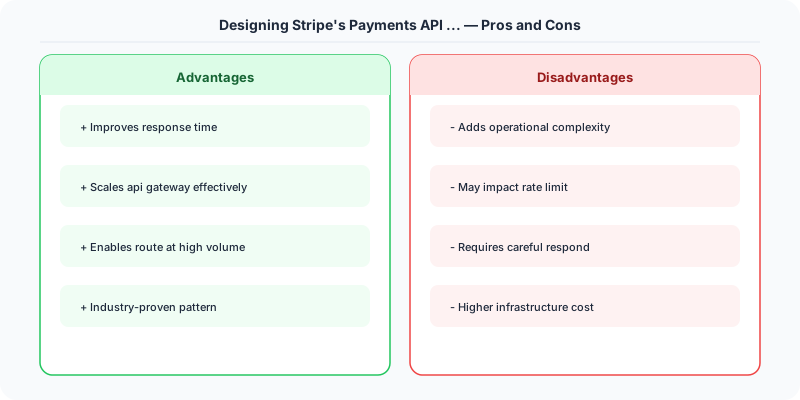
- Understand the core problem this resource addresses and be able to explain it in 2-3 sentences without jargon
- Know the key trade-offs: what does this approach optimize for, and what does it sacrifice?
- Be ready to compare this with alternative approaches and explain when each is appropriate
- Connect the concepts to real-world systems you have worked with or studied
- Demonstrate depth by discussing failure modes and how they are handled
How This Applies to Modern .NET Systems
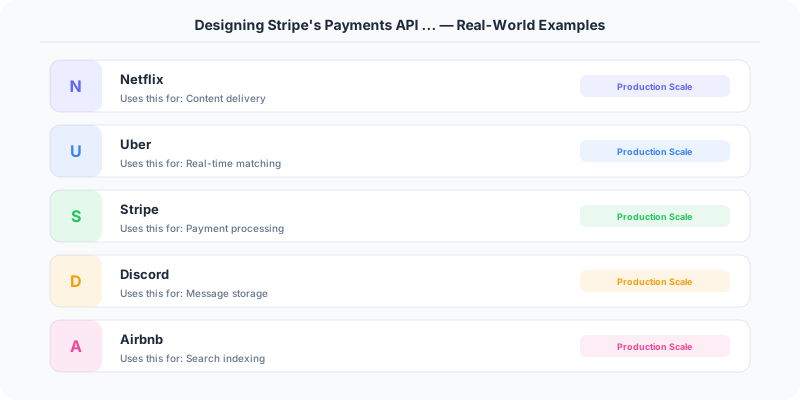
The concepts from this resource translate to .NET through several established libraries and patterns:
Azure managed services often abstract away the underlying distributed systems complexity, but understanding the fundamentals helps you configure them correctly, debug issues, and make informed architectural decisions.
NuGet packages in the .NET ecosystem provide production-ready implementations of many patterns described in this resource. Before building custom solutions, check if a well-maintained package already exists.
ASP.NET Core middleware pipeline is where many of these patterns are implemented in practice: caching, rate limiting, health checks, and circuit breaking all fit naturally into the middleware model.