Spanner: Google's Globally Distributed Database
Google's globally distributed SQL database that uses GPS and atomic clocks (TrueTime) to achieve external consistency across continents.
Historical Context
Published by James Corbett et al. at Google in 2012 (OSDI), Spanner was the first system to distribute data globally and support externally-consistent distributed transactions. Before Spanner, Google relied on Bigtable for scalable storage and Megastore for cross-datacenter replication, but Bigtable lacked cross-row transactions and Megastore suffered from poor write throughput. Application teams increasingly needed both scale and transactional guarantees, leading Google to build a system that was effectively a "globally distributed, externally consistent, synchronously replicated database."
Core Problem
How can you provide ACID transactions and strong consistency across data centers on different continents without sacrificing availability or horizontal scalability?
Key Innovation
Spanner's breakthrough is the TrueTime API, a clock service that combines GPS receivers and atomic clocks in every data center to provide a bounded uncertainty interval for the current time. Instead of returning a single timestamp, TrueTime returns an interval [earliest, latest] and guarantees the true time falls within it. The uncertainty is typically 1-7 milliseconds.
Spanner uses TrueTime to assign globally meaningful timestamps to transactions. After committing a transaction, Spanner waits out the clock uncertainty ("commit-wait") before making the result visible, ensuring that if transaction T1 committed before T2 started, then T1's timestamp is strictly less than T2's. This property is called external consistency (equivalent to linearizability for transactions), and it means any observer anywhere in the world sees a consistent order of transactions.
Under the hood, Spanner uses Paxos groups for replication. Data is organized into directories (contiguous ranges of rows sharing a common key prefix), and each directory is replicated across data centers via a Paxos group. Cross-shard transactions use two-phase commit coordinated across Paxos groups, with TrueTime timestamps ensuring consistent ordering.
Architecture / Algorithm
- TrueTime API: Returns time as an interval [earliest, latest]. Commit-wait ensures causal ordering.
- Paxos Groups: Each shard is replicated via Paxos; the Paxos leader handles reads and writes.
- Directories: Fine-grained data movement units that can be migrated between Paxos groups.
- Two-Phase Commit: Cross-shard transactions are coordinated with 2PC, made safe by Paxos-replicated participant logs.
- Schema: Semi-relational with SQL support, hierarchical table interleaving for data locality.
Strengths
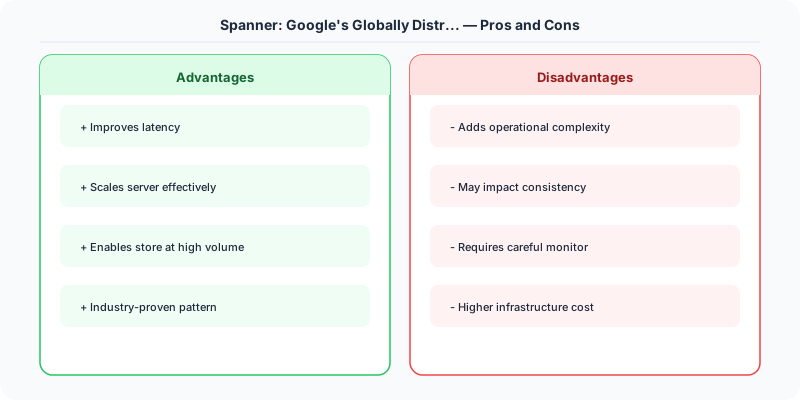
- External consistency (strongest guarantee) across global data centers
- Full SQL support with ACID transactions at global scale
- Automatic sharding and rebalancing
- High availability via Paxos replication
Weaknesses
- Commit-wait adds latency proportional to clock uncertainty (milliseconds, not microseconds)
- Requires specialized hardware (GPS receivers, atomic clocks) for TrueTime
- Write latency is higher than eventually-consistent systems due to cross-datacenter Paxos
- Extremely complex to build and operate — practically only Google (and now CockroachDB with software clocks) has attempted it
Modern Systems Influenced
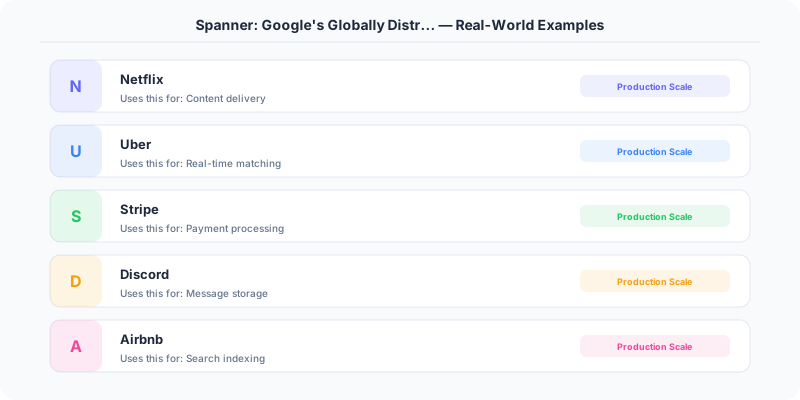
Google Cloud Spanner is the public version. CockroachDB adopted Spanner's architecture but replaced TrueTime with hybrid logical clocks (accepting slightly weaker guarantees). YugabyteDB also draws from Spanner's design. TiDB's distributed transaction model is inspired by Spanner. The paper showed the industry that global strong consistency is achievable, shifting expectations for distributed databases.
Interview Relevance
Cite Spanner when discussing globally distributed systems, strong consistency across regions, or the role of time in distributed systems. Know how TrueTime works, why commit-wait is necessary, and the tradeoff of latency for consistency. Compare with Dynamo (AP) to show understanding of the consistency spectrum. Spanner is the gold standard answer for "how would you design a globally consistent database?"
Plain-English Summary
Spanner stores data across data centers worldwide, keeping it in sync using Paxos consensus. It assigns globally ordered timestamps to every transaction using GPS and atomic clocks, then waits a few milliseconds to ensure no other transaction can sneak in with a conflicting timestamp. This gives you the same strong guarantees as a single-machine database, but spread across the planet.
Practical Implementation for .NET Developers
In a .NET application, you would typically implement this pattern using the following approach:
ASP.NET Core setup: Create a service class that encapsulates the logic, register it with dependency injection, and inject it into your controllers or minimal API endpoints. The built-in DI container handles lifecycle management.
Entity Framework Core: For database interactions, EF Core provides the ORM layer. Use migrations for schema management and raw SQL for performance-critical queries. Consider Dapper for read-heavy paths where EF Core's overhead matters.
Azure integration: If deploying to Azure, leverage managed services — Azure Cache for Redis, Azure SQL, Azure Service Bus, Azure Cosmos DB. These eliminate operational overhead and provide built-in monitoring through Application Insights.
Testing: Use xUnit with Testcontainers for integration tests that spin up real databases in Docker. Mock external dependencies with NSubstitute. The WebApplicationFactory class lets you test your entire HTTP pipeline in-process.
Monitoring: Add Application Insights telemetry to track request latency, dependency calls, and custom metrics. Use structured logging with Serilog to make production debugging possible:
Log.Information("Processing order {OrderId} for {CustomerId}", orderId, customerId);
This gives you searchable, structured logs in Azure Monitor or Seq.
Key Takeaways for Interviews
- Understand the core problem this resource addresses and be able to explain it in 2-3 sentences without jargon
- Know the key trade-offs: what does this approach optimize for, and what does it sacrifice?
- Be ready to compare this with alternative approaches and explain when each is appropriate
- Connect the concepts to real-world systems you have worked with or studied
- Demonstrate depth by discussing failure modes and how they are handled
How This Applies to Modern .NET Systems
The concepts from this resource translate to .NET through several established libraries and patterns:
Azure managed services often abstract away the underlying distributed systems complexity, but understanding the fundamentals helps you configure them correctly, debug issues, and make informed architectural decisions.
NuGet packages in the .NET ecosystem provide production-ready implementations of many patterns described in this resource. Before building custom solutions, check if a well-maintained package already exists.
ASP.NET Core middleware pipeline is where many of these patterns are implemented in practice: caching, rate limiting, health checks, and circuit breaking all fit naturally into the middleware model.