Martin Kleppmann's Distributed Systems Talks
A guide to Martin Kleppmann's distributed systems lectures and conference talks — from his Cambridge university course to his influential presentations on.
Overview
Martin Kleppmann is a researcher at the University of Cambridge, the author of Designing Data-Intensive Applications (DDIA), and one of the most influential voices in distributed systems education. His talks, available on YouTube and his personal website, cover distributed systems topics with a rigor that bridges the gap between academic research and production engineering.
Unlike most system design content creators who target interview preparation, Kleppmann teaches the underlying theory: formal models of consistency, correctness proofs for replication algorithms, and the mathematical foundations of CRDTs. This makes his content invaluable for engineers who want to understand not just how distributed systems work, but why they work — and crucially, when they do not.
The Cambridge Distributed Systems Lecture Series
Kleppmann's most comprehensive resource is his distributed systems lecture series from the University of Cambridge. The full course is available on YouTube and covers:
Lecture 1-2: Introduction and Models. What is a distributed system? System models (synchronous, asynchronous, partially synchronous). Failure models (crash-stop, crash-recovery, Byzantine). The two generals problem and why it proves that consensus over unreliable networks is impossible in certain models.
Lecture 3-4: Time, Clocks, and Ordering. Physical clocks vs logical clocks. Lamport timestamps. Vector clocks. Happens-before relationships. Why clock synchronization is fundamentally imprecise and what that means for distributed databases.
Lecture 5-6: Replication. Single-leader, multi-leader, and leaderless replication. Quorum reads and writes. Read-your-writes, monotonic reads, and consistent prefix reads. This material maps directly to DDIA Chapter 5 but with more formal treatment.
Lecture 7-8: Consensus. The FLP impossibility result (no deterministic consensus algorithm can guarantee termination in an asynchronous system with even one crash failure). Paxos. Raft. The relationship between consensus, total order broadcast, and atomic commit.
Lecture 9-10: Consistency Models. Linearizability. Sequential consistency. Causal consistency. Eventual consistency. The hierarchy of consistency models and the performance cost of each.
Lecture 11-12: Fault Tolerance and Recovery. Log-based recovery. Checkpointing. Exactly-once semantics in stream processing. Idempotency.
This lecture series is the closest thing to a free university course on distributed systems available online. It assumes computer science fundamentals (algorithms, basic networking) but does not require prior distributed systems knowledge.

Conference Talks
Beyond the lecture series, Kleppmann's conference talks are some of the most cited in the distributed systems community:
"Turning the Database Inside Out" (Strange Loop 2014)
This talk proposes that databases should be decomposed into their constituent parts: a commit log (like Kafka), materialized views (derived from the log), and caches (also derived from the log). Instead of treating the database as a monolithic black box, you use the log as the source of truth and derive all other data representations from it.
This idea — databases as derived views of an event log — influenced the design of Kafka Streams, ksqlDB, and the event sourcing movement. It remains one of the most important talks for understanding modern data architectures.
"Transactions: Myths, Surprises and Opportunities" (Strange Loop 2015)
Kleppmann systematically dismantles common misconceptions about database transactions. Most engineers believe that "serializable" means "serial execution" (it does not — it means the result is equivalent to some serial order). Most engineers believe that "READ COMMITTED" prevents all read anomalies (it does not — phantom reads, write skew, and lost updates can still occur).
This talk is essential viewing for any engineer who uses a relational database, which is nearly everyone.
"CRDTs and the Quest for Distributed Consistency" (QCon 2018)
Conflict-free Replicated Data Types (CRDTs) are data structures that can be replicated across multiple nodes and merged without coordination. Kleppmann explains how CRDTs work (using lattice theory), what data types are available (counters, sets, registers, sequences), and where they are used (collaborative editing in Figma, shopping carts, distributed counters).
This talk is important for understanding eventual consistency beyond the hand-waving "just use last-writer-wins." CRDTs provide mathematically guaranteed convergence without conflict resolution logic.
"Is Kafka a Database?" (Kafka Summit 2019)
Kleppmann examines Kafka's properties through the lens of database theory. Kafka provides durability (replicated log), ordered writes (per partition), and consumer position tracking (offsets). But it lacks random access reads, secondary indexes, and efficient point queries. The conclusion: Kafka is not a database in the traditional sense, but it is a critical building block for building databases (via event sourcing, CQRS, and materialized views).
Strengths
Intellectual rigor. Kleppmann does not simplify to the point of inaccuracy. When he discusses consistency models, he uses formal definitions. When he discusses consensus, he references the original papers and proofs. This rigor means you can trust the content to be correct.
Timeless content. Because Kleppmann teaches principles rather than specific technologies, his talks from 2014 are still relevant in 2026. The consistency models, replication algorithms, and consensus protocols have not changed.
Bridges theory and practice. Kleppmann draws connections between academic research (FLP impossibility, linearizability proofs) and production systems (PostgreSQL isolation levels, Kafka's delivery guarantees). This bridging is rare and extremely valuable.
Challenges conventional wisdom. Kleppmann questions assumptions that most engineers take for granted: "Are ACID transactions sufficient for correctness?", "Is eventual consistency always a compromise?", "Should we trust the database's consistency guarantees?" These questions push engineers to think more carefully about their systems.
Weaknesses
Academic pacing. The lecture series follows a university course structure — methodical, thorough, and slower than the typical YouTube tech video. Engineers expecting a 10-minute overview will find the pacing challenging.
Not interview-focused. Kleppmann's content teaches deep understanding but does not directly prepare you for the format of a system design interview. You will not learn how to draw a system architecture on a whiteboard in 45 minutes.
Requires concentration. The formal models, mathematical notation, and proof sketches demand focused attention. This is not background listening content.
Who Should Watch
Engineers preparing for staff+ or principal engineer level interviews, where depth of understanding matters more than breadth of coverage. Engineers working on distributed databases, stream processing, or replication systems. Anyone who has read DDIA and wants the live-lecture version of the same material with additional depth.
Kleppmann's content is the graduate-level complement to the undergraduate-level system design channels. Start with ByteByteGo or Gaurav Sen for the fundamentals, then graduate to Kleppmann for the theory that explains why those fundamentals work.
Practical Implementation for .NET Developers
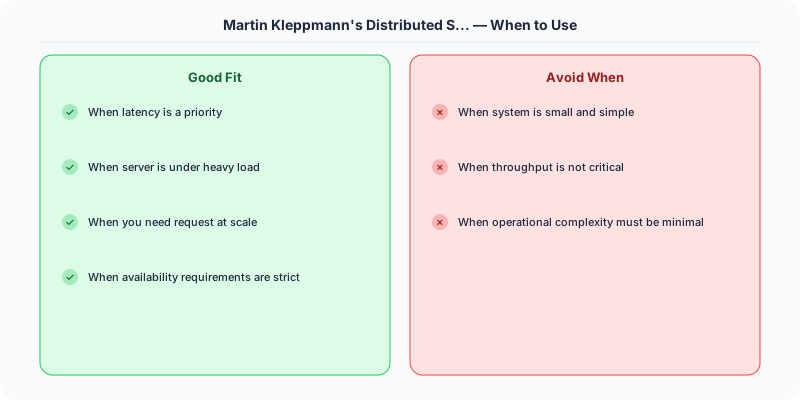
In a .NET application, you would typically implement this pattern using the following approach:
ASP.NET Core setup: Create a service class that encapsulates the logic, register it with dependency injection, and inject it into your controllers or minimal API endpoints. The built-in DI container handles lifecycle management.
Entity Framework Core: For database interactions, EF Core provides the ORM layer. Use migrations for schema management and raw SQL for performance-critical queries. Consider Dapper for read-heavy paths where EF Core's overhead matters.
Azure integration: If deploying to Azure, leverage managed services — Azure Cache for Redis, Azure SQL, Azure Service Bus, Azure Cosmos DB. These eliminate operational overhead and provide built-in monitoring through Application Insights.
Testing: Use xUnit with Testcontainers for integration tests that spin up real databases in Docker. Mock external dependencies with NSubstitute. The WebApplicationFactory class lets you test your entire HTTP pipeline in-process.
Monitoring: Add Application Insights telemetry to track request latency, dependency calls, and custom metrics. Use structured logging with Serilog to make production debugging possible:
Log.Information("Processing order {OrderId} for {CustomerId}", orderId, customerId);
This gives you searchable, structured logs in Azure Monitor or Seq.
Key Takeaways for Interviews
- Understand the core problem this resource addresses and be able to explain it in 2-3 sentences without jargon
- Know the key trade-offs: what does this approach optimize for, and what does it sacrifice?
- Be ready to compare this with alternative approaches and explain when each is appropriate
- Connect the concepts to real-world systems you have worked with or studied
- Demonstrate depth by discussing failure modes and how they are handled
How This Applies to Modern .NET Systems
The concepts from this resource translate to .NET through several established libraries and patterns:
Azure managed services often abstract away the underlying distributed systems complexity, but understanding the fundamentals helps you configure them correctly, debug issues, and make informed architectural decisions.
NuGet packages in the .NET ecosystem provide production-ready implementations of many patterns described in this resource. Before building custom solutions, check if a well-maintained package already exists.
ASP.NET Core middleware pipeline is where many of these patterns are implemented in practice: caching, rate limiting, health checks, and circuit breaking all fit naturally into the middleware model.