MapReduce: Simplified Data Processing on Large Clusters
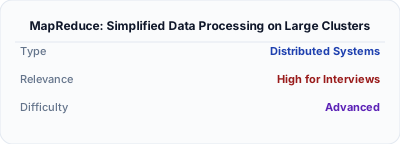
Google's programming model for processing massive datasets in parallel across thousands of commodity machines — the paper that launched the big data era.
Historical Context
Published by Jeffrey Dean and Sanjay Ghemawat at Google in 2004 (OSDI), MapReduce was born from the observation that many of Google's internal computations — building search indexes, counting page hits, sorting logs — followed the same pattern: apply a function to each input record, then aggregate the results. Before MapReduce, engineers wrote ad-hoc distributed programs for each task, re-solving parallelism, fault tolerance, and data distribution every time.
Core Problem
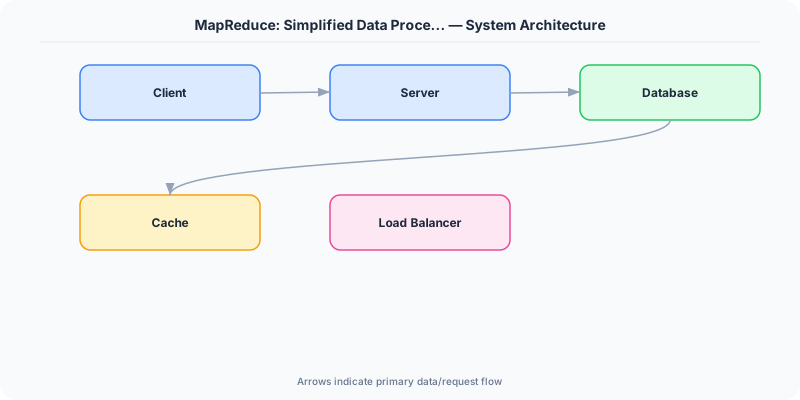
How can engineers with no distributed-systems expertise process petabytes of data across thousands of unreliable commodity machines, without writing explicit networking, fault-recovery, or scheduling code?
Key Innovation
MapReduce abstracts parallel computation into two user-defined functions. The Map function takes an input key-value pair and emits intermediate key-value pairs. The framework groups all intermediate values by key (the "shuffle" step), then the Reduce function merges all values for each key into a final result.
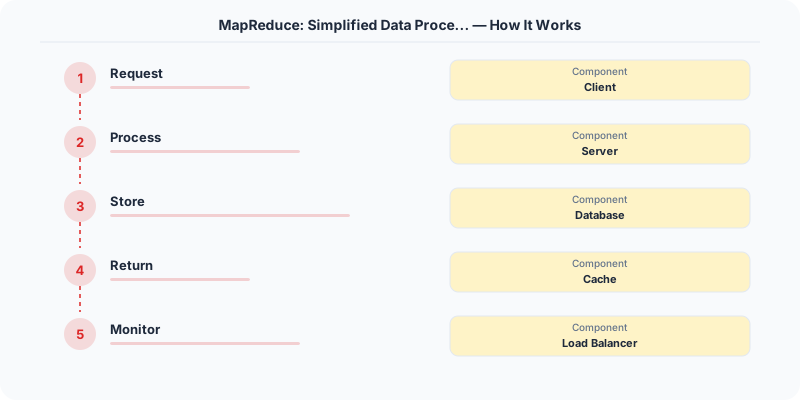
The runtime handles everything else: splitting input data into 16-64 MB chunks, scheduling Map tasks close to the data on GFS, re-executing failed tasks on other machines, and writing output back to GFS. A single master node assigns work and tracks progress. If a worker dies, the master simply reassigns its tasks — since Map output is stored on local disk and Reduce output goes to GFS, recomputation is straightforward.
A key optimization is the combiner function, which performs a local partial reduce on each mapper before the shuffle, dramatically cutting network traffic. Another is locality-aware scheduling: the master prefers to run Map tasks on machines that already hold the relevant GFS chunk.
Architecture / Algorithm
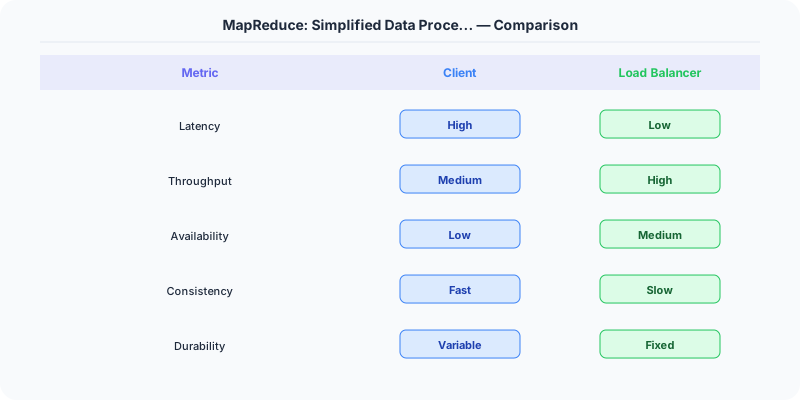
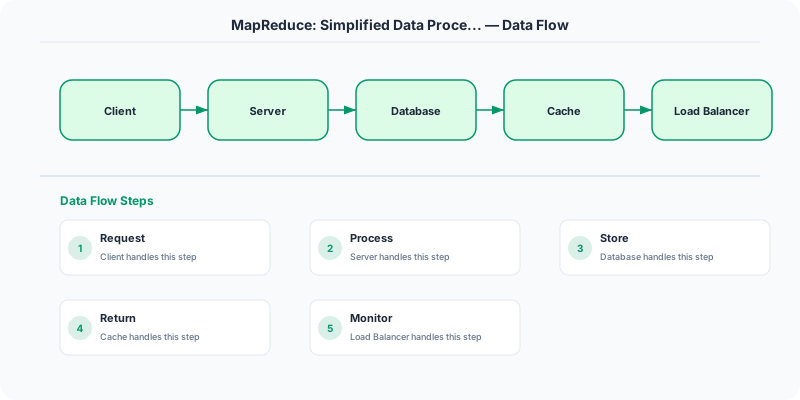
- Input Splitting: Data is divided into M splits, each processed by one Map task.
- Map Phase: Each mapper reads its split, applies the user Map function, and writes intermediate pairs to local disk, partitioned into R buckets.
- Shuffle Phase: Reducers pull their partition from every mapper via RPC, then sort by key.
- Reduce Phase: Each reducer iterates through sorted keys, calling the user Reduce function, and writes output to GFS.
- Master: Coordinates task assignment, monitors heartbeats, handles stragglers by launching backup tasks.
Strengths
- Radically simple programming model: users only write Map and Reduce
- Automatic fault tolerance through deterministic re-execution
- Scales linearly by adding commodity machines
- Backup tasks mitigate stragglers (slow machines)
Weaknesses
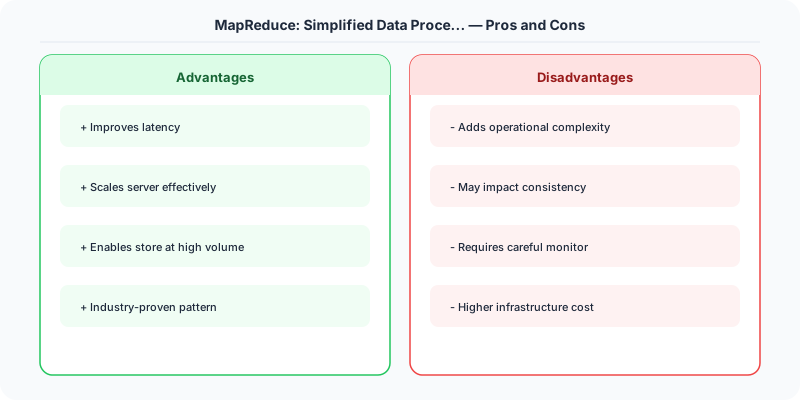
- High latency: each job reads from and writes to disk, making it unsuitable for interactive queries
- Rigid two-phase model: multi-stage pipelines require chaining multiple MapReduce jobs
- Single master is a potential bottleneck for very large clusters
- Superseded by more flexible frameworks (Spark, Flink, Dataflow) that support in-memory processing and DAG execution
Modern Systems Influenced
Apache Hadoop is a direct open-source reimplementation. Spark replaced MapReduce's disk-heavy model with in-memory RDDs. Google Cloud Dataflow and Apache Beam generalized the model into streaming/batch pipelines. The map-shuffle-reduce pattern remains fundamental to every distributed data processing framework.
Interview Relevance
MapReduce is a go-to reference when designing offline data pipelines, batch analytics, or log processing systems. Know how input splitting enables parallelism, why the shuffle phase is the bottleneck, and how fault tolerance works via re-execution. Compare it with Spark's in-memory model when discussing latency-sensitive analytics.
Plain-English Summary
MapReduce lets you process huge datasets by breaking the work into two steps: Map applies a function to every record independently (fully parallel), then Reduce aggregates the results by key. The framework handles splitting data, scheduling work, and retrying failures. You write two small functions; the system handles the distributed computing.
Practical Implementation for .NET Developers
In a .NET application, you would typically implement this pattern using the following approach:
ASP.NET Core setup: Create a service class that encapsulates the logic, register it with dependency injection, and inject it into your controllers or minimal API endpoints. The built-in DI container handles lifecycle management.
Entity Framework Core: For database interactions, EF Core provides the ORM layer. Use migrations for schema management and raw SQL for performance-critical queries. Consider Dapper for read-heavy paths where EF Core's overhead matters.
Azure integration: If deploying to Azure, leverage managed services — Azure Cache for Redis, Azure SQL, Azure Service Bus, Azure Cosmos DB. These eliminate operational overhead and provide built-in monitoring through Application Insights.
Testing: Use xUnit with Testcontainers for integration tests that spin up real databases in Docker. Mock external dependencies with NSubstitute. The WebApplicationFactory class lets you test your entire HTTP pipeline in-process.
Monitoring: Add Application Insights telemetry to track request latency, dependency calls, and custom metrics. Use structured logging with Serilog to make production debugging possible:
Log.Information("Processing order {OrderId} for {CustomerId}", orderId, customerId);
This gives you searchable, structured logs in Azure Monitor or Seq.
Key Takeaways for Interviews
- Understand the core problem this resource addresses and be able to explain it in 2-3 sentences without jargon
- Know the key trade-offs: what does this approach optimize for, and what does it sacrifice?
- Be ready to compare this with alternative approaches and explain when each is appropriate
- Connect the concepts to real-world systems you have worked with or studied
- Demonstrate depth by discussing failure modes and how they are handled
How This Applies to Modern .NET Systems
The concepts from this resource translate to .NET through several established libraries and patterns:
Azure managed services often abstract away the underlying distributed systems complexity, but understanding the fundamentals helps you configure them correctly, debug issues, and make informed architectural decisions.
NuGet packages in the .NET ecosystem provide production-ready implementations of many patterns described in this resource. Before building custom solutions, check if a well-maintained package already exists.
ASP.NET Core middleware pipeline is where many of these patterns are implemented in practice: caching, rate limiting, health checks, and circuit breaking all fit naturally into the middleware model.