The Log-Structured Merge-Tree (LSM-Tree)
O'Neil's write-optimized storage structure that converts random writes into sequential I/O — the engine inside Cassandra, RocksDB, and LevelDB.
Historical Context
Published by Patrick O'Neil, Edward Cheng, Dieter Gawlick, and Elizabeth O'Neil in 1996 (Acta Informatica), the LSM-Tree was designed for workloads where writes vastly outnumber reads — transaction logging, event recording, and time-series data. Traditional B-trees required random I/O for every write (seeking to the correct leaf page), which was catastrophically slow on the spinning hard drives of the era. The LSM-Tree offered an alternative that converted random writes into sequential writes at the cost of more expensive reads.
Core Problem
How do you build a storage structure that maximizes write throughput on disk-based systems by avoiding random I/O, while still supporting efficient lookups?
Key Innovation
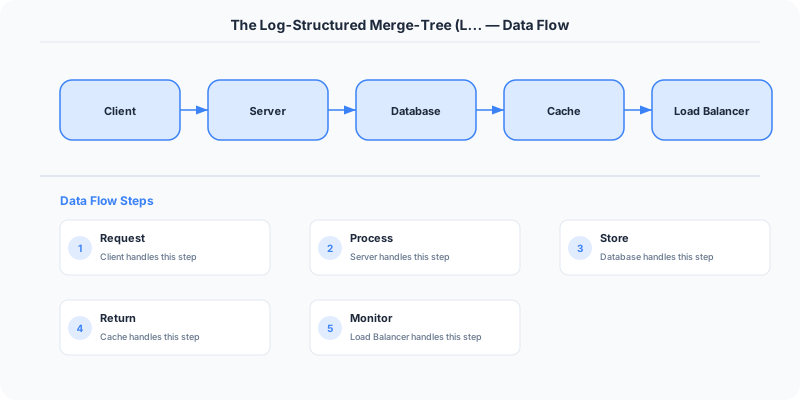
The LSM-Tree buffers incoming writes in an in-memory sorted structure (the memtable, typically a red-black tree or skip list). When the memtable reaches a size threshold, it is flushed as a complete, sorted, immutable file called an SSTable (Sorted String Table) — a purely sequential write operation.
Over time, the system accumulates many SSTables. To prevent reads from scanning all of them, a background compaction process periodically merges multiple SSTables into fewer, larger ones, discarding deleted entries and older versions. This is similar to merge sort: since each SSTable is already sorted, merging them is efficient sequential I/O.
Reads must check the memtable and potentially multiple SSTables. Bloom filters — probabilistic data structures that can definitively say a key is absent — dramatically reduce wasted reads by skipping SSTables that do not contain the target key. A bloom filter might have a 1% false positive rate, meaning 99% of unnecessary SSTable reads are avoided.
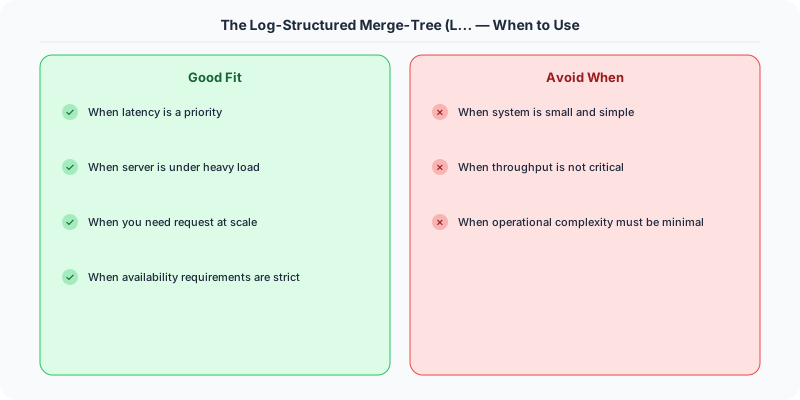
The tradeoff is clear: writes are fast (always sequential), but reads may require checking multiple levels. Compaction reduces read amplification but consumes I/O bandwidth. Tuning the compaction strategy (size-tiered vs. leveled) is a key operational decision.
Architecture / Algorithm
- Memtable: In-memory sorted buffer (skip list or balanced tree). All writes land here first.
- WAL (Write-Ahead Log): Persists writes before memtable insertion for crash recovery.
- SSTable Flush: When memtable is full, it is written to disk as an immutable sorted file.
- Compaction: Merges SSTables to reduce read amplification. Size-tiered (merge similarly-sized files) vs. leveled (maintain size-bounded levels).
- Bloom Filters: Per-SSTable probabilistic filters that skip files not containing the requested key.
- Read Path: Check memtable, then SSTables from newest to oldest, using bloom filters to skip.
Strengths
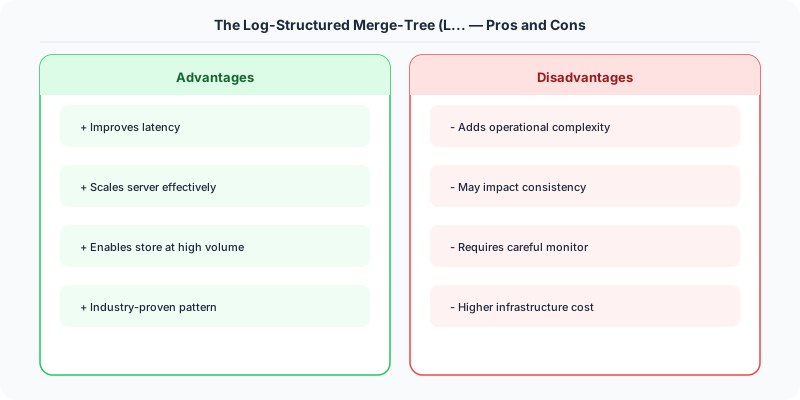
- Exceptional write throughput: all writes are sequential I/O
- Efficient space usage through compaction and versioned garbage collection
- Tunable read/write tradeoff via compaction strategy
- Works exceptionally well on SSDs (sequential writes reduce wear)
Weaknesses
- Read amplification: point lookups may check multiple SSTables
- Write amplification: compaction re-writes data multiple times over its lifetime
- Space amplification: during compaction, temporary extra space is needed
- Compaction can cause latency spikes if not properly throttled
Modern Systems Influenced
Google's LevelDB and Facebook's RocksDB are pure LSM-tree implementations. Cassandra, HBase, and Bigtable all use LSM-trees as their storage engine. SQLite's LSM extension, WiredTiger (MongoDB), and InfluxDB's TSI index also use LSM-tree variants. The memtable + SSTable + compaction pattern is arguably the most widely deployed storage engine design in modern databases.
Interview Relevance
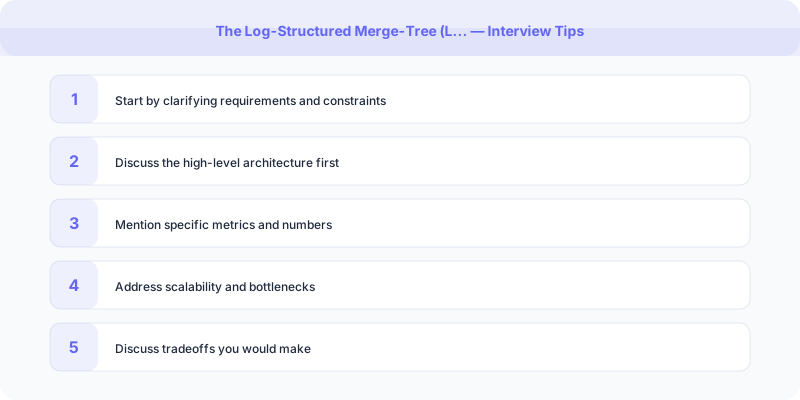
Reference LSM-trees when discussing write-heavy workloads, time-series databases, or comparing storage engines. Know the write path (WAL to memtable to SSTable), how compaction works, and the three amplification factors (read, write, space). Compare with B-trees: B-trees are better for read-heavy, LSM-trees for write-heavy. This is a common "how would you design a storage engine?" interview topic.
Plain-English Summary
An LSM-Tree buffers writes in memory, then periodically flushes them as sorted files to disk — all sequential I/O, no random seeking. Over time, background compaction merges these sorted files to keep reads fast. Bloom filters help skip files that definitely lack a requested key. The result is a storage engine that handles massive write loads efficiently, used by Cassandra, RocksDB, and many other databases.
Practical Implementation for .NET Developers
In a .NET application, you would typically implement this pattern using the following approach:
ASP.NET Core setup: Create a service class that encapsulates the logic, register it with dependency injection, and inject it into your controllers or minimal API endpoints. The built-in DI container handles lifecycle management.
Entity Framework Core: For database interactions, EF Core provides the ORM layer. Use migrations for schema management and raw SQL for performance-critical queries. Consider Dapper for read-heavy paths where EF Core's overhead matters.
Azure integration: If deploying to Azure, leverage managed services — Azure Cache for Redis, Azure SQL, Azure Service Bus, Azure Cosmos DB. These eliminate operational overhead and provide built-in monitoring through Application Insights.
Testing: Use xUnit with Testcontainers for integration tests that spin up real databases in Docker. Mock external dependencies with NSubstitute. The WebApplicationFactory class lets you test your entire HTTP pipeline in-process.
Monitoring: Add Application Insights telemetry to track request latency, dependency calls, and custom metrics. Use structured logging with Serilog to make production debugging possible:
Log.Information("Processing order {OrderId} for {CustomerId}", orderId, customerId);
This gives you searchable, structured logs in Azure Monitor or Seq.
Key Takeaways for Interviews
- Understand the core problem this resource addresses and be able to explain it in 2-3 sentences without jargon
- Know the key trade-offs: what does this approach optimize for, and what does it sacrifice?
- Be ready to compare this with alternative approaches and explain when each is appropriate
- Connect the concepts to real-world systems you have worked with or studied
- Demonstrate depth by discussing failure modes and how they are handled
How This Applies to Modern .NET Systems
The concepts from this resource translate to .NET through several established libraries and patterns:
Azure managed services often abstract away the underlying distributed systems complexity, but understanding the fundamentals helps you configure them correctly, debug issues, and make informed architectural decisions.
NuGet packages in the .NET ecosystem provide production-ready implementations of many patterns described in this resource. Before building custom solutions, check if a well-maintained package already exists.
ASP.NET Core middleware pipeline is where many of these patterns are implemented in practice: caching, rate limiting, health checks, and circuit breaking all fit naturally into the middleware model.