Gaurav Sen's System Design Channel
A review of Gaurav Sen's YouTube channel — one of the original system design education channels, known for whiteboard-style explanations that emphasize.
Overview
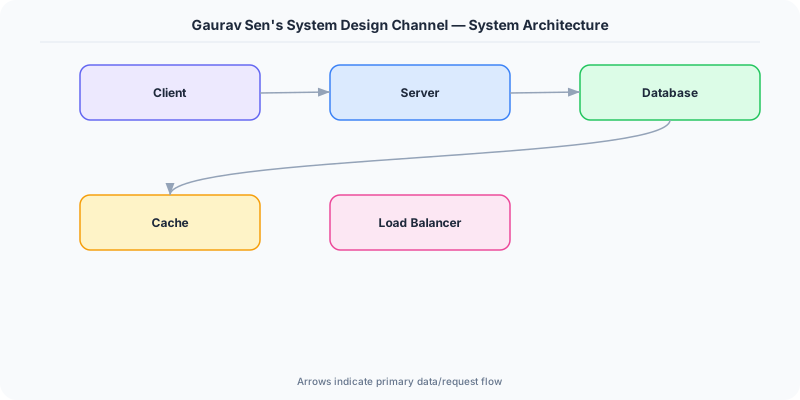
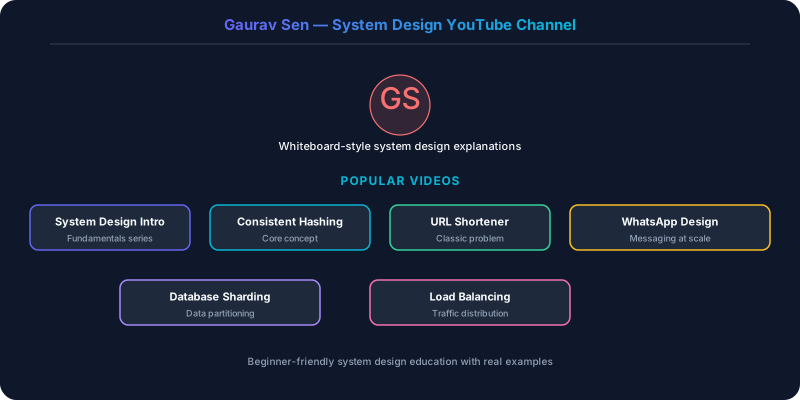
Gaurav Sen's YouTube channel is one of the pioneering system design education channels, with over 700,000 subscribers. Gaurav, a former engineer at Uber and DE Shaw, started the channel in 2018 — well before system design content became mainstream on YouTube. His whiteboard-style videos walk through design problems by reasoning from first principles rather than presenting pre-built solutions.
What distinguishes Gaurav's content from other system design channels is his teaching approach. He starts with the problem, asks "what do we need?", builds the solution incrementally, and explains why each decision makes sense. This mirrors how a strong candidate approaches a system design interview — reasoning through the problem rather than reciting a memorized architecture.
Content Structure
System Design Interview Walkthroughs
The channel's most popular content is end-to-end system design walkthroughs that simulate interview conditions:
- Design a URL Shortener — Covers hashing, base62 encoding, database choice, and handling collision.
- Design Instagram — Walks through the feed algorithm, photo storage, and the fanout-on-write vs fanout-on-read tradeoff.
- Design WhatsApp — Covers real-time messaging, WebSocket connections, message delivery guarantees, and group messaging.
- Design a Distributed Cache — Explains consistent hashing, eviction policies, and cache replication.
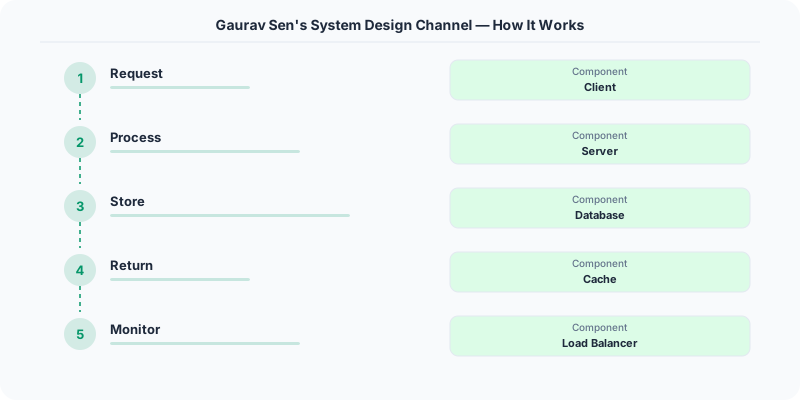
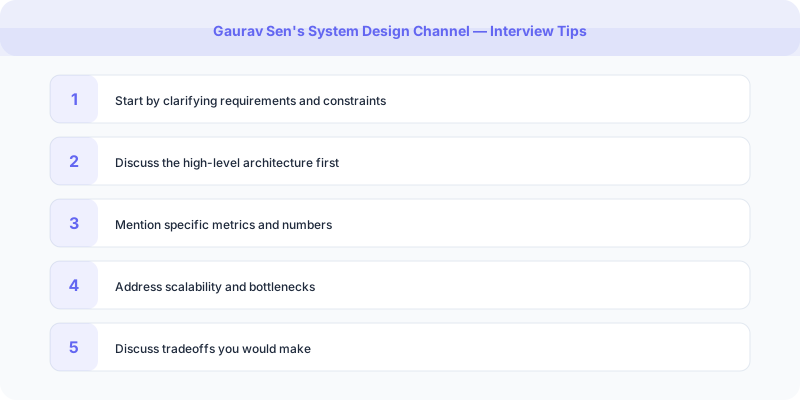
Each walkthrough is 15-30 minutes and follows a natural problem-solving flow: requirements gathering, high-level design, component deep dives, and scaling discussion.
Concept Deep Dives
Gaurav's concept videos are among the most intuitive explanations available:
- Consistent Hashing — The most watched consistent hashing explanation on YouTube. Uses a clock analogy to make the hash ring concept intuitive.
- Load Balancing — Covers Layer 4 vs Layer 7, round-robin, weighted, least-connections, and consistent hashing-based load balancing.
- Database Sharding — Explains horizontal partitioning, shard key selection, and the problems of cross-shard queries.
- CAP Theorem — A clear walkthrough with real-world examples of CP and AP systems.
Algorithms and Data Structures for System Design
Unlike purely architecture-focused channels, Gaurav covers the algorithms that power distributed systems:
- Bloom Filters — Why probabilistic data structures matter for scale.
- Consistent Hashing — The algorithm in detail, not just the concept.
- Rate Limiting Algorithms — Token bucket, leaky bucket, sliding window.
Strengths
First-principles reasoning. Gaurav does not hand you a finished architecture. He starts with "we need to store URLs" and builds to "we need consistent hashing for the cache layer" through a chain of logical reasoning. This teaches you how to think, not what to memorize.
Interview-realistic pacing. The walkthroughs feel like actual interviews. Gaurav verbalizes his thought process, asks clarifying questions, and makes design decisions on the fly. Watching these videos trains you to think out loud in interviews.
Mathematical grounding. When discussing concepts like consistent hashing or sharding, Gaurav includes the mathematical reasoning (hash distribution, load factor, probability of collision). This level of rigor is rare in system design content and valuable for understanding why solutions work.
Engaging presentation. Gaurav is an energetic and clear communicator. The whiteboard format with real-time drawing keeps the viewer engaged. Complex topics feel approachable because of the conversational tone.
Algorithmic focus. The inclusion of data structure and algorithm content alongside system design helps engineers understand the building blocks. Knowing that a Bloom filter has a false positive rate related to the number of hash functions and bit array size is not required for interviews, but understanding when to use one is valuable.
Weaknesses
Production quality variation. Early videos have lower production quality (audio, visuals) compared to channels like ByteByteGo. The content quality is strong throughout, but the presentation has improved significantly over time.
Less structured learning path. The videos are organized by topic but there is no recommended sequence. A beginner does not know whether to start with "What is a Load Balancer" or "Design Tinder." A curated playlist for different experience levels would help.
Fewer architecture deep dives from real companies. Unlike ByteByteGo, which frequently references specific engineering blog posts, Gaurav's content focuses more on general patterns and interview scenarios. Engineers looking for "how does Netflix actually do X" may need to look elsewhere.
Upload frequency. The channel uploads less frequently than some competitors. Some topics have only a single video when a series would provide better coverage.
Recommended Videos
For system design interview preparation:
- "System Design: How to design Twitter" — One of the clearest explanations of the fanout problem and the hybrid push/pull solution.
- "Consistent Hashing" — The definitive YouTube explanation. Watch this before any video on distributed caching or load balancing.
- "System Design: Uber Lyft ride sharing" — Covers geospatial indexing, matching algorithms, and real-time systems.
- "Horizontal vs Vertical Scaling" — A foundational video that every beginner should start with.
- "What is a Message Queue and When should you use Messaging Queue" — Explains async processing with practical examples.
How to Use This Channel
For interview preparation: Start with the concept videos (consistent hashing, load balancing, caching) to build your vocabulary. Then watch the system design walkthroughs and pause the video after the requirements discussion to attempt your own design before seeing Gaurav's approach.
For deepening understanding: After reading DDIA or the System Design Primer, watch Gaurav's videos on the same topics. Hearing the same concept explained from a different angle reinforces understanding and reveals nuances you missed.
Gaurav Sen's channel remains one of the best resources for learning to reason about system design rather than memorize solutions. For engineers who want to build design intuition rather than a catalog of architectures, this channel is essential.
Practical Implementation for .NET Developers
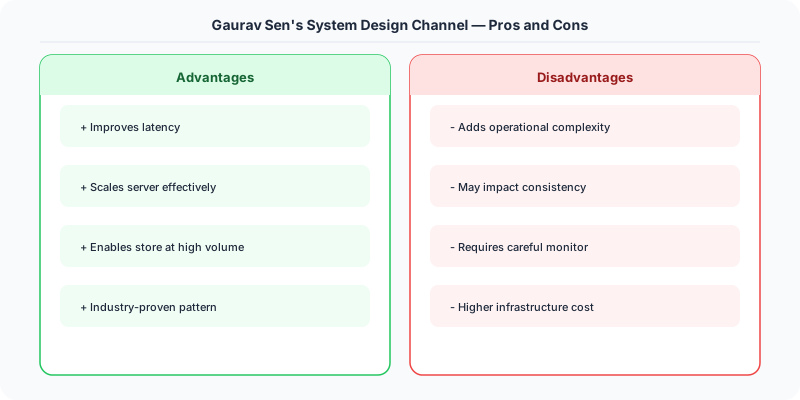
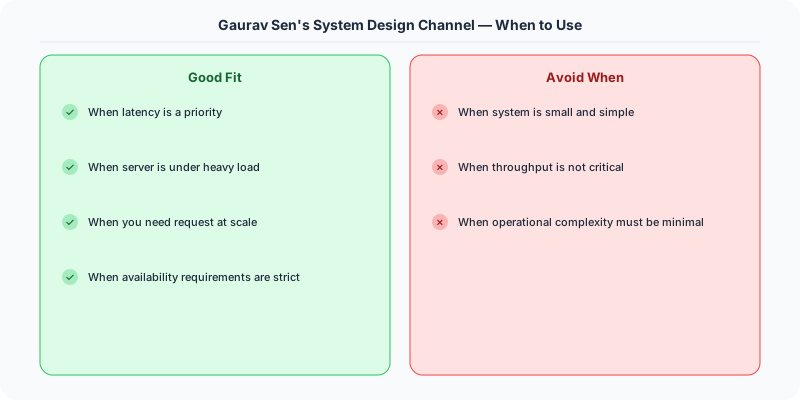
In a .NET application, you would typically implement this pattern using the following approach:
ASP.NET Core setup: Create a service class that encapsulates the logic, register it with dependency injection, and inject it into your controllers or minimal API endpoints. The built-in DI container handles lifecycle management.
Entity Framework Core: For database interactions, EF Core provides the ORM layer. Use migrations for schema management and raw SQL for performance-critical queries. Consider Dapper for read-heavy paths where EF Core's overhead matters.
Azure integration: If deploying to Azure, leverage managed services — Azure Cache for Redis, Azure SQL, Azure Service Bus, Azure Cosmos DB. These eliminate operational overhead and provide built-in monitoring through Application Insights.
Testing: Use xUnit with Testcontainers for integration tests that spin up real databases in Docker. Mock external dependencies with NSubstitute. The WebApplicationFactory class lets you test your entire HTTP pipeline in-process.
Monitoring: Add Application Insights telemetry to track request latency, dependency calls, and custom metrics. Use structured logging with Serilog to make production debugging possible:
Log.Information("Processing order {OrderId} for {CustomerId}", orderId, customerId);
This gives you searchable, structured logs in Azure Monitor or Seq.
Key Takeaways for Interviews
- Understand the core problem this resource addresses and be able to explain it in 2-3 sentences without jargon
- Know the key trade-offs: what does this approach optimize for, and what does it sacrifice?
- Be ready to compare this with alternative approaches and explain when each is appropriate
- Connect the concepts to real-world systems you have worked with or studied
- Demonstrate depth by discussing failure modes and how they are handled
How This Applies to Modern .NET Systems
The concepts from this resource translate to .NET through several established libraries and patterns:
Azure managed services often abstract away the underlying distributed systems complexity, but understanding the fundamentals helps you configure them correctly, debug issues, and make informed architectural decisions.
NuGet packages in the .NET ecosystem provide production-ready implementations of many patterns described in this resource. Before building custom solutions, check if a well-maintained package already exists.
ASP.NET Core middleware pipeline is where many of these patterns are implemented in practice: caching, rate limiting, health checks, and circuit breaking all fit naturally into the middleware model.