Dynamo: Amazon's Highly Available Key-Value Store
Amazon's AP-leaning distributed key-value store that pioneered consistent hashing, vector clocks, and sloppy quorums — the blueprint for Cassandra and.
Historical Context
Published by Giuseppe DeCandia et al. at Amazon in 2007 (SOSP), Dynamo was built for Amazon's core services like the shopping cart, where even a brief outage during peak traffic could cost millions. Amazon's experience showed that most services needed only primary-key access (no complex queries) but demanded "always-on" writes — the system should accept writes even during network partitions. Existing solutions like traditional RDBMS and even early distributed databases prioritized consistency over availability, which did not meet Amazon's requirements.
Core Problem
How do you build a key-value store that is always writable, always available for reads, and can operate reliably across multiple data centers — even when nodes fail or the network partitions?
Key Innovation
Dynamo explicitly chose availability and partition tolerance over strong consistency (AP in CAP terms). It introduced a synthesis of techniques, each solving one aspect of distributed storage. Consistent hashing distributes keys across nodes on a virtual ring, allowing nodes to join or leave with minimal data movement. Each key is replicated to N successive nodes on the ring.
Sloppy quorum with hinted handoff ensures writes succeed even when some target replicas are down: a write is considered successful after W nodes acknowledge it, and if a target node is unreachable, a neighboring node temporarily accepts the write and forwards it once the target recovers.
Vector clocks track the causal history of each value, enabling the system to detect conflicting updates. When concurrent writes create divergent versions, Dynamo preserves all versions and lets the application resolve the conflict on the next read (semantic reconciliation). Amazon's shopping cart, for example, merges conflicting carts by taking the union of items.
Anti-entropy via Merkle trees lets nodes efficiently compare their replica contents and synchronize any divergences in the background.
Architecture / Algorithm
- Consistent Hashing Ring: Virtual nodes distribute load evenly; adding a node requires rehashing only neighboring segments.
- Replication: Each key is stored on N coordinator nodes (typically N=3).
- Read/Write Quorums: Configurable W (write) and R (read) with R + W > N for strong-read consistency if desired.
- Vector Clocks: Per-key version histories that track which nodes have seen which updates.
- Hinted Handoff: Temporary writes to available nodes when targets are down.
- Merkle Trees: Hash trees per key range for efficient replica synchronization.
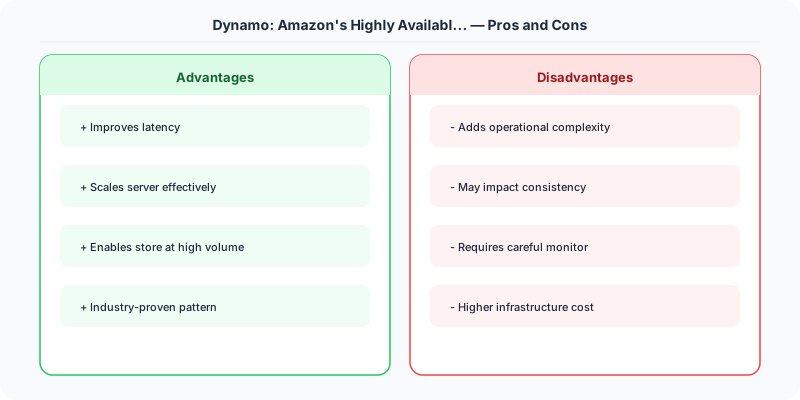
Strengths
- Always-writable: no single point of failure for writes
- Highly tunable consistency via W, R, N parameters
- Incremental scalability: add nodes without downtime
- Peer-to-peer architecture: no master or coordinator node
Weaknesses
- Application must handle conflict resolution, increasing client complexity
- Vector clocks can grow large with many concurrent writers
- Eventual consistency makes it unsuitable for operations requiring strict ordering
- Debugging data inconsistencies across replicas is difficult
Modern Systems Influenced
Apache Cassandra combined Dynamo's partitioning and replication with Bigtable's data model. Riak directly implemented Dynamo's design. Amazon DynamoDB is the managed successor. Voldemort (LinkedIn) also adopted the architecture. The consistent-hashing-with-virtual-nodes pattern appears in countless distributed systems.
Interview Relevance
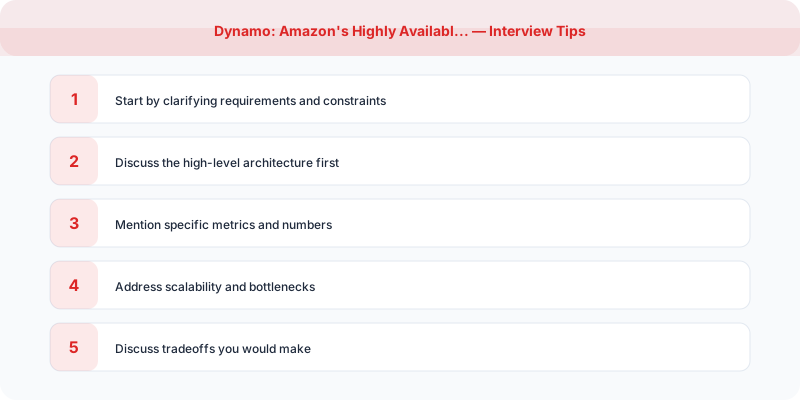
Dynamo is essential for any "design a key-value store" question. Know consistent hashing, how quorum parameters tune the consistency/availability tradeoff, and why vector clocks are needed. Be ready to explain hinted handoff and when you would choose AP over CP. The paper is also a great reference for discussing eventual consistency patterns.
Plain-English Summary
Dynamo spreads key-value data across a ring of servers using consistent hashing so any server can handle any request. It replicates each key to multiple servers and uses flexible quorum rules so reads and writes can succeed even when some servers are down. When conflicts happen because two clients wrote simultaneously, the system keeps both versions and lets the application decide which one wins.
Practical Implementation for .NET Developers
In a .NET application, you would typically implement this pattern using the following approach:
ASP.NET Core setup: Create a service class that encapsulates the logic, register it with dependency injection, and inject it into your controllers or minimal API endpoints. The built-in DI container handles lifecycle management.
Entity Framework Core: For database interactions, EF Core provides the ORM layer. Use migrations for schema management and raw SQL for performance-critical queries. Consider Dapper for read-heavy paths where EF Core's overhead matters.
Azure integration: If deploying to Azure, leverage managed services — Azure Cache for Redis, Azure SQL, Azure Service Bus, Azure Cosmos DB. These eliminate operational overhead and provide built-in monitoring through Application Insights.
Testing: Use xUnit with Testcontainers for integration tests that spin up real databases in Docker. Mock external dependencies with NSubstitute. The WebApplicationFactory class lets you test your entire HTTP pipeline in-process.
Monitoring: Add Application Insights telemetry to track request latency, dependency calls, and custom metrics. Use structured logging with Serilog to make production debugging possible:
Log.Information("Processing order {OrderId} for {CustomerId}", orderId, customerId);
This gives you searchable, structured logs in Azure Monitor or Seq.
Key Takeaways for Interviews
- Consistent hashing with virtual nodes distributes data across a ring of servers with minimal redistribution when nodes are added or removed. This is the foundation of most distributed databases.
- Sloppy quorum + hinted handoff allows writes to succeed even when target replicas are down by temporarily storing data on alternate nodes. This is how Dynamo achieves "always writable."
- Vector clocks track causal ordering of writes so the system can detect conflicts. When two clients write concurrently, Dynamo preserves both versions and lets the application resolve the conflict.
- Tunable consistency (R + W > N) lets you adjust the consistency/availability tradeoff per operation. R=1, W=1 is maximum availability. R=N, W=N is maximum consistency.
- Anti-entropy with Merkle trees enables efficient background synchronization between replicas by comparing hash trees instead of scanning all data.
How This Applies to Modern .NET Systems
In .NET, you interact with Dynamo's principles through Amazon DynamoDB (the managed successor) or through libraries that implement similar patterns:
DynamoDB SDK for .NET: Use the AWSSDK.DynamoDBv2 package. DynamoDB abstracts away consistent hashing and replication — you get single-digit millisecond reads and writes at any scale without managing infrastructure. Use the Document Model for flexible schemas or the Object Persistence Model for strongly-typed access.
Eventual consistency in practice: When reading from DynamoDB, you choose between eventually consistent reads (cheaper, faster, may return stale data) and strongly consistent reads (guaranteed fresh, 2x cost). For most read operations in a .NET web application, eventually consistent reads are fine. Use strongly consistent reads after writes where the user expects to see their change immediately.
Conflict resolution patterns: If your .NET application uses multi-region DynamoDB global tables, concurrent writes to the same item in different regions will be resolved with last-writer-wins (based on timestamps). If you need more sophisticated conflict resolution, implement application-level merge logic in your Lambda trigger or change stream handler.