Designing Data-Intensive Applications (DDIA)
A comprehensive summary of Martin Kleppmann's Designing Data-Intensive Applications — the most recommended book for understanding the foundations of.
Why This Book Matters
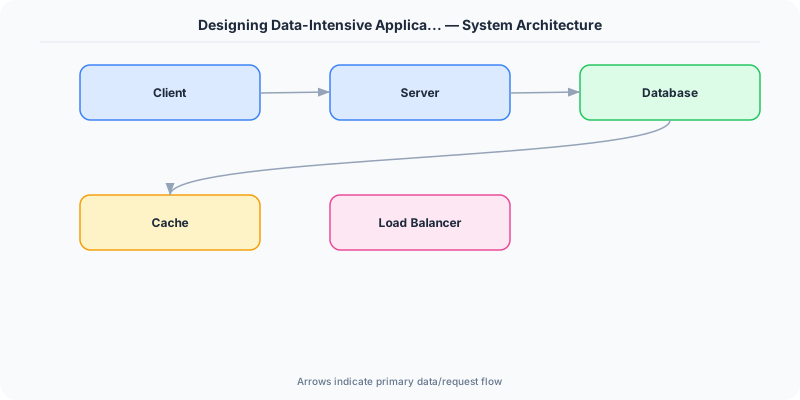
Designing Data-Intensive Applications by Martin Kleppmann is the single most recommended book for engineers preparing for system design interviews or transitioning into infrastructure and distributed systems roles. Published in 2017 by O'Reilly, it has become the de facto textbook for understanding how modern data systems work under the hood.
What makes DDIA different from other system design books is its depth. It does not give you a checklist of "use Redis for caching, use Kafka for messaging." Instead, it explains the fundamental principles behind these systems — the algorithms, the data structures, the consistency models, and the tradeoffs — so that you can reason about any system, including ones that do not exist yet.
Part I: Foundations of Data Systems
The first section covers the building blocks of data storage and retrieval.
Chapter 1: Reliable, Scalable, and Maintainable Applications defines the three pillars of data system design. Reliability means the system works correctly even when things go wrong (hardware faults, software bugs, human errors). Scalability means the system can handle growth in data volume, traffic, or complexity. Maintainability means the system can be operated, understood, and evolved by different people over time.
Chapter 2: Data Models and Query Languages surveys the evolution from hierarchical databases (IMS) to relational (SQL) to document (MongoDB) to graph (Neo4j) databases. The key insight: the data model you choose determines what queries are easy and what queries are hard. Relational models are good for many-to-many relationships. Document models are good for self-contained documents. Graph models are good for highly interconnected data.
Chapter 3: Storage and Retrieval explains how databases store data on disk. Two major families: log-structured storage (LSM trees, used by Cassandra, RocksDB, LevelDB) and page-oriented storage (B-trees, used by PostgreSQL, MySQL, SQL Server). LSM trees have faster writes; B-trees have faster reads. This chapter also covers column-oriented storage (used in data warehouses like BigQuery and Redshift) and the difference between OLTP and OLAP workloads.
Chapter 4: Encoding and Evolution covers how data is serialized for storage and network transmission. JSON, XML, Protocol Buffers, Avro, and Thrift each have different tradeoffs for schema evolution (adding and removing fields over time), compactness, and human readability. This chapter is essential for understanding API versioning and data migration strategies.
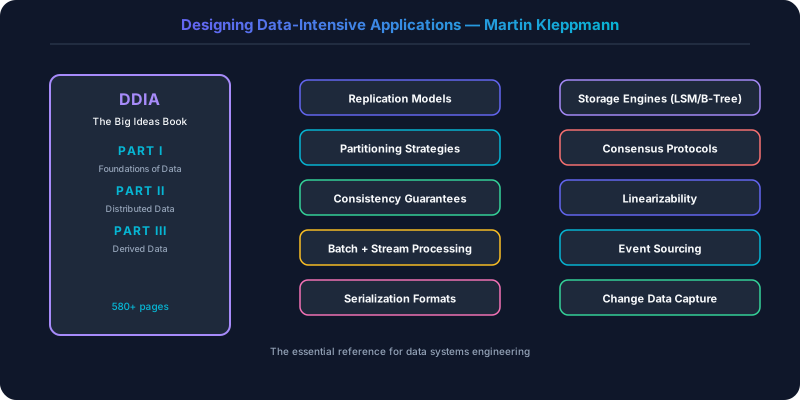
Part II: Distributed Data
The second section tackles the hard problems of distributing data across multiple machines.
Chapter 5: Replication covers single-leader, multi-leader, and leaderless replication. It explains replication lag, read-after-write consistency, monotonic reads, and consistent prefix reads. The treatment of conflict resolution in multi-leader and leaderless systems is the best available explanation outside of academic papers.
Chapter 6: Partitioning (Sharding) explains how to split data across multiple nodes. Key-range partitioning versus hash partitioning. How secondary indexes work in partitioned databases. The problem of hot spots and skewed partitions. This chapter directly maps to system design interview questions about database scaling.
Chapter 7: Transactions is one of the most important chapters. It demystifies ACID (Atomicity, Consistency, Isolation, Durability), explains isolation levels (Read Committed, Snapshot Isolation, Serializable), and describes how databases actually implement these guarantees (two-phase locking, serializable snapshot isolation). Most engineers use transactions daily without understanding what happens when two transactions conflict.
Chapter 8: The Trouble with Distributed Systems is a reality check. Networks are unreliable. Clocks are inaccurate. Processes can pause unpredictably. This chapter explains why distributed systems are hard and why you cannot simply assume the network is reliable.
Chapter 9: Consistency and Consensus covers linearizability, causal consistency, total order broadcast, and consensus algorithms (Paxos, Raft, Zab). It explains why the CAP theorem is often misunderstood and what it actually means in practice.
Part III: Derived Data
The third section covers systems that transform and process data.
Chapter 10: Batch Processing traces the evolution from Unix pipes to MapReduce to Spark. It explains the dataflow model, the advantages of immutable inputs, and why batch processing is still relevant in a world of real-time streaming.
Chapter 11: Stream Processing covers event streams, message brokers (Kafka, RabbitMQ), change data capture, event sourcing, and stream processing frameworks (Flink, Kafka Streams). This chapter connects the dots between databases and event-driven architectures.
Chapter 12: The Future of Data Systems proposes a unified architecture where batch processing and stream processing converge, and where derived data is maintained through a dataflow model rather than synchronous updates.
How to Read DDIA
For system design interview preparation, focus on chapters 5-9 (distributed data). These chapters cover the topics that appear most frequently in interviews: replication, partitioning, transactions, failure modes, and consensus.
For a broader understanding of data infrastructure, read cover to cover. Each chapter builds on the previous one, and the cross-references between chapters reveal connections that you miss by reading selectively.
The book is dense. Budget 1-2 hours per chapter. Take notes. The investment pays off — engineers who have internalized DDIA's concepts can reason about novel system design problems from first principles rather than pattern matching against memorized architectures.
Criticisms
DDIA was published in 2017 and does not cover recent developments: serverless databases (Aurora Serverless, PlanetScale), NewSQL databases (CockroachDB, TiDB), or the rise of Kafka as a database (ksqlDB, Kafka Streams). The fundamental principles have not changed, but the specific systems and patterns have evolved.
The book is also academic in tone. Engineers looking for practical "how-to" guidance (how to set up PostgreSQL replication, how to configure Kafka) should supplement DDIA with hands-on resources.
Who Should Read This
Every backend engineer with 2+ years of experience. Every engineer preparing for system design interviews at senior+ levels. Every engineer who wants to understand why their database behaves the way it does under load. DDIA is not a beginner book, but it is the best investment of reading time in the system design space.
Practical Implementation for .NET Developers
In a .NET application, you would typically implement this pattern using the following approach:
ASP.NET Core setup: Create a service class that encapsulates the logic, register it with dependency injection, and inject it into your controllers or minimal API endpoints. The built-in DI container handles lifecycle management.
Entity Framework Core: For database interactions, EF Core provides the ORM layer. Use migrations for schema management and raw SQL for performance-critical queries. Consider Dapper for read-heavy paths where EF Core's overhead matters.
Azure integration: If deploying to Azure, leverage managed services — Azure Cache for Redis, Azure SQL, Azure Service Bus, Azure Cosmos DB. These eliminate operational overhead and provide built-in monitoring through Application Insights.
Testing: Use xUnit with Testcontainers for integration tests that spin up real databases in Docker. Mock external dependencies with NSubstitute. The WebApplicationFactory class lets you test your entire HTTP pipeline in-process.
Monitoring: Add Application Insights telemetry to track request latency, dependency calls, and custom metrics. Use structured logging with Serilog to make production debugging possible:
Log.Information("Processing order {OrderId} for {CustomerId}", orderId, customerId);
This gives you searchable, structured logs in Azure Monitor or Seq.
Key Takeaways for Interviews
- Reliability, Scalability, Maintainability are the three pillars of data-intensive applications. Reliability means the system works correctly even when things go wrong. Scalability means the system handles growth. Maintainability means the system is easy to operate and evolve.
- Data models matter more than you think: Relational (SQL), document (MongoDB), graph (Neo4j), and time-series (InfluxDB) each excel at different access patterns. Choosing wrong means fighting your database forever.
- Replication and partitioning are the two fundamental strategies for distributing data. Replication copies the same data to multiple nodes (for availability and read scaling). Partitioning splits different data across nodes (for write scaling and storage).
- Exactly-once processing in stream processing requires idempotent consumers and careful state management. The book's treatment of this topic is considered the definitive reference.
- Batch processing (MapReduce) vs. stream processing (Kafka Streams): Batch is simpler and more reliable but has higher latency. Stream provides real-time results but is harder to get right. Many systems use both (Lambda architecture).
How This Applies to Modern .NET Systems
Martin Kleppmann's book is technology-agnostic, but every concept maps to the .NET ecosystem:
Encoding and evolution: Use System.Text.Json for JSON serialization (built into .NET, high performance). For schema evolution in event-driven systems, use Apache Avro with a schema registry, or Protobuf with the Google.Protobuf NuGet package.
Transactions: EF Core provides transaction support with SaveChanges (implicit) and BeginTransaction (explicit). For distributed transactions across multiple databases, implement the Saga pattern using MassTransit or NServiceBus — avoid distributed transactions (2PC) in microservices.
Stream processing: Use the Azure Stream Analytics or Apache Flink for complex event processing. For simpler scenarios, consume from Kafka or Event Hubs in .NET with Confluent.Kafka or Azure.Messaging.EventHubs and process with custom logic.
The DDIA book is the single best preparation resource for system design interviews. Read chapters 5 (Replication), 6 (Partitioning), and 7 (Transactions) as your highest priority — these topics appear in almost every interview.