The Chubby Lock Service for Loosely-Coupled Distributed Systems
Google's Paxos-based distributed lock service that provides coarse-grained locking and reliable storage for small metadata — the inspiration for ZooKeeper.
Historical Context
Published by Mike Burrows at Google in 2006 (OSDI), Chubby was designed because Google's infrastructure teams kept needing the same thing: a reliable way to elect a leader among a group of servers and store small amounts of configuration data. Rather than having each team embed Paxos directly into their applications (which is notoriously hard to get right), Google built a centralized lock service. Chubby became a critical piece of Google's infrastructure, depended upon by GFS (for master election), Bigtable (for tablet server coordination), and MapReduce (for job coordination).
Core Problem
How do you provide a reliable, easy-to-use distributed lock and configuration service that dozens of internal teams can depend on, without requiring each team to implement consensus themselves?
Key Innovation
Chubby chose to be a lock service with a file-system interface rather than a raw consensus library. This was a deliberate design decision: Burrows observed that developers are much more comfortable with files and locks than with Paxos rounds. Chubby exposes a small set of "files" (called nodes) in a hierarchical namespace, and clients can acquire locks on these nodes and read/write small data to them.
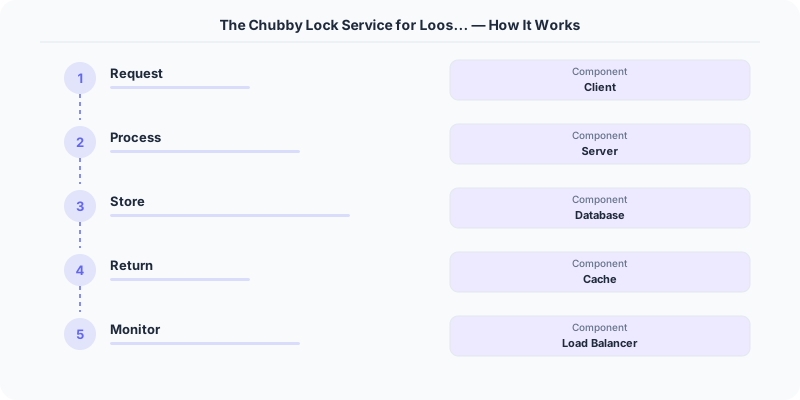
The lock service is replicated across five machines (a "cell") using Paxos for consensus. One replica is elected master and handles all reads and writes. If the master fails, Paxos elects a new master, and clients transparently reconnect. Locks are coarse-grained — designed to be held for hours or days (like "I am the master of this GFS cell") rather than milliseconds. This differs from fine-grained database locks and simplifies the design.
Chubby provides sessions with keepalive heartbeats. If a client's session expires (network partition, crash), its locks are released. Clients can register event callbacks to be notified of changes to files or lock ownership. The system also includes a sequencer mechanism: when a client acquires a lock, it receives a sequencer token that downstream services can verify, preventing a delayed message from a previous lock holder from being honored.
Architecture / Algorithm
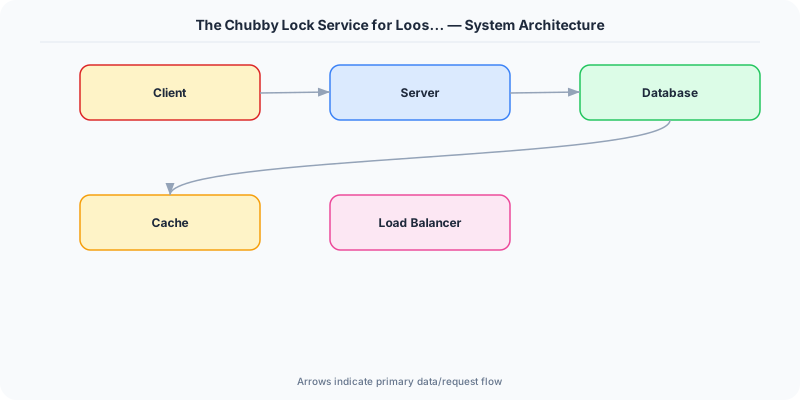
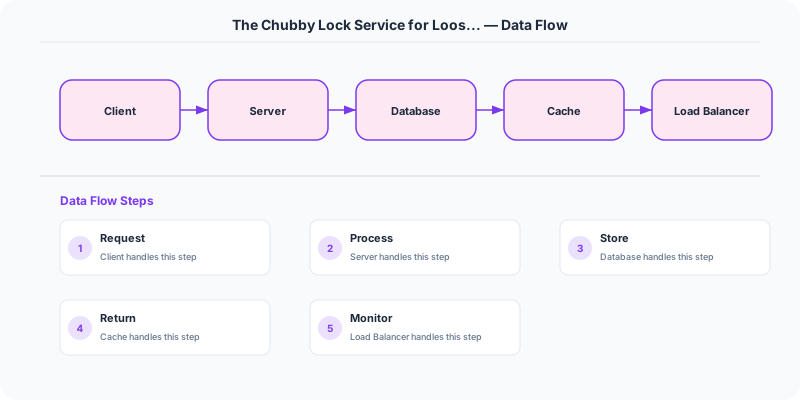
- Cell: Five replicas running Paxos, with one elected master.
- Namespace: Hierarchical file-like tree of nodes (similar to a file system).
- Locks: Advisory, coarse-grained. Clients acquire exclusive or shared locks on nodes.
- Sessions and KeepAlives: Clients maintain sessions; locks released on session expiry.
- Events/Callbacks: Notification of lock changes, node modifications, and master failover.
- Sequencers: Tokens that encode lock ownership for fencing.
Strengths
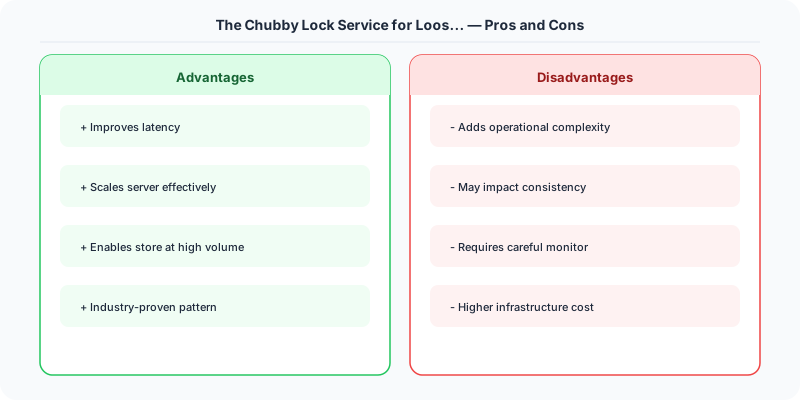
- Simple API: developers use familiar file/lock abstractions instead of raw consensus
- Reliable: Paxos replication across five servers tolerates two failures
- Coarse-grained locks avoid performance problems of fine-grained distributed locking
- Sequencers prevent stale-lock hazards
Weaknesses
- Single cell (5 replicas) is a potential capacity bottleneck for the entire organization
- Coarse-grained design means it is unsuitable for short-lived, high-frequency locks
- Clients must handle session expiry and re-acquisition gracefully
- Not open-sourced: Google-internal only
Modern Systems Influenced
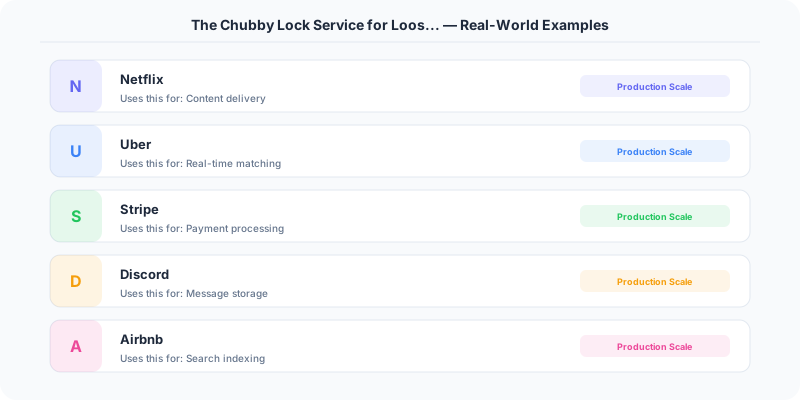
Apache ZooKeeper was directly inspired by Chubby but chose a wait-free API over a lock-centric one. etcd (Kubernetes) and Consul provide similar coordination services. The pattern of externalizing consensus into a dedicated service rather than embedding it in every application became an industry standard. Chubby's sequencer concept reappears as "fencing tokens" in distributed lock literature.
Interview Relevance
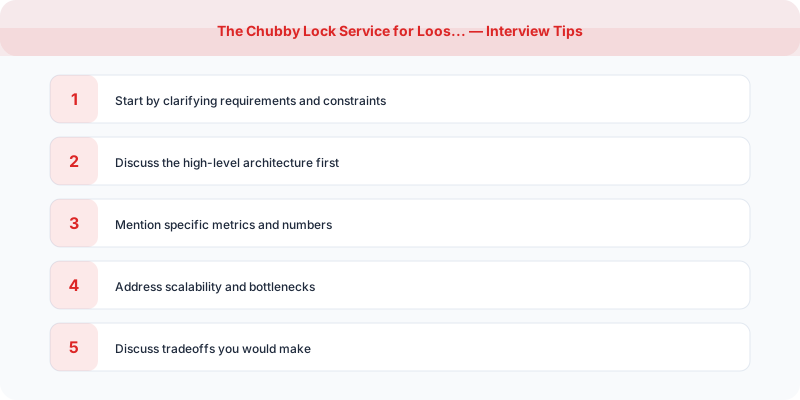
Reference Chubby when discussing distributed locks, leader election, or why consensus should be centralized in a dedicated service. Know the difference between coarse-grained and fine-grained locks. Explain why a lock service is easier to adopt than a consensus library. Chubby's sequencer concept is directly relevant to the "how do distributed locks fail?" question — mention fencing tokens.
Plain-English Summary
Chubby is Google's internal service that lets distributed systems elect leaders and store small configuration data using a simple file-and-lock interface. Five servers run Paxos consensus so the service stays available even if two servers fail. Applications acquire coarse-grained locks (held for long periods) and receive tokens that prove lock ownership. This saved Google's teams from having to implement Paxos in every application.
Practical Implementation for .NET Developers
In a .NET application, you would typically implement this pattern using the following approach:
ASP.NET Core setup: Create a service class that encapsulates the logic, register it with dependency injection, and inject it into your controllers or minimal API endpoints. The built-in DI container handles lifecycle management.
Entity Framework Core: For database interactions, EF Core provides the ORM layer. Use migrations for schema management and raw SQL for performance-critical queries. Consider Dapper for read-heavy paths where EF Core's overhead matters.
Azure integration: If deploying to Azure, leverage managed services — Azure Cache for Redis, Azure SQL, Azure Service Bus, Azure Cosmos DB. These eliminate operational overhead and provide built-in monitoring through Application Insights.
Testing: Use xUnit with Testcontainers for integration tests that spin up real databases in Docker. Mock external dependencies with NSubstitute. The WebApplicationFactory class lets you test your entire HTTP pipeline in-process.
Monitoring: Add Application Insights telemetry to track request latency, dependency calls, and custom metrics. Use structured logging with Serilog to make production debugging possible:
Log.Information("Processing order {OrderId} for {CustomerId}", orderId, customerId);
This gives you searchable, structured logs in Azure Monitor or Seq.
Key Takeaways for Interviews
- Understand the core problem this resource addresses and be able to explain it in 2-3 sentences without jargon
- Know the key trade-offs: what does this approach optimize for, and what does it sacrifice?
- Be ready to compare this with alternative approaches and explain when each is appropriate
- Connect the concepts to real-world systems you have worked with or studied
- Demonstrate depth by discussing failure modes and how they are handled
How This Applies to Modern .NET Systems
The concepts from this resource translate to .NET through several established libraries and patterns:
Azure managed services often abstract away the underlying distributed systems complexity, but understanding the fundamentals helps you configure them correctly, debug issues, and make informed architectural decisions.
NuGet packages in the .NET ecosystem provide production-ready implementations of many patterns described in this resource. Before building custom solutions, check if a well-maintained package already exists.
ASP.NET Core middleware pipeline is where many of these patterns are implemented in practice: caching, rate limiting, health checks, and circuit breaking all fit naturally into the middleware model.