Alex Xu's System Design Interview Books
A review of Alex Xu's System Design Interview Volume 1 and Volume 2 — the most popular interview preparation books, covering structured frameworks and 25+.
Overview
Alex Xu's "System Design Interview — An Insider's Guide" (Volume 1, published 2020) and "System Design Interview — An Insider's Guide Volume 2" (published 2022) are the most widely purchased system design interview preparation books. Combined, they have sold hundreds of thousands of copies and are recommended by engineers at Google, Meta, Amazon, and Microsoft.
The books take a practical approach: each chapter designs a specific system (URL shortener, news feed, chat system, video streaming platform) following a consistent framework. This learn-by-example approach makes them immediately useful for interview preparation.
Volume 1: The Foundation
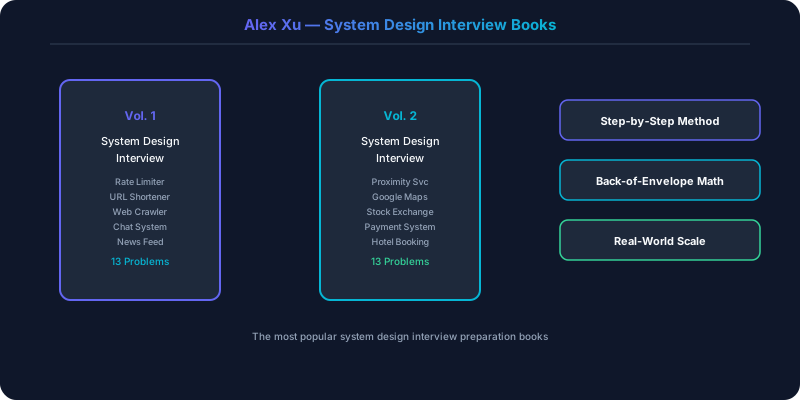
Volume 1 covers 13 system design problems, progressing from simpler to more complex:
Chapter 1: Scale from Zero to Millions provides the foundation — single server, database, load balancer, cache, CDN, stateless architecture, data centers, message queues, database sharding. This chapter is essentially a compressed system design course that shows how each component is added as scale grows.
Key system designs in Volume 1:
- Rate Limiter — Token bucket, leaky bucket, fixed window, sliding window log, and sliding window counter algorithms. Distributed rate limiting with Redis.
- Consistent Hashing — Virtual nodes, hash ring, server addition/removal. How DynamoDB and Cassandra use it.
- URL Shortener — Base62 encoding, hash collision resolution, 301 vs 302 redirects, analytics tracking.
- Web Crawler — BFS crawling, URL frontier, politeness, deduplication, distributed architecture.
- Notification System — Push notifications (APNs, FCM), SMS, email. Rate limiting notifications. Retry and failure handling.
- News Feed — Fanout on write, fanout on read, hybrid approach. Cache architecture for feed rendering.
- Chat System — WebSocket connections, message delivery, group chat, online presence indicators. Storage for messages.
- Search Autocomplete — Trie data structure, distributed trie, data gathering pipeline, query optimization.
Each chapter follows a four-step framework: understand the problem and establish design scope, propose a high-level design, do a deep dive into key components, and wrap up with discussion points.
Volume 2: Advanced Systems
Volume 2 tackles more complex systems that require deeper distributed systems knowledge:
- Proximity Service — Geospatial indexing with geohash, quadtree, and Google S2. Location-based search at scale.
- Nearby Friends — Real-time location sharing using WebSocket, Redis Pub/Sub, and geohash-based subscriptions.
- Google Maps — Tile-based map rendering, routing algorithms (Dijkstra, A*), ETA computation, real-time traffic.
- Distributed Message Queue — Building Kafka-like systems. Partitioning, replication, consumer groups, delivery guarantees.
- Metrics Monitoring — Time-series databases (InfluxDB, Prometheus), data model, query optimization, alerting pipeline.
- Ad Click Event Aggregation — Real-time aggregation with MapReduce, exactly-once processing, data reconciliation.
- Hotel Reservation — Inventory management, overbooking handling, distributed locking for room allocation.
- Email Service — SMTP, receiving pipeline, spam filtering, search indexing, storage architecture.
- S3-like Object Storage — Data placement, erasure coding, metadata management, garbage collection.
- Real-time Gaming Leaderboard — Sorted sets in Redis, range queries, distributed leaderboard across regions.
- Stock Exchange — Matching engine, order book, sequencer architecture, ultra-low latency design.
- Payment System — Payment flow, idempotency, exactly-once payment, reconciliation, ledger design.
- Digital Wallet — Event sourcing, CQRS, audit trail, balance computation, distributed transactions.
Volume 2 is notably harder than Volume 1. The systems require understanding of distributed consensus, real-time processing, and domain-specific constraints (financial regulations, gaming physics, geospatial algorithms).
Strengths
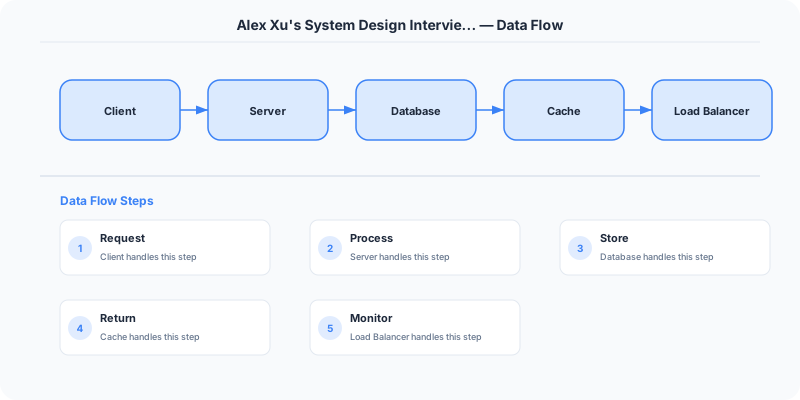
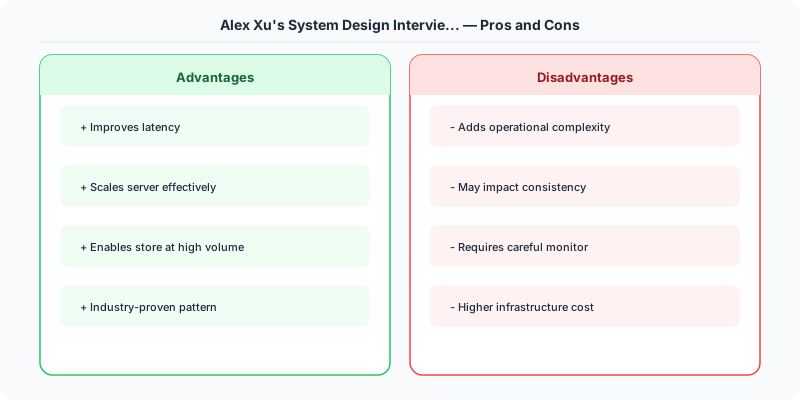
Structured framework. The four-step approach (scope, high-level design, deep dive, wrap-up) is directly applicable in interviews. Practicing with this framework builds the muscle memory of structured system design thinking.
Practical scope. The books cover the exact systems that appear in interviews at major companies. URL shorteners, chat systems, news feeds, and notification systems are among the most common interview questions.
Back-of-the-envelope calculations. Each chapter includes estimation sections that teach you to compute storage requirements, QPS, bandwidth, and server counts. This skill is critical in interviews and rarely taught elsewhere.
Diagrams and visual explanations. Every chapter includes clear architecture diagrams showing data flow, component interactions, and scaling strategies. The diagrams are designed to be recreatable on a whiteboard.
Progressive difficulty. Volume 1 starts with simpler systems and builds to more complex ones. Volume 2 assumes familiarity with the fundamentals from Volume 1.
Weaknesses
Presents a single solution without alternatives. Each chapter shows one design. A real interview rewards candidates who can discuss multiple approaches and articulate why they chose one over another. Supplementing with other resources that discuss alternative designs is important.
Limited depth on underlying algorithms. The books explain what to use (consistent hashing, Bloom filters, LSM trees) but not the mathematical foundations. Engineers who want to understand why these algorithms work need DDIA or academic papers.
Somewhat formulaic. After reading several chapters, the four-step pattern can feel repetitive. The framework is useful but can lead to mechanical interviews if followed too rigidly. The best candidates adapt their approach to the specific problem.
Missing operational concerns. The books focus on architecture and data flow but spend less time on monitoring, alerting, deployment strategies, and incident response — topics that come up in senior-level interviews.
How to Use These Books
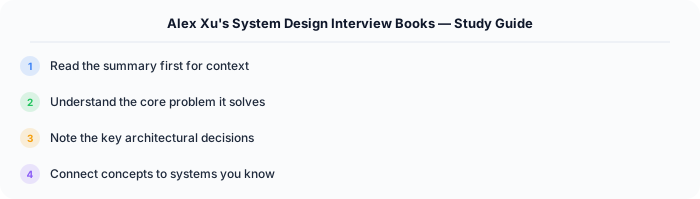
For 4-week prep: Read Volume 1 cover to cover, spending one day per chapter. Attempt each design before reading the solution. After finishing the book, redo the designs from memory.
For 8-week prep: Read both volumes. After each chapter, research the real-world implementation (Netflix's CDN, Uber's matching system) and compare it to the book's design. This builds the depth that separates good candidates from great ones.
As a reference during study: When practicing system design with a partner, use the books' scoping questions and requirements as starting points. Then compare your design to the book's solution.
The Alex Xu books are the most time-efficient system design interview preparation resources available. They are not the deepest (DDIA wins there) or the most visual (ByteByteGo wins there), but they are the most directly applicable to the interview format.
Practical Implementation for .NET Developers
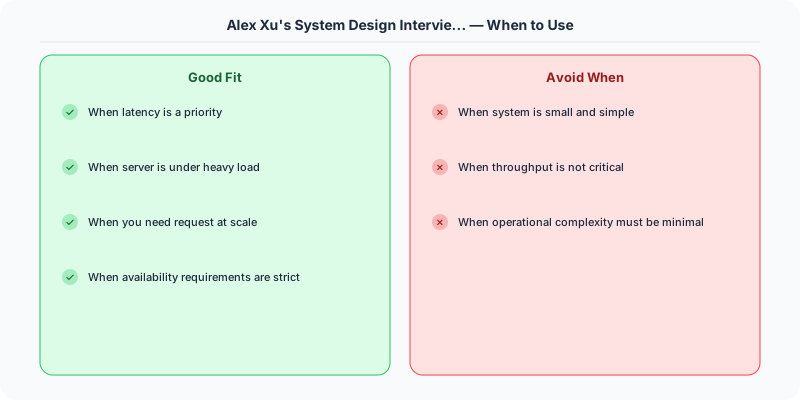
In a .NET application, you would typically implement this pattern using the following approach:
ASP.NET Core setup: Create a service class that encapsulates the logic, register it with dependency injection, and inject it into your controllers or minimal API endpoints. The built-in DI container handles lifecycle management.
Entity Framework Core: For database interactions, EF Core provides the ORM layer. Use migrations for schema management and raw SQL for performance-critical queries. Consider Dapper for read-heavy paths where EF Core's overhead matters.
Azure integration: If deploying to Azure, leverage managed services — Azure Cache for Redis, Azure SQL, Azure Service Bus, Azure Cosmos DB. These eliminate operational overhead and provide built-in monitoring through Application Insights.
Testing: Use xUnit with Testcontainers for integration tests that spin up real databases in Docker. Mock external dependencies with NSubstitute. The WebApplicationFactory class lets you test your entire HTTP pipeline in-process.
Monitoring: Add Application Insights telemetry to track request latency, dependency calls, and custom metrics. Use structured logging with Serilog to make production debugging possible:
Log.Information("Processing order {OrderId} for {CustomerId}", orderId, customerId);
This gives you searchable, structured logs in Azure Monitor or Seq.
Key Takeaways for Interviews
- Understand the core problem this resource addresses and be able to explain it in 2-3 sentences without jargon
- Know the key trade-offs: what does this approach optimize for, and what does it sacrifice?
- Be ready to compare this with alternative approaches and explain when each is appropriate
- Connect the concepts to real-world systems you have worked with or studied
- Demonstrate depth by discussing failure modes and how they are handled
How This Applies to Modern .NET Systems
The concepts from this resource translate to .NET through several established libraries and patterns:
Azure managed services often abstract away the underlying distributed systems complexity, but understanding the fundamentals helps you configure them correctly, debug issues, and make informed architectural decisions.
NuGet packages in the .NET ecosystem provide production-ready implementations of many patterns described in this resource. Before building custom solutions, check if a well-maintained package already exists.
ASP.NET Core middleware pipeline is where many of these patterns are implemented in practice: caching, rate limiting, health checks, and circuit breaking all fit naturally into the middleware model.