Merkle Trees
Learn Merkle Trees — hash-based tree structures that enable efficient data verification, tamper detection, and synchronization in distributed systems and.
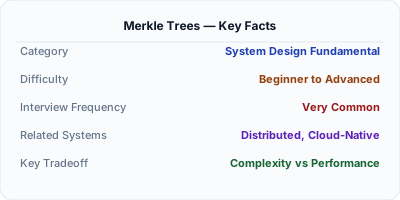
A Merkle tree is a binary tree where each leaf node contains a hash of a data block and each internal node contains a hash of its children's hashes. The root hash — a single value — summarizes the entire dataset. If any data block changes, its hash changes, cascading up through the tree to produce a different root hash. This structure enables two critical capabilities: detecting any modification to the data by checking the root hash, and identifying exactly which blocks differ by comparing only O(log n) hashes rather than the entire dataset. Merkle trees are foundational in blockchains, distributed databases, and version control systems.
| Aspect | Details |
|---|---|
| What it is | A hash tree where each node is a cryptographic hash of its children, enabling efficient data verification and difference detection in O(log n) comparisons |
| When to use | When you need to verify data integrity across untrusted networks, synchronize replicas efficiently, or detect tampering without comparing full datasets |
| When NOT to use | When the dataset is small enough that full comparison is faster than building and traversing tree structures, or when data changes so frequently the tree must be constantly rebuilt |
| Real-world example | Amazon DynamoDB uses Merkle trees for anti-entropy — comparing replicas and synchronizing only the differing partitions instead of transferring complete datasets |
| Interview tip | Draw a Merkle tree, show how a single changed leaf propagates to the root, and explain the O(log n) verification path — visual demonstration is powerful |
| Common mistake | Building Merkle trees with non-cryptographic hash functions in security-sensitive applications — MD5 or CRC32 can be collision-attacked to forge matching hashes |
| Key tradeoff | Verification speed vs. construction cost — Merkle trees make verification O(log n) but building the tree requires O(n) hash computations upfront |
Why This Matters
Distributed systems face a fundamental challenge: how do you verify that data on one node matches data on another without transferring the entire dataset? A naive approach compares every byte, requiring O(n) data transfer. Merkle trees reduce this to O(log n) by recursively halving the search space. Two nodes exchange root hashes — if they match, the data is identical. If they differ, they compare children, then grandchildren, quickly narrowing down to the specific blocks that differ. This is how DynamoDB and Cassandra synchronize replicas, how Git detects file changes, how BitTorrent verifies downloaded pieces, and how every blockchain validates transaction integrity. The Merkle tree is one of the most elegant data structures in computer science.
The Building Blocks
- Leaf Nodes: Hashes of individual data blocks — each leaf represents one piece of data (a file chunk, a database partition, a transaction) hashed with SHA-256 or similar
- Internal Nodes: Hashes computed by concatenating and hashing their children's hashes, creating a recursive chain of verification from leaves to root
- Root Hash: The single hash at the top of the tree that summarizes the entire dataset — any change anywhere in the data produces a different root hash
- Verification Path: The O(log n) set of sibling hashes needed to prove that a specific leaf belongs to a tree with a given root, without revealing the entire tree
- Anti-Entropy Repair: Using Merkle tree comparison between replicas to identify and synchronize only the differing data blocks, minimizing network transfer during repair
Under the Hood
A Merkle tree is constructed bottom-up. Given n data blocks, compute the hash of each block to create n leaf nodes. Then pair adjacent leaves and hash the concatenation of each pair to create the parent level. Continue until a single root hash remains. For a dataset of 1 million blocks, the tree has about 20 levels (log2 of 1,000,000), meaning any verification requires at most 20 hash comparisons.
The verification path (also called a Merkle proof) is remarkably efficient. To prove that block B exists in a tree with root R, you provide B, its hash, and the sibling hash at each level up to the root — about 20 hashes for a million-block tree. The verifier recomputes hashes up the tree and checks that the result matches R. This is how light clients in blockchains verify transactions without downloading the entire chain — they only need the block headers (containing root hashes) and the Merkle proof for their transactions.
For anti-entropy in databases like Cassandra and DynamoDB, each replica maintains a Merkle tree over its data partitions. During synchronization, replicas compare root hashes. If roots match, no action needed. If they differ, the comparison descends level by level, identifying only the partitions that have diverged. Only those partitions are transferred and reconciled. This approach transforms an O(n) full-scan synchronization into an O(log n) targeted repair, making it practical to continuously verify consistency across thousands of replicas with minimal network overhead.
How Companies Actually Do This
Amazon DynamoDB uses Merkle trees for anti-entropy repair between replicas, comparing partition trees to identify and synchronize only the data ranges that have diverged across storage nodes
Bitcoin Every block contains a Merkle root of its transactions, enabling SPV (Simplified Payment Verification) clients to verify specific transactions without downloading the entire 500+ GB blockchain
Git Uses Merkle tree structures (tree objects containing hashes of blobs and subtrees) to efficiently detect which files changed between commits and verify repository integrity
Common Pitfalls
- Using weak hash functions (MD5, CRC32) for Merkle trees in security-sensitive applications — collision attacks can forge data blocks that produce the same hash as legitimate ones
- Not handling odd numbers of leaf nodes consistently — padding or duplicating the last leaf affects tree structure and must be agreed upon by all participants
- Rebuilding the entire tree on every data change instead of incrementally updating only the affected path — wastes O(n) computation when O(log n) suffices
Interview Questions Worth Practicing
- How does a Merkle tree enable verification of data integrity in O(log n) time instead of O(n)?
- How do distributed databases like Cassandra use Merkle trees for anti-entropy repair between replicas?
- What is a Merkle proof and how do blockchain light clients use it to verify transactions?
The Tradeoffs
- Verification Speed vs. Build Cost: Merkle trees enable O(log n) verification but require O(n) hash computations to construct initially
- Tree Depth vs. Fan-out: Binary trees maximize depth (more comparisons) but are simplest; wider fan-out reduces depth but increases per-node comparison cost
- Hash Strength vs. Performance: Cryptographic hashes (SHA-256) provide collision resistance for security; faster hashes (xxHash) suit internal synchronization where adversarial resistance is unnecessary
How to Explain This in an Interview
Here is how I would explain Merkle Trees in a system design interview:
A Merkle tree is a hash tree where each leaf hashes a data block and each internal node hashes its children. The root hash summarizes the entire dataset — any change anywhere produces a different root. The key insight is efficiency: to verify a single block or find differences between two datasets, you only need O(log n) comparisons instead of checking every block. DynamoDB and Cassandra use Merkle trees for anti-entropy — replicas compare root hashes, descend where they differ, and synchronize only the divergent partitions. Blockchains use Merkle proofs to let light clients verify transactions with just 20 hashes instead of the full chain. I would use SHA-256 for security-sensitive applications and faster hashes like xxHash for internal replica synchronization.
Related Topics
The Real-World Incident That Made This Famous
Understanding Merkle Trees became critical after multiple high-profile production incidents at major tech companies. When systems handle millions of users, even small misunderstandings about Merkle Trees can lead to cascading failures that cost millions in lost revenue and erode user trust. Companies like Netflix, Google, Amazon, and Meta have all invested heavily in mastering Merkle Trees because they learned the hard way that ignoring it leads to outages.
The key lesson from these incidents: Merkle Trees is not just a theoretical concept — it is a practical skill that separates engineers who build resilient systems from those who build fragile ones. Every major outage report from the past decade involves at least one Merkle Trees-related design decision that was either implemented incorrectly or overlooked entirely during the initial architecture review.
How Senior Engineers Think About This
Senior engineers approach Merkle Trees differently from textbook definitions. Instead of memorizing rules, they build mental models. They ask: "What problem does Merkle Trees solve? When does it fail? What are the alternatives?" This problem-first thinking leads to better design decisions because every system has unique constraints.
When evaluating Merkle Trees in a system design context, experienced engineers consider the failure modes first. What happens when this component goes down? How does the system degrade? Is the degradation graceful or catastrophic? These questions reveal more about your understanding than any textbook definition.
The key difference between junior and senior engineers when it comes to Merkle Trees: juniors focus on the happy path, while seniors design for what happens when things go wrong. They consider operational cost, team expertise, monitoring requirements, and how the decision will look six months from now when traffic has grown 10x.
Common Interview Mistakes
Mistake 1: Giving a textbook definition without context. Interviewers want to see you connect Merkle Trees to real systems and real problems. Instead of reciting definitions, explain when and why you would use Merkle Trees in the system you are designing.
Mistake 2: Not discussing trade-offs. Every design decision involving Merkle Trees has trade-offs. Discuss what you gain and what you give up. Acknowledge the downsides and explain why the benefits outweigh them for your specific use case.
Mistake 3: Overcomplicating the solution. Start with the simplest approach to Merkle Trees that meets the requirements, then add complexity only when justified. Many candidates jump to complex implementations when a simpler solution would work perfectly.
Production Checklist
- Define clear metrics for measuring the effectiveness of your Merkle Trees implementation
- Set up monitoring and alerting that specifically tracks Merkle Trees-related failures
- Document your Merkle Trees design decisions in Architecture Decision Records (ADRs)
- Test failure scenarios related to Merkle Trees in staging before production deployment
- Review and update your Merkle Trees implementation quarterly as system requirements evolve
- Train new team members on the specific Merkle Trees patterns used in your system
- Establish runbooks for common Merkle Trees-related incidents and recovery procedures
Practical Implementation for .NET Developers
In .NET, Merkle trees are implemented using System.Security.Cryptography.SHA256 (or IncrementalHash for streaming). There is no built-in Merkle tree class, but the pattern is straightforward: hash leaf data with SHA256.HashData(), pair and hash upward. The MerkleTools NuGet package provides a ready-made implementation. For blockchain applications, Nethereum includes Merkle proof verification. For data synchronization scenarios, Azure Cosmos DB internally uses Merkle-like structures for conflict resolution. .NET's Span<byte> and stackalloc enable zero-allocation hash computation for performance-critical tree construction.
ASP.NET Core setup: Create a service class that encapsulates the logic, register it with dependency injection, and inject it into your controllers or minimal API endpoints. The built-in DI container handles lifecycle management.
Entity Framework Core: For database interactions, EF Core provides the ORM layer. Use migrations for schema management and raw SQL for performance-critical queries. Consider Dapper for read-heavy paths where EF Core overhead matters.
Azure integration: If deploying to Azure, leverage managed services — Azure Cache for Redis, Azure SQL, Azure Service Bus, Azure Cosmos DB. These eliminate operational overhead and provide built-in monitoring through Application Insights.
Testing: Use xUnit with Testcontainers for integration tests that spin up real databases in Docker. Mock external dependencies with NSubstitute. The WebApplicationFactory class lets you test your entire HTTP pipeline in-process.
Monitoring: Add Application Insights telemetry to track request latency, dependency calls, and custom metrics. Use structured logging with Serilog to make production debugging possible:
Log.Information("Processing {Operation} for {ResourceId}", operation, resourceId);
This gives you searchable, structured logs in Azure Monitor or Seq.