MapReduce
Learn MapReduce — the parallel data processing paradigm that splits computation across distributed nodes using map and reduce phases, pioneered by Google.
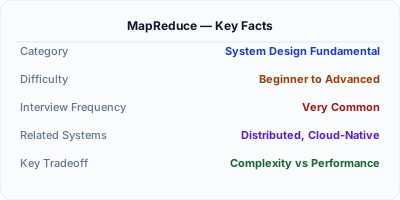
MapReduce is a programming model for processing massive datasets in parallel across a distributed cluster. It breaks computation into two phases: the Map phase applies a function to each input record independently, producing intermediate key-value pairs, and the Reduce phase aggregates all values sharing the same key. This simple abstraction — map then reduce — handles the complexity of parallelization, data distribution, fault tolerance, and load balancing automatically. Google invented MapReduce to build their search index, and it became the foundation for Hadoop and modern big data processing.
| Aspect | Details |
|---|---|
| What it is | A distributed computing paradigm that processes large datasets in parallel by splitting work into independent map tasks and aggregating results in reduce tasks |
| When to use | When processing terabytes to petabytes of data that cannot fit on a single machine — log analysis, index building, ETL pipelines, large-scale aggregation |
| When NOT to use | When you need real-time or low-latency results — MapReduce is batch-oriented with high startup overhead; use stream processing (Kafka Streams, Flink) instead |
| Real-world example | Google's original MapReduce paper described processing 20+ petabytes per day for web indexing, PageRank computation, and building the search index |
| Interview tip | Walk through a concrete word-count example showing map emitting (word, 1) pairs and reduce summing them — then discuss fault tolerance and data locality |
| Common mistake | Using MapReduce for small datasets that fit in memory on a single machine — the coordination overhead far exceeds the computation time |
| Key tradeoff | Simplicity vs. efficiency — MapReduce's two-phase model is easy to reason about but forces multiple disk writes between phases, making it slower than modern engines |
Why This Matters
Before MapReduce, processing terabytes of data required custom distributed systems expertise — managing parallelism, handling node failures, and coordinating data movement. MapReduce democratized large-scale data processing by providing a simple contract: write a map function and a reduce function, and the framework handles everything else. The map function processes input records independently (embarrassingly parallel), and the reduce function aggregates intermediate results. The framework automatically distributes data to nodes, re-executes failed tasks on other nodes, and optimizes data locality by moving computation to where data resides. While modern systems like Spark and Flink have largely superseded MapReduce for performance-sensitive workloads, the map-reduce paradigm remains one of the most influential ideas in distributed computing and directly influenced the design of every subsequent big data framework.
The Building Blocks
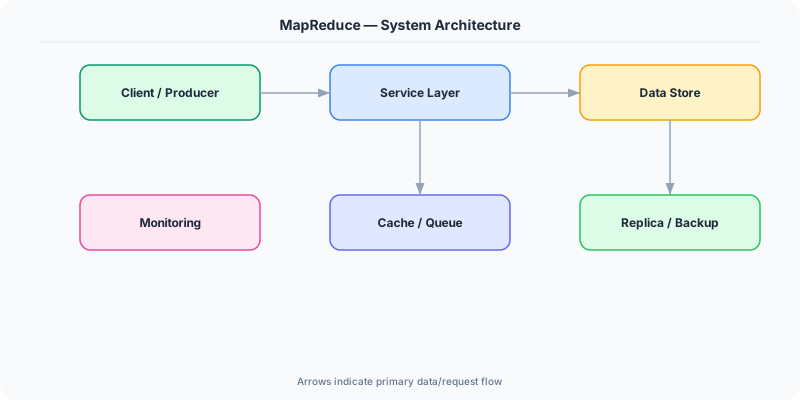
- Map Phase: Each mapper processes a split of input data independently, applying a user-defined function that emits intermediate key-value pairs for further processing
- Shuffle and Sort: The framework partitions, sorts, and transfers intermediate key-value pairs across the network so that all values for the same key arrive at the same reducer
- Reduce Phase: Each reducer receives all values for a given key and applies an aggregation function — sum, count, max, join — producing the final output
- Fault Tolerance: The master tracks task progress and re-schedules failed map or reduce tasks on other nodes, leveraging input data replication for map task re-execution
- Data Locality: The scheduler assigns map tasks to nodes that already hold the input data, minimizing network transfer by moving computation to data rather than data to computation
Under the Hood
A MapReduce job begins when the framework splits input data (stored in a distributed file system like HDFS) into chunks, typically 64-128MB each. The master node assigns each chunk to a mapper. Mappers read their chunk, apply the user's map function to each record, and write intermediate key-value pairs to local disk partitioned by key range (determined by a hash function).
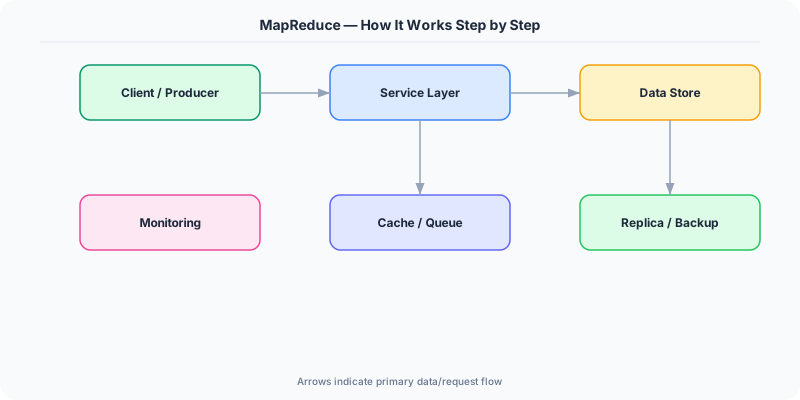
The shuffle phase is the most network-intensive operation. Reducers pull their assigned key partitions from every mapper across the network, then sort the key-value pairs so that all values for the same key are contiguous. This sorted merge enables the reduce function to process one key at a time without holding the entire dataset in memory. The reduce function receives a key and an iterator over its values, producing zero or more output records written to the distributed file system.
Fault tolerance is achieved through deterministic re-execution. If a mapper fails, its task is reassigned to another node that reads the same input split from HDFS replicas. If a reducer fails, its key partition is reassigned. Since map functions are pure (deterministic, no side effects), re-execution produces identical output. The master detects failures through heartbeats and reschedules within seconds. Modern successors like Apache Spark improve on MapReduce by keeping intermediate data in memory instead of writing to disk, providing 10-100x speedup for iterative algorithms. However, Spark's RDD transformations are still fundamentally map and reduce operations.
How Companies Actually Do This
Google Invented MapReduce to process the entire web for search indexing, running thousands of MapReduce jobs daily processing over 20 petabytes of data across their infrastructure
Facebook Used Hadoop MapReduce extensively for data warehouse operations, processing petabytes of user activity logs for analytics and ad targeting before migrating to Spark and Presto
Yahoo Built and open-sourced Apache Hadoop, the first widely available MapReduce implementation, which became the foundation of the entire big data ecosystem
Common Pitfalls
- Using MapReduce for iterative algorithms (machine learning, graph processing) where intermediate results are written to disk between iterations — Spark keeps data in memory and is 10-100x faster
- Not leveraging combiners (mini-reducers that run on mapper nodes) to reduce shuffle data volume — a word count without a combiner sends every (word, 1) pair across the network
- Ignoring data skew where one key has millions of values while others have few — a single overloaded reducer becomes the bottleneck for the entire job
Interview Questions Worth Practicing
- Walk through how a MapReduce word count works, including the shuffle and sort phase between map and reduce.
- How does MapReduce achieve fault tolerance when a mapper or reducer node fails mid-computation?
- Why did Spark largely replace MapReduce, and what fundamental limitation of MapReduce does Spark address?
The Tradeoffs
- Simplicity vs. Performance: The two-phase model is easy to understand and implement but forces disk writes between phases, adding latency that in-memory frameworks avoid
- Fault Tolerance vs. Speed: Writing intermediate data to disk enables re-execution on failure but is 10-100x slower than in-memory processing for iterative workloads
- Batch vs. Real-Time: MapReduce excels at large-scale batch processing but has minutes of startup overhead, making it unsuitable for real-time or interactive queries
How to Explain This in an Interview
Here is how I would explain MapReduce in a system design interview:
MapReduce is a distributed computing paradigm with two phases: Map applies a function to each input record independently, emitting key-value pairs, and Reduce aggregates all values per key. The framework handles parallelization, data distribution, and fault tolerance — if a node fails, its tasks are re-executed on another node. The shuffle phase between map and reduce transfers intermediate data across the network, sorted by key. Data locality is critical — the scheduler runs mappers on nodes holding the input data. MapReduce's limitation is writing intermediate results to disk, making it slow for iterative algorithms. Apache Spark addresses this by keeping data in memory, providing 10-100x speedup. Despite this, the map-reduce paradigm remains foundational to all modern big data frameworks.
Related Topics
The Real-World Incident That Made This Famous
Understanding MapReduce became critical after multiple high-profile production incidents at major tech companies. When systems handle millions of users, even small misunderstandings about MapReduce can lead to cascading failures that cost millions in lost revenue and erode user trust. Companies like Netflix, Google, Amazon, and Meta have all invested heavily in mastering MapReduce because they learned the hard way that ignoring it leads to outages.
The key lesson from these incidents: MapReduce is not just a theoretical concept — it is a practical skill that separates engineers who build resilient systems from those who build fragile ones. Every major outage report from the past decade involves at least one MapReduce-related design decision that was either implemented incorrectly or overlooked entirely during the initial architecture review.
How Senior Engineers Think About This
Senior engineers approach MapReduce differently from textbook definitions. Instead of memorizing rules, they build mental models. They ask: "What problem does MapReduce solve? When does it fail? What are the alternatives?" This problem-first thinking leads to better design decisions because every system has unique constraints.
When evaluating MapReduce in a system design context, experienced engineers consider the failure modes first. What happens when this component goes down? How does the system degrade? Is the degradation graceful or catastrophic? These questions reveal more about your understanding than any textbook definition.
The key difference between junior and senior engineers when it comes to MapReduce: juniors focus on the happy path, while seniors design for what happens when things go wrong. They consider operational cost, team expertise, monitoring requirements, and how the decision will look six months from now when traffic has grown 10x.
Common Interview Mistakes
Mistake 1: Giving a textbook definition without context. Interviewers want to see you connect MapReduce to real systems and real problems. Instead of reciting definitions, explain when and why you would use MapReduce in the system you are designing.
Mistake 2: Not discussing trade-offs. Every design decision involving MapReduce has trade-offs. Discuss what you gain and what you give up. Acknowledge the downsides and explain why the benefits outweigh them for your specific use case.
Mistake 3: Overcomplicating the solution. Start with the simplest approach to MapReduce that meets the requirements, then add complexity only when justified. Many candidates jump to complex implementations when a simpler solution would work perfectly.
Production Checklist
- Define clear metrics for measuring the effectiveness of your MapReduce implementation
- Set up monitoring and alerting that specifically tracks MapReduce-related failures
- Document your MapReduce design decisions in Architecture Decision Records (ADRs)
- Test failure scenarios related to MapReduce in staging before production deployment
- Review and update your MapReduce implementation quarterly as system requirements evolve
- Train new team members on the specific MapReduce patterns used in your system
- Establish runbooks for common MapReduce-related incidents and recovery procedures
Practical Implementation for .NET Developers
In .NET, MapReduce concepts are expressed through PLINQ (Parallel LINQ) for single-machine parallelism: source.AsParallel().SelectMany(map).GroupBy(key).Select(reduce). For distributed MapReduce, .NET runs on Hadoop via the Microsoft.Hadoop.MapReduce SDK or Apache Spark via the .NET for Apache Spark library (Microsoft.Spark). Azure HDInsight supports .NET MapReduce jobs on managed Hadoop clusters. For modern distributed processing, Azure Synapse and Databricks provide Spark-based engines accessible from .NET. The TPL Dataflow library enables producer-consumer pipeline patterns similar to MapReduce stages.
ASP.NET Core setup: Create a service class that encapsulates the logic, register it with dependency injection, and inject it into your controllers or minimal API endpoints. The built-in DI container handles lifecycle management.
Entity Framework Core: For database interactions, EF Core provides the ORM layer. Use migrations for schema management and raw SQL for performance-critical queries. Consider Dapper for read-heavy paths where EF Core overhead matters.
Azure integration: If deploying to Azure, leverage managed services — Azure Cache for Redis, Azure SQL, Azure Service Bus, Azure Cosmos DB. These eliminate operational overhead and provide built-in monitoring through Application Insights.
Testing: Use xUnit with Testcontainers for integration tests that spin up real databases in Docker. Mock external dependencies with NSubstitute. The WebApplicationFactory class lets you test your entire HTTP pipeline in-process.
Monitoring: Add Application Insights telemetry to track request latency, dependency calls, and custom metrics. Use structured logging with Serilog to make production debugging possible:
Log.Information("Processing {Operation} for {ResourceId}", operation, resourceId);
This gives you searchable, structured logs in Azure Monitor or Seq.