BASE Properties
BASE (Basically Available, Soft state, Eventually consistent) is an alternative to ACID that relaxes consistency guarantees in favor of availability and.
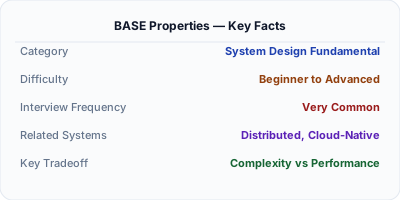
BASE stands for Basically Available, Soft state, and Eventually consistent — a set of properties that prioritize availability over immediate consistency in distributed systems. Unlike ACID, which guarantees strict consistency after every transaction, BASE accepts that data may be temporarily inconsistent across nodes but will converge to a consistent state over time. This model underpins most NoSQL databases and large-scale distributed systems where high availability and partition tolerance matter more than real-time consistency.
| Aspect | Details |
|---|---|
| What it is | A consistency model for distributed databases that trades immediate consistency for higher availability and partition tolerance |
| When to use | High-traffic distributed systems where brief inconsistency is acceptable, such as social media feeds, shopping carts, or analytics dashboards |
| When NOT to use | Financial transactions, inventory management with strict counts, or any domain where stale reads cause real monetary or safety harm |
| Real-world example | Amazon DynamoDB uses BASE properties to keep its shopping cart available across global regions even during network partitions |
| Interview tip | Always contrast BASE with ACID and tie it back to the CAP theorem — explain that BASE favors AP while ACID favors CP |
| Common mistake | Assuming eventually consistent means data will never be consistent — it will converge, the question is how long the window is |
| Key tradeoff | You gain availability and horizontal scalability but must handle stale reads, conflict resolution, and application-level consistency logic |
Why This Matters
BASE matters because most modern internet-scale applications cannot afford to sacrifice availability for perfect consistency. When you have millions of users across the globe, a strict ACID model forces synchronous coordination between nodes, creating latency and availability bottlenecks. BASE acknowledges that in distributed systems, temporary inconsistency is a practical reality and gives engineers a framework to reason about it. Understanding BASE is essential for designing systems that stay responsive under partition, handle conflict resolution gracefully, and scale horizontally without locking.
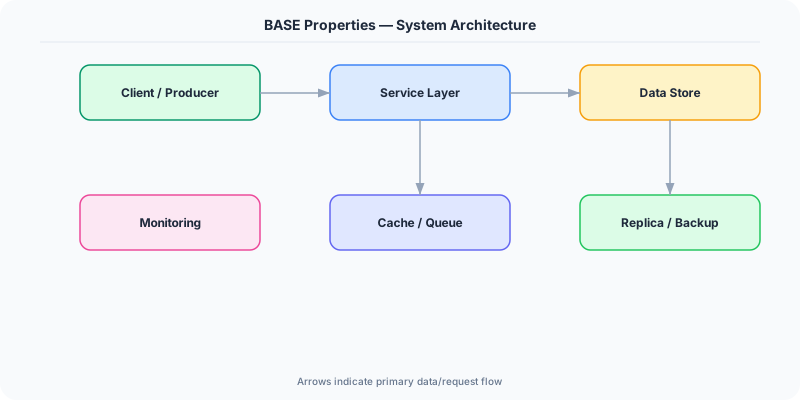
The Building Blocks
- Basically Available: The system guarantees a response for every request, even if the data returned might not be the most recent. Partial failures don't take down the whole system.
- Soft State: The state of the system may change over time even without new input, because data is still propagating between replicas and nodes in the background.
- Eventually Consistent: If no new updates are made, all replicas will converge to the same value after some period. The inconsistency window varies by system.
- Conflict Resolution: When concurrent writes happen on different replicas, strategies like last-write-wins, vector clocks, or CRDTs determine which value prevails.
- Tunable Consistency: Many BASE systems let you dial consistency per query — e.g., DynamoDB's strong vs eventual read, or Cassandra's quorum levels — giving fine-grained control.
Under the Hood
BASE properties emerge from the realities of distributed data storage. When a write arrives at one node, it's acknowledged locally and then asynchronously replicated to other nodes. During this replication window, different nodes may return different values for the same key. The system remains available because no node waits for all replicas to confirm before responding.
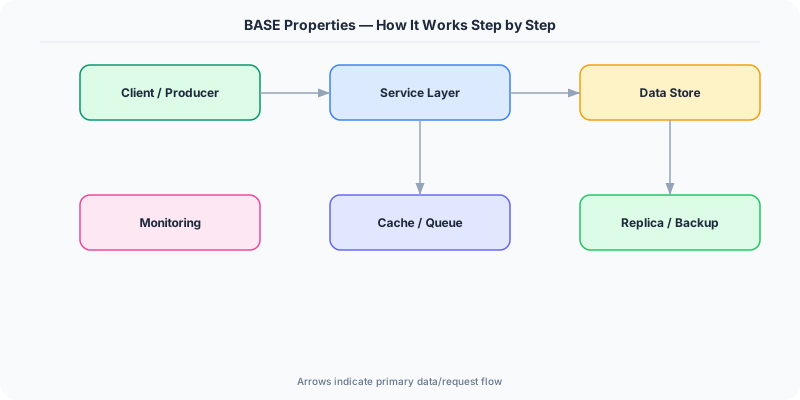
Under the hood, eventual consistency is maintained through anti-entropy mechanisms. Systems use techniques like read repair (fixing stale data when it's read), hinted handoff (queuing writes for temporarily unavailable nodes), and Merkle trees (efficiently detecting divergence between replicas). These background processes continuously reconcile differences.
The soft state aspect means the system must handle the fact that data in memory or on a single node is transient until fully propagated. Applications built on BASE must be designed to tolerate stale reads — for example, showing a slightly outdated follower count is acceptable, but showing a wrong bank balance is not. This is why choosing between BASE and ACID is fundamentally an application-domain decision.
How Companies Actually Do This
Amazon DynamoDB uses BASE with tunable consistency — applications choose between eventual and strong reads per query, enabling the shopping cart to remain available across all regions even during network partitions.
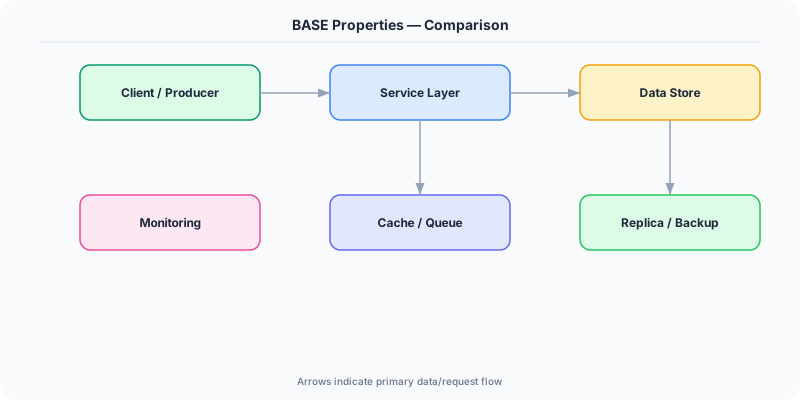
Netflix Uses Cassandra (a BASE-oriented database) for its viewing history and recommendations, accepting that a user might briefly see slightly stale recommendations in exchange for global availability across 190+ countries.
Twitter The timeline service relies on eventually consistent caches and data stores so that tweets propagate to followers' timelines within seconds rather than requiring synchronous global writes that would cripple throughput.
Common Pitfalls
- Treating eventual consistency as 'instant' — developers write code assuming replicas sync in milliseconds, but under load or partition the window can stretch to seconds or minutes, causing visible bugs
- Not implementing conflict resolution — if two users update the same record on different replicas, you need an explicit strategy (LWW, vector clocks, CRDTs) or you'll silently lose writes
- Using BASE for data that requires ACID — choosing eventual consistency for financial balances or inventory counts leads to overselling, double-spending, or lost money
Interview Questions Worth Practicing
- How would you explain the difference between ACID and BASE to a non-technical stakeholder?
- In a distributed e-commerce system, which parts would you model with BASE properties and which require ACID? Why?
- How does eventual consistency interact with the CAP theorem, and what happens during a network partition in a BASE system?
The Tradeoffs
- Consistency vs Availability: BASE sacrifices immediate consistency to stay available during partitions — you must handle stale reads at the application layer
- Simplicity vs Scalability: ACID is simpler to reason about but BASE enables horizontal scaling across regions without expensive distributed transactions
- Latency vs Correctness: BASE responds faster by not waiting for all replicas, but the response may reflect an older state of the data
How to Explain This in an Interview
Here is how I would explain BASE Properties in a system design interview:
In an interview, explain BASE by contrasting it with ACID. Say that ACID guarantees every transaction is immediately consistent, but that's expensive in distributed systems because you need coordination across nodes. BASE relaxes this — the system is basically available (always responds), has soft state (data may be in flux), and is eventually consistent (replicas converge over time). Give a concrete example: a social media like count doesn't need to be perfectly accurate in real-time, so BASE works great. But a bank transfer does, so you'd use ACID there. Emphasize that BASE isn't inferior to ACID — it's a deliberate architectural choice driven by CAP theorem tradeoffs, and most large-scale systems use both models for different data.
Related Topics
The Real-World Incident That Made This Famous
Understanding BASE Properties became critical after multiple high-profile production incidents at major tech companies. When systems handle millions of users, even small misunderstandings about BASE Properties can lead to cascading failures that cost millions in lost revenue and erode user trust. Companies like Netflix, Google, Amazon, and Meta have all invested heavily in mastering BASE Properties because they learned the hard way that ignoring it leads to outages.
The key lesson from these incidents: BASE Properties is not just a theoretical concept — it is a practical skill that separates engineers who build resilient systems from those who build fragile ones. Every major outage report from the past decade involves at least one BASE Properties-related design decision that was either implemented incorrectly or overlooked entirely during the initial architecture review.
How Senior Engineers Think About This
Senior engineers approach BASE Properties differently from textbook definitions. Instead of memorizing rules, they build mental models. They ask: "What problem does BASE Properties solve? When does it fail? What are the alternatives?" This problem-first thinking leads to better design decisions because every system has unique constraints.
When evaluating BASE Properties in a system design context, experienced engineers consider the failure modes first. What happens when this component goes down? How does the system degrade? Is the degradation graceful or catastrophic? These questions reveal more about your understanding than any textbook definition.
The key difference between junior and senior engineers when it comes to BASE Properties: juniors focus on the happy path, while seniors design for what happens when things go wrong. They consider operational cost, team expertise, monitoring requirements, and how the decision will look six months from now when traffic has grown 10x.
Common Interview Mistakes
Mistake 1: Giving a textbook definition without context. Interviewers want to see you connect BASE Properties to real systems and real problems. Instead of reciting definitions, explain when and why you would use BASE Properties in the system you are designing.
Mistake 2: Not discussing trade-offs. Every design decision involving BASE Properties has trade-offs. Discuss what you gain and what you give up. Acknowledge the downsides and explain why the benefits outweigh them for your specific use case.
Mistake 3: Overcomplicating the solution. Start with the simplest approach to BASE Properties that meets the requirements, then add complexity only when justified. Many candidates jump to complex implementations when a simpler solution would work perfectly.
Production Checklist
- Define clear metrics for measuring the effectiveness of your BASE Properties implementation
- Set up monitoring and alerting that specifically tracks BASE Properties-related failures
- Document your BASE Properties design decisions in Architecture Decision Records (ADRs)
- Test failure scenarios related to BASE Properties in staging before production deployment
- Review and update your BASE Properties implementation quarterly as system requirements evolve
- Train new team members on the specific BASE Properties patterns used in your system
- Establish runbooks for common BASE Properties-related incidents and recovery procedures
Practical Implementation for .NET Developers
In .NET, you encounter BASE properties when using distributed databases like Azure Cosmos DB. The Microsoft.Azure.Cosmos SDK lets you set consistency levels per request — from strong to eventual. You can configure the CosmosClient with ConsistencyLevel.Session for a balance, or ConsistencyLevel.Eventual for maximum throughput. When building event-driven systems with MassTransit or NServiceBus on top of eventually consistent stores, implement idempotent handlers and use the Outbox pattern to prevent duplicate processing during replication delays.
ASP.NET Core setup: Create a service class that encapsulates the logic, register it with dependency injection, and inject it into your controllers or minimal API endpoints. The built-in DI container handles lifecycle management.
Entity Framework Core: For database interactions, EF Core provides the ORM layer. Use migrations for schema management and raw SQL for performance-critical queries. Consider Dapper for read-heavy paths where EF Core overhead matters.
Azure integration: If deploying to Azure, leverage managed services — Azure Cache for Redis, Azure SQL, Azure Service Bus, Azure Cosmos DB. These eliminate operational overhead and provide built-in monitoring through Application Insights.
Testing: Use xUnit with Testcontainers for integration tests that spin up real databases in Docker. Mock external dependencies with NSubstitute. The WebApplicationFactory class lets you test your entire HTTP pipeline in-process.
Monitoring: Add Application Insights telemetry to track request latency, dependency calls, and custom metrics. Use structured logging with Serilog to make production debugging possible:
Log.Information("Processing {Operation} for {ResourceId}", operation, resourceId);
This gives you searchable, structured logs in Azure Monitor or Seq.