How Uber Handles Millions of Concurrent Rides
How Uber Handles Millions of Concurrent Rides
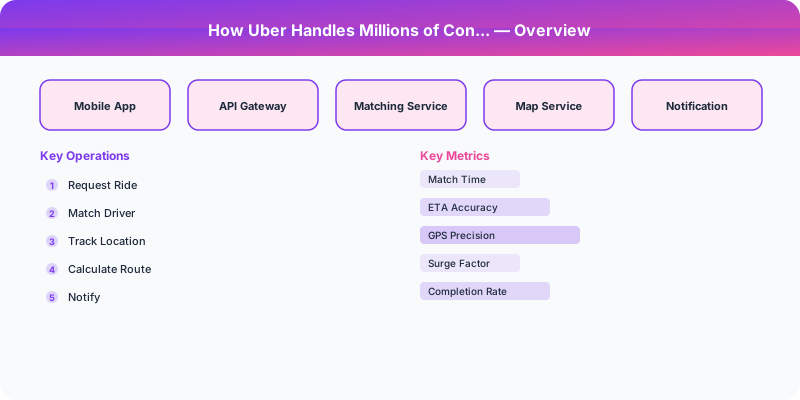
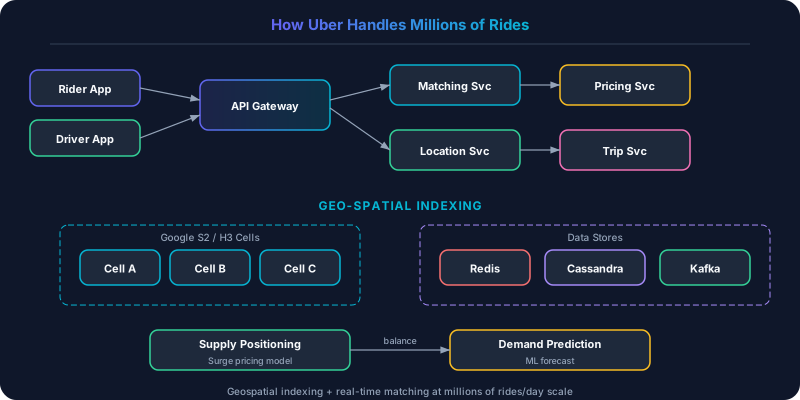
Uber processes over 20 million rides per day across 70 countries. At peak (New Year's Eve), they handle 1M+ concurrent rides simultaneously. This requires real-time geospatial processing, intelligent dispatch, and dynamic pricing — all with sub-second latency.
Core Technical Challenges
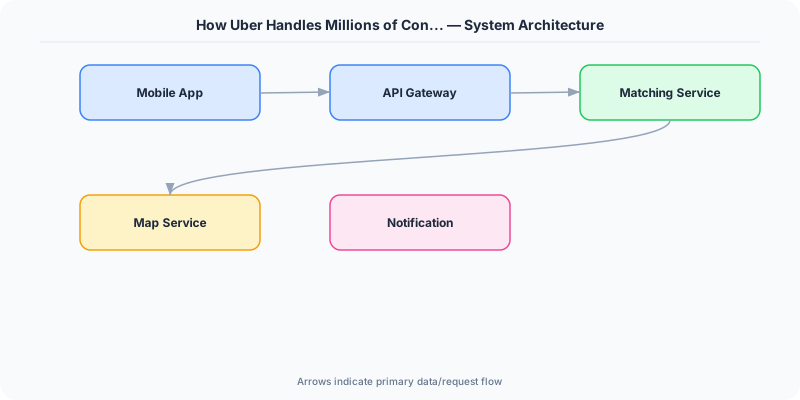
1. Geospatial Indexing: Where Are the Drivers?
5 million active drivers send GPS updates every 4 seconds. That is 1.25 million location updates per second. Uber needs to answer: "Which available drivers are within 5 minutes of this rider?"
Solution: Google S2 Geometry Library
Uber divides the Earth's surface into hierarchical cells using S2 (a spherical geometry library). Each cell has a unique 64-bit ID. Driver locations are indexed by their S2 cell ID.
Finding nearby drivers:
- Compute the S2 cell covering the rider's location
- Expand to neighboring cells (radius search)
- Look up drivers in those cells from an in-memory index
- Filter by availability, vehicle type, ETA
This is O(1) for cell lookup + O(K) for filtering K candidate drivers.
2. Dispatch: Matching Riders with Drivers
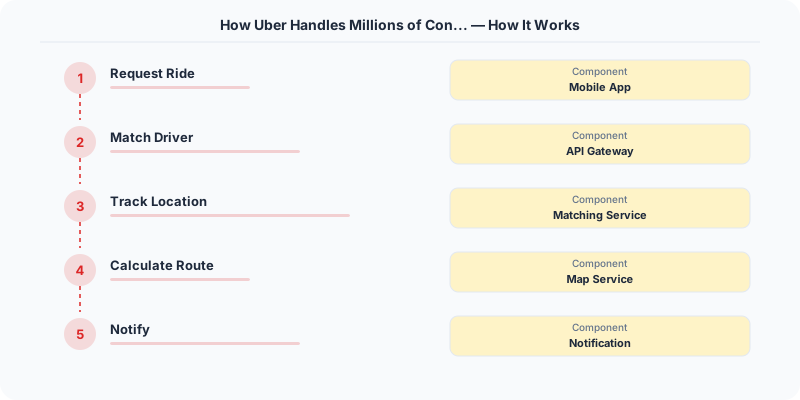
When a rider requests a ride, the dispatch system must find the optimal driver within seconds.
Algorithm:
- Query geospatial index for available drivers within radius
- Compute ETA from each driver to the rider (using road network graph, not straight-line distance)
- Score each driver: ETA + driver rating + supply/demand balance
- Send ride offer to the top-scored driver
- If driver declines (15-second timeout), offer to the next driver
At scale, Uber batches dispatch: every 2 seconds, the system considers ALL pending ride requests and ALL available drivers in a city, computing a globally optimal matching. This is better than greedy one-at-a-time matching because it can avoid sending a far driver to a near rider when a closer driver is about to become available.
3. Surge Pricing: Balancing Supply and Demand
When demand exceeds supply in a zone, Uber increases prices. This serves two purposes:
- Demand reduction: Some riders defer their trip
- Supply increase: Drivers are incentivized to drive to the surge zone
How it works:
- Each city is divided into hexagonal zones
- Every 1-2 minutes, compute: surge_multiplier = demand_requests / available_drivers per zone
- If ratio > 1.5x, apply surge. Multipliers range from 1.2x to 5x+
- Surge is displayed to the rider before they confirm
4. Reliable Payment Processing
Every ride involves a payment. Uber must guarantee:
- No double-charging (idempotency)
- No lost charges (durability)
- Correct fare calculation (distance + time + surge)
Uber uses a double-entry ledger system with idempotency keys. Each payment attempt has a unique ID. If the first attempt is ambiguous (timeout), the retry with the same ID returns the original result.
Key Takeaways
- S2 Geometry for geospatial: Hierarchical cell indexing is more efficient than naive distance calculations
- Batch dispatch outperforms greedy: Considering all requests and drivers together produces better matches
- Surge pricing is a market mechanism: It solves the supply/demand imbalance algorithmically
- Idempotency everywhere: Financial operations must be safely retryable
Sources
- Uber Engineering Blog: eng.uber.com
- System-Design-Overview
Putting This Into Practice
Understanding the theory is only half the battle. Here is how to apply these concepts in your daily work:
Start small. Pick one project or one component of your current system and apply the ideas from this article. Do not try to redesign everything at once.
Document your decisions. When you make an architectural choice, write a short ADR (Architecture Decision Record) explaining what you chose, why, and what alternatives you considered. Future you will thank present you.
Talk to your team. System design is a team sport. Share what you learn, discuss tradeoffs openly, and build shared understanding. The best architectures come from teams that communicate well, not from lone geniuses.
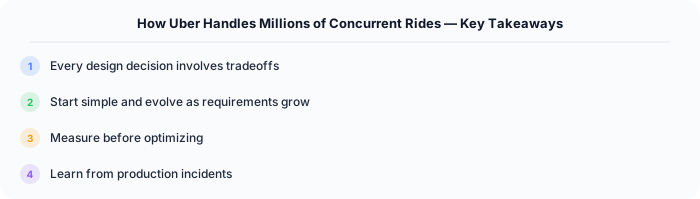
Key Takeaways
- Every design decision involves tradeoffs — there is no perfect solution
- Start simple and evolve as requirements grow
- Measure before optimizing — premature optimization wastes engineering time
- Learn from production incidents — they teach you more than any textbook
- Practice explaining your reasoning — this is what interviews test
The ETA Prediction Challenge

Predicting how long a ride will take sounds simple: distance divided by speed. But in practice, ETA prediction is one of Uber's hardest engineering problems. Traffic conditions change minute by minute. Construction zones, accidents, and weather all affect actual travel time. Rush hour patterns differ by city, day of week, and even holiday schedules.
Uber's ETA model uses a combination of historical GPS traces (millions of past trips on every road segment), real-time GPS data from active drivers (updated every 4 seconds), and external signals like traffic incidents and weather. The model predicts travel time for each road segment independently, then sums them along the optimal route.
Accuracy matters enormously: if the ETA is too short, riders get frustrated waiting. If too long, they might choose a competitor. Uber targets within 2 minutes of actual time for 90 percent of rides.
Payment at Scale
Every ride involves charging the rider and paying the driver — millions of financial transactions per day that must be exactly correct. Uber uses an idempotency-key system similar to Stripe: each payment attempt has a unique ID, and retrying with the same ID returns the original result without double-charging.
The fare itself is calculated from GPS data: the actual distance traveled and time elapsed, multiplied by per-mile and per-minute rates, plus any surge multiplier. Uber records the complete GPS trail of every ride for fare disputes and auditing.
Settlement with drivers happens weekly. Uber nets out the platform fee (typically 20-25 percent), deducts expenses, and transfers the balance to the driver's bank account. This settlement system processes payments in 70 or more countries with different banking systems, currencies, and tax requirements.
Practical Implementation for .NET Developers
In a .NET application, you would typically implement this pattern using the following approach:
ASP.NET Core setup: Create a service class that encapsulates the logic, register it with dependency injection, and inject it into your controllers or minimal API endpoints. The built-in DI container handles lifecycle management.
Entity Framework Core: For database interactions, EF Core provides the ORM layer. Use migrations for schema management and raw SQL for performance-critical queries. Consider Dapper for read-heavy paths where EF Core's overhead matters.
Azure integration: If deploying to Azure, leverage managed services — Azure Cache for Redis, Azure SQL, Azure Service Bus, Azure Cosmos DB. These eliminate operational overhead and provide built-in monitoring through Application Insights.
Testing: Use xUnit with Testcontainers for integration tests that spin up real databases in Docker. Mock external dependencies with NSubstitute. The WebApplicationFactory class lets you test your entire HTTP pipeline in-process.
Monitoring: Add Application Insights telemetry to track request latency, dependency calls, and custom metrics. Use structured logging with Serilog to make production debugging possible:
Log.Information("Processing order {OrderId} for {CustomerId}", orderId, customerId);
This gives you searchable, structured logs in Azure Monitor or Seq.
Explore More
What Most Articles Get Wrong
Most articles about Uber focus on the rider experience and ignore the driver dispatch system, which is arguably the most technically interesting part. The dispatch system is essentially a real-time marketplace matching problem: given N available drivers and M ride requests, find the optimal assignment that minimizes total wait time while considering fairness (no driver should go too long without a ride) and efficiency (batch nearby requests together).
Another common oversimplification is treating surge pricing as "just supply and demand." Uber's surge pricing algorithm uses H3 hexagonal grid cells to calculate supply-demand ratios at a hyperlocal level. A surge in downtown does not affect prices 2 miles away in a residential area. The algorithm also predicts future supply (drivers heading toward an area) and future demand (based on event schedules, weather, time patterns) to smooth out pricing spikes.
The Numbers That Matter
- 20+ million rides per day globally across Uber's platform
- 5 million active drivers sending GPS updates every 3-4 seconds = 1.25 million location updates per second
- Under 3 minutes average pickup ETA in major cities during normal demand
- H3 resolution 7 hexagons (approximately 5 km2) are used for geospatial indexing of driver locations
- $0.50 per trip in marketplace matching infrastructure cost (at scale, every millisecond of compute matters)
- 20% of trips are batched with another ride (UberPool/UberShare) using route optimization algorithms