How to Think in Tradeoffs
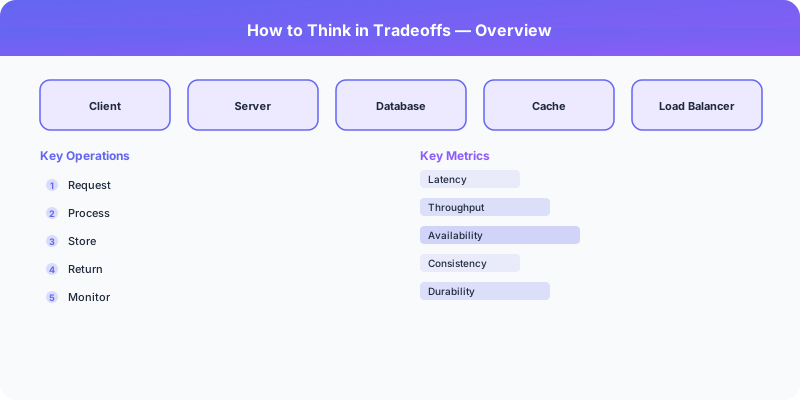
How to Think in Tradeoffs
Every system design decision is a tradeoff. There is no universally "best" database, no perfect caching strategy, no architecture that optimizes everything simultaneously. The skill that separates junior engineers from senior architects is the ability to identify competing concerns, evaluate them against concrete requirements, and make deliberate choices with clear reasoning.
The Tradeoff Identification Framework
Before evaluating solutions, name the competing forces. Most system design tradeoffs fall into recurring categories:
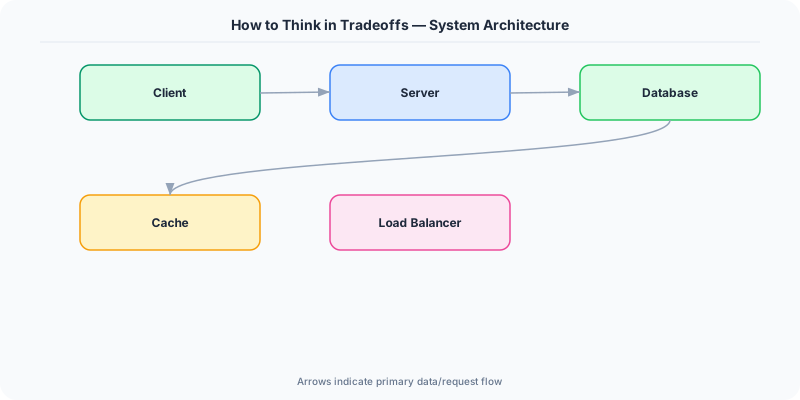
Consistency vs. Availability: The CAP theorem formalizes this, but the practical version is simpler — do you return stale data quickly (availability) or make the user wait for the latest data (consistency)? A social media feed can show slightly stale content. A bank balance cannot.
Latency vs. Throughput: Batching requests improves throughput (more work per second) but increases latency for individual requests. Real-time chat needs low latency. Batch analytics needs high throughput.
Simplicity vs. Flexibility: A monolith is simpler to deploy and debug. Microservices are more flexible to scale and evolve independently. The right choice depends on your team size and rate of change.
Cost vs. Performance: More replicas improve read performance but cost more. Caching reduces database load but adds operational complexity. Every performance optimization has a cost — sometimes financial, sometimes in complexity.
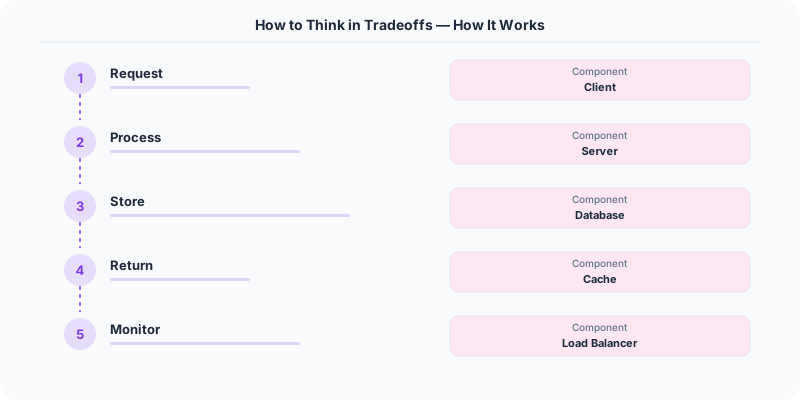
Write Speed vs. Read Speed: LSM-trees optimize writes; B-trees optimize reads. You cannot optimize both simultaneously without tradeoffs elsewhere (space, complexity).
The Evaluation Process
Once you have identified the competing concerns, evaluate them against concrete requirements, not abstract ideals.
Step 1: Quantify the requirements. "Fast" is not a requirement. "p99 latency under 200ms for reads" is. "Scalable" is vague. "Handle 10,000 writes per second with the ability to scale to 100,000" is specific.
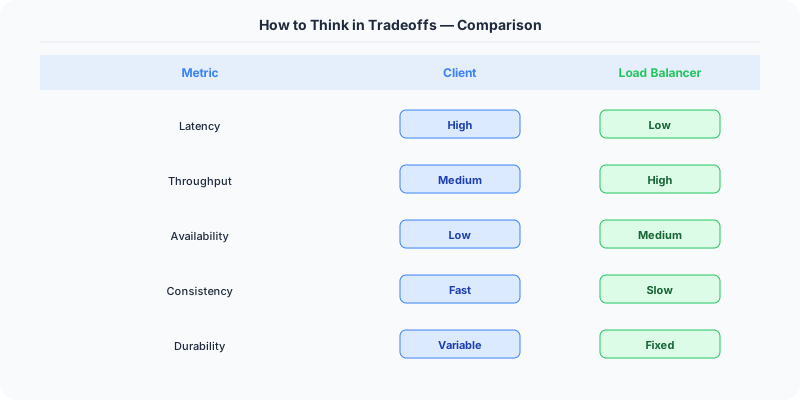
Step 2: Rank the concerns. Not all tradeoffs matter equally for your use case. If you are building a payment system, consistency is non-negotiable. If you are building a news feed, availability matters more. Write down which concerns are hard requirements vs. nice-to-haves.
Step 3: Build a decision matrix. List your options (e.g., PostgreSQL, Cassandra, DynamoDB) as rows. List your ranked concerns as columns. Score each option against each concern. This forces explicit reasoning rather than gut feelings or familiarity bias.
Step 4: Document the decision and the reasoning. Six months from now, someone (possibly you) will wonder why you chose Cassandra over PostgreSQL. The tradeoff analysis is the answer.
Applying This in Interviews
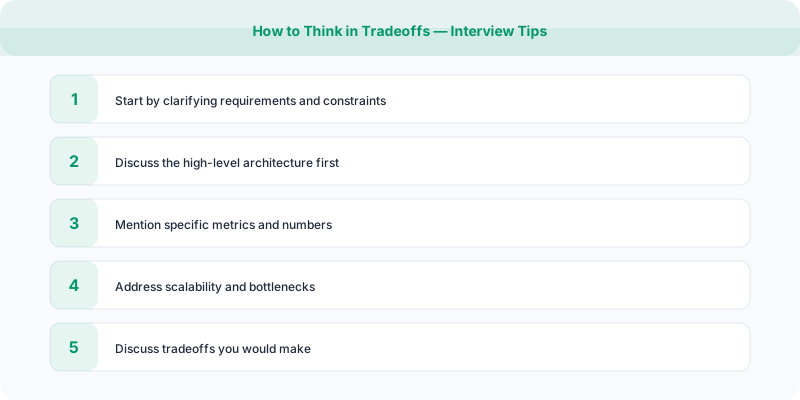
In a system design interview, saying "I would use Cassandra" is a weak answer. Saying "I would use Cassandra because our write volume is 50x our read volume, we can tolerate eventual consistency for this use case, and we need horizontal write scaling — which rules out a single-leader SQL database" demonstrates architectural thinking.
The interviewer is not testing whether you pick the "right" answer. They are testing whether you can identify the relevant tradeoffs, evaluate them against the stated requirements, and articulate your reasoning clearly.
Common Tradeoff Mistakes
Optimizing for the wrong dimension. Building a globally-consistent distributed database for a prototype that serves 100 users. Match the solution complexity to the problem scale.
Ignoring operational cost. A theoretically superior architecture that your team cannot operate reliably is worse than a simpler one you can manage. Operational simplicity is a real requirement.
Treating tradeoffs as permanent. Good architecture is evolvable. Start with the simplest solution that meets current requirements, and design seams where you expect to need flexibility later.
Comparing options on a single axis. "Redis is faster than PostgreSQL" is meaningless without context. Faster for what? Under what access pattern? With what consistency guarantees?
Summary
Identify the competing concerns. Quantify the requirements. Rank what matters most. Score your options. Document your reasoning. This process works for choosing databases, designing APIs, selecting caching strategies, and every other system design decision you will face.
Practical Implementation for .NET Developers
In a .NET application, you would typically implement this pattern using the following approach:
ASP.NET Core setup: Create a service class that encapsulates the logic, register it with dependency injection, and inject it into your controllers or minimal API endpoints. The built-in DI container handles lifecycle management.
Entity Framework Core: For database interactions, EF Core provides the ORM layer. Use migrations for schema management and raw SQL for performance-critical queries. Consider Dapper for read-heavy paths where EF Core's overhead matters.
Azure integration: If deploying to Azure, leverage managed services — Azure Cache for Redis, Azure SQL, Azure Service Bus, Azure Cosmos DB. These eliminate operational overhead and provide built-in monitoring through Application Insights.
Testing: Use xUnit with Testcontainers for integration tests that spin up real databases in Docker. Mock external dependencies with NSubstitute. The WebApplicationFactory class lets you test your entire HTTP pipeline in-process.
Monitoring: Add Application Insights telemetry to track request latency, dependency calls, and custom metrics. Use structured logging with Serilog to make production debugging possible:
Log.Information("Processing order {OrderId} for {CustomerId}", orderId, customerId);
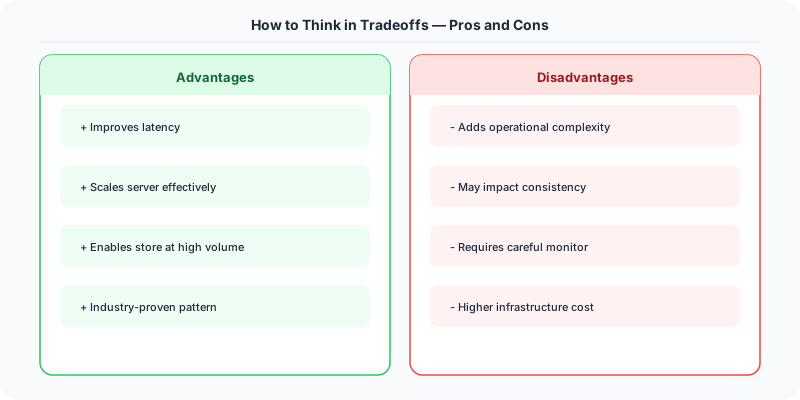
This gives you searchable, structured logs in Azure Monitor or Seq.
What Most Articles Get Wrong
Many articles about How To Think In Tradeoffs present an oversimplified view that misses the operational reality. In production, the theoretical best practices often collide with constraints like legacy systems, team expertise, budget limitations, and compliance requirements. The engineers who successfully implement these patterns at scale are the ones who understand not just the "what" but the "when" and "when not to."
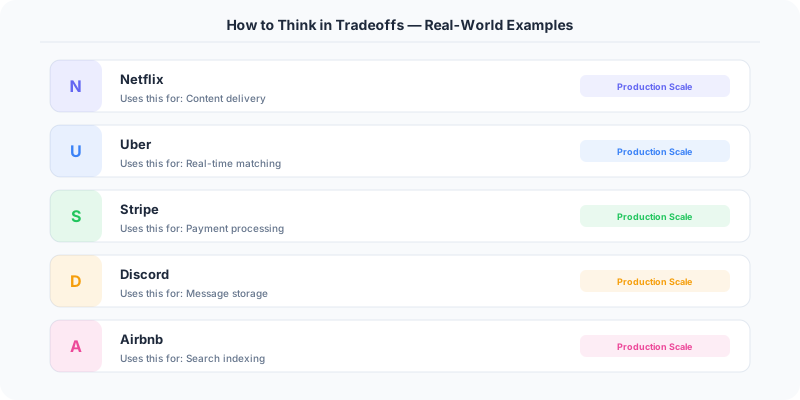
The nuance that matters: context determines everything. A pattern that works at Netflix's scale (200M users, 1000+ engineers) is overkill for a startup with 10,000 users and 3 engineers. Always match the solution complexity to the problem complexity.
The Numbers That Matter
- Latency percentiles matter more than averages: p99 latency often reveals problems that p50 hides
- Error budgets quantify acceptable risk: if your SLA is 99.95%, you have 21.9 minutes of downtime per month to spend on deployments and experiments
- Cost per request at scale determines architecture: a $0.001 cost difference per request becomes $1M per year at 1 billion requests/year
- Team cognitive load is the hidden constraint: a system your team cannot understand is a system your team cannot operate safely