How Stripe Designs APIs That Developers Love
How Stripe Designs APIs That Developers Love
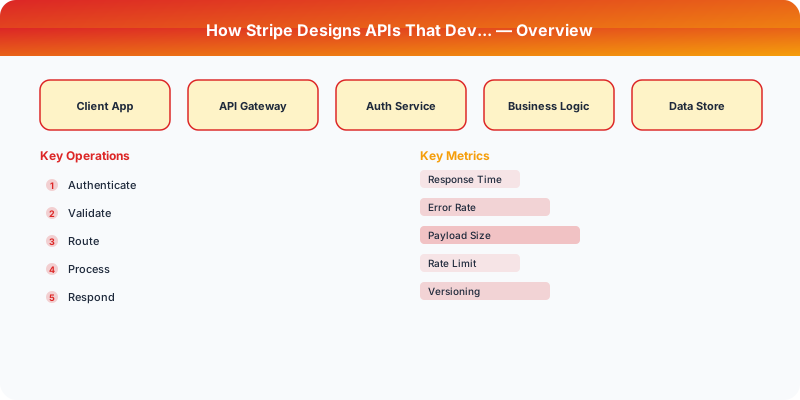
Stripe's API is widely regarded as the best-designed API in the industry. After 10+ years of evolution, it processes hundreds of billions of dollars in payments annually. Here is what makes it exceptional and what you can learn for your own APIs.
Core Design Principles
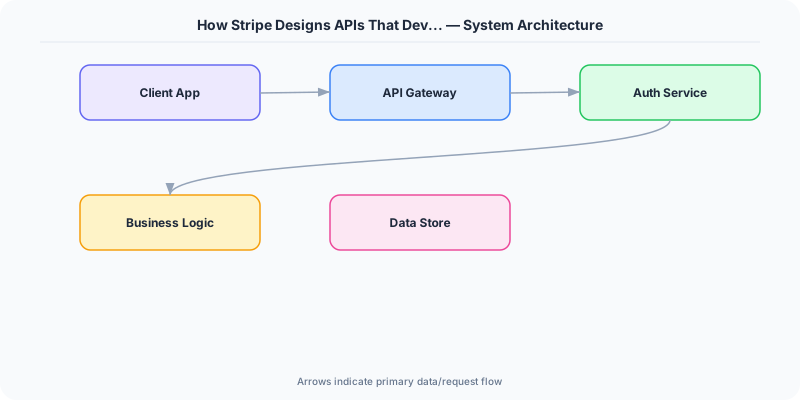
1. Resource-Oriented REST
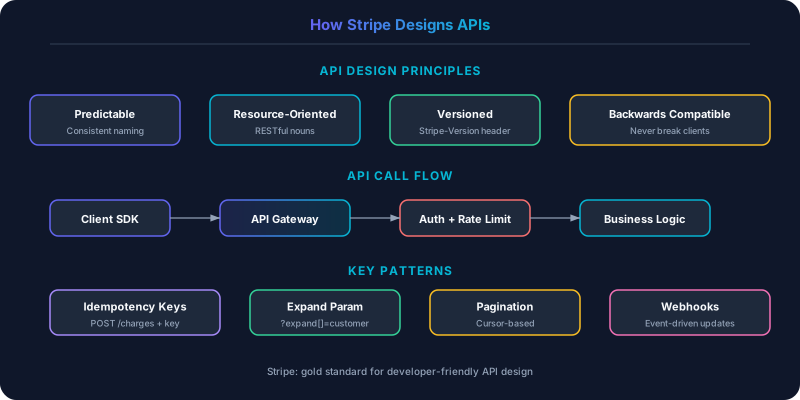
Every Stripe object is a resource with a consistent URL pattern:
POST /v1/charges— create a chargeGET /v1/charges/ch_123— retrieve a chargePOST /v1/refunds— create a refund
No verb-based URLs. No inconsistent naming. Every endpoint follows the same pattern.
2. Idempotency Keys
Network failures happen. Stripe lets you safely retry any POST request by including an Idempotency-Key header:
- First request: processes the charge, stores the result keyed by the idempotency key
- Retry with same key: returns the stored result without re-processing
- This guarantees exactly-once payment processing even with retries
3. API Versioning Without Breaking Clients
Stripe's most innovative design decision: every API call is pinned to a specific API version. When you create a Stripe account, your integration is locked to that day's API version. Stripe can release breaking changes without affecting existing integrations.
How it works:
- Each request includes a
Stripe-Versionheader (or uses the account's pinned version) - Stripe maintains compatibility layers that transform requests/responses between versions
- You upgrade on your own schedule by changing the pinned version
This means Stripe has shipped hundreds of breaking changes over 10 years without breaking a single existing integration.
4. Expandable Objects
A charge includes a customer field. By default, it returns just the customer ID. But add ?expand[]=customer and Stripe returns the full customer object inline — no second API call needed.
This elegantly solves the REST under-fetching problem without the complexity of GraphQL.
5. Consistent Error Handling
Every error includes:
- type: The error category (card_error, api_error, authentication_error)
- code: Machine-readable error code (card_declined, expired_card)
- message: Human-readable explanation
- param: Which request parameter caused the error
- doc_url: Direct link to documentation for this error
This makes debugging trivial — you never see a generic "500 Internal Server Error."
Lessons for Your APIs
- Be consistent: Same URL patterns, same response shapes, same error format everywhere
- Support idempotency: Especially for operations that charge money or create resources
- Version from day one: You will need to make breaking changes. Plan for it.
- Design errors for developers: Include enough information to fix the problem without reading docs
- Use expandable objects: Let clients choose their data granularity
Sources
Putting This Into Practice
Understanding the theory is only half the battle. Here is how to apply these concepts in your daily work:
Start small. Pick one project or one component of your current system and apply the ideas from this article. Do not try to redesign everything at once.
Document your decisions. When you make an architectural choice, write a short ADR (Architecture Decision Record) explaining what you chose, why, and what alternatives you considered. Future you will thank present you.
Talk to your team. System design is a team sport. Share what you learn, discuss tradeoffs openly, and build shared understanding. The best architectures come from teams that communicate well, not from lone geniuses.
Key Takeaways
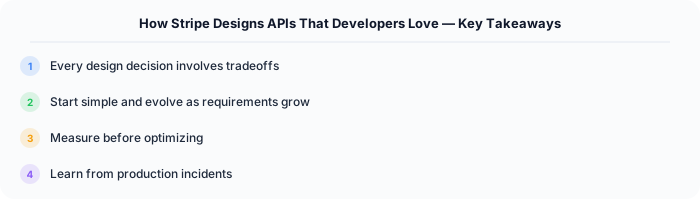
- Every design decision involves tradeoffs — there is no perfect solution
- Start simple and evolve as requirements grow
- Measure before optimizing — premature optimization wastes engineering time
- Learn from production incidents — they teach you more than any textbook
- Practice explaining your reasoning — this is what interviews test
Stripe's Error Handling Philosophy
One of Stripe's most copied innovations is their error response format. Every error includes four fields: type (category like card_error or api_error), code (machine-readable like card_declined), message (human-readable explanation), and param (which request parameter caused the issue). Some errors also include a doc_url that links directly to the relevant documentation page.
This design means developers rarely need to search documentation when debugging. The error itself tells them exactly what went wrong and where to look for the fix. Compare this to APIs that return generic "400 Bad Request" with no context — Stripe's approach saves developers hours of debugging time.
Pagination Done Right
Stripe uses cursor-based pagination instead of offset-based. Instead of "give me page 5" (which requires counting all previous results), you say "give me results after this cursor." This is more efficient for large datasets because the database does not need to skip rows, and it handles concurrent inserts gracefully — new items do not shift page boundaries.
The pagination response includes has_more (boolean) and a URL for the next page. This self-describing response means clients never need to calculate page numbers or guess at total counts.
What You Can Apply Today
Even if you are not building a payment API, Stripe's principles apply universally: be consistent across all endpoints, version from day one, make errors self-explanatory, use idempotency for any operation that changes state, and invest in documentation as a product feature. The best APIs are the ones developers never need to ask questions about.
Practical Implementation for .NET Developers
In a .NET application, you would typically implement this pattern using the following approach:
ASP.NET Core setup: Create a service class that encapsulates the logic, register it with dependency injection, and inject it into your controllers or minimal API endpoints. The built-in DI container handles lifecycle management.
Entity Framework Core: For database interactions, EF Core provides the ORM layer. Use migrations for schema management and raw SQL for performance-critical queries. Consider Dapper for read-heavy paths where EF Core's overhead matters.
Azure integration: If deploying to Azure, leverage managed services — Azure Cache for Redis, Azure SQL, Azure Service Bus, Azure Cosmos DB. These eliminate operational overhead and provide built-in monitoring through Application Insights.
Testing: Use xUnit with Testcontainers for integration tests that spin up real databases in Docker. Mock external dependencies with NSubstitute. The WebApplicationFactory class lets you test your entire HTTP pipeline in-process.
Monitoring: Add Application Insights telemetry to track request latency, dependency calls, and custom metrics. Use structured logging with Serilog to make production debugging possible:
Log.Information("Processing order {OrderId} for {CustomerId}", orderId, customerId);
This gives you searchable, structured logs in Azure Monitor or Seq.
Explore More
What Most Articles Get Wrong
Most articles praise Stripe's API design for its consistency and documentation but miss the architectural innovation underneath: idempotency keys. Every mutating Stripe API endpoint accepts an Idempotency-Key header. If a client retries a request with the same key (due to network timeout), Stripe returns the original response without reprocessing. This sounds simple but implementing it at scale is extremely hard — you need to store every response, handle concurrent duplicate requests, and manage the TTL of idempotency records.
Another underappreciated aspect is Stripe's API versioning strategy. Unlike most APIs that use URL versioning (/v1, /v2), Stripe uses date-based versioning in headers. Each API key is pinned to the API version that existed when the key was created. This means old integrations continue working indefinitely, and developers upgrade on their own schedule. Stripe maintains backward compatibility with API versions going back to 2011.
The Numbers That Matter
- Hundreds of millions of API calls per day across Stripe's platform
- 99.999% API uptime target (Stripe's availability SLA)
- 200+ API versions maintained simultaneously via date-based versioning
- 24-hour TTL for idempotency keys (after which the key can be reused)
- Under 300ms average API response time for payment creation
- $1+ trillion in payment volume processed annually