How Netflix Serves 200 Million Subscribers
How Netflix Serves 200 Million Subscribers
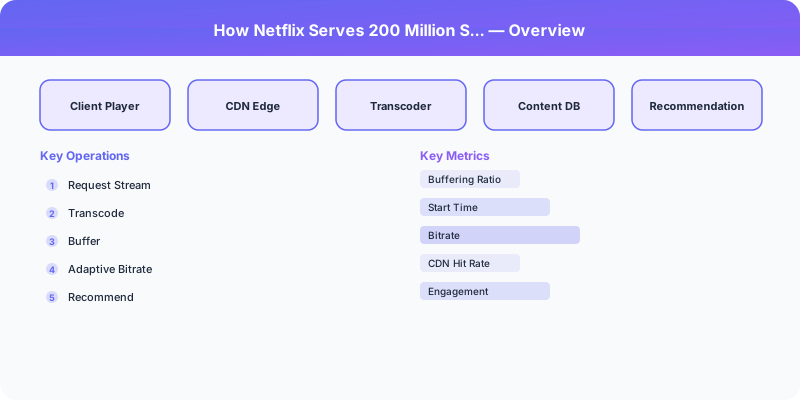
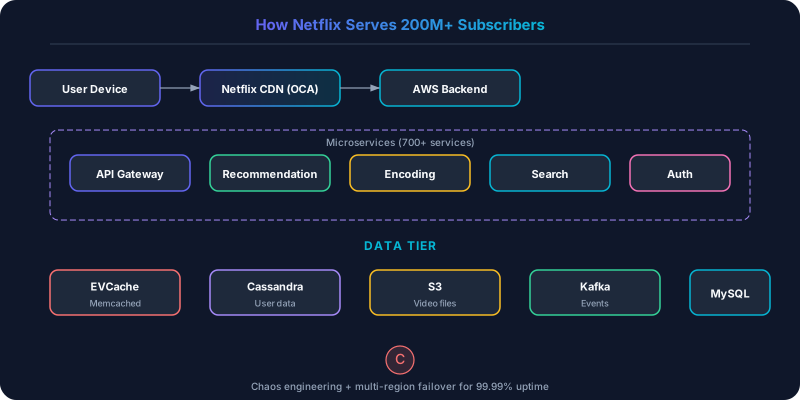
Netflix accounts for roughly 15% of all internet downstream traffic globally. Serving 200M+ subscribers across 190 countries requires an architecture that is resilient, globally distributed, and optimized for the viewing experience.
The Architecture Stack
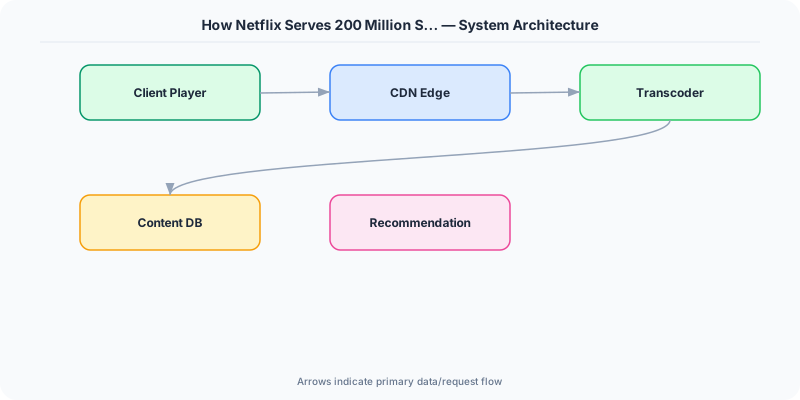
Netflix runs entirely on AWS for its control plane (user authentication, recommendations, billing, content catalog) but uses its own CDN — Open Connect — for the actual video delivery.
Open Connect: Netflix's CDN
Instead of paying Akamai or CloudFront, Netflix built Open Connect — a network of servers placed directly inside ISP networks worldwide. When you watch Netflix, the video streams from a server physically located in your ISP's data center, not from a remote AWS region.
How it works:
- During off-peak hours, Netflix pushes popular content to Open Connect Appliances (OCAs) at ISP locations
- When you press play, the Netflix control plane (running on AWS) determines which OCA has the content closest to you
- Your player connects directly to the OCA and streams via HTTP
- If the closest OCA is overloaded, traffic spills to the next closest
This reduces Netflix's bandwidth costs, reduces latency for viewers, and reduces internet backbone congestion for ISPs — a win for everyone.
Microservices Architecture
Netflix runs 1,000+ microservices on AWS. Each team owns their service end-to-end (build, deploy, operate). Key services:
- API Gateway (Zuul): Routes all client requests, handles authentication, rate limiting, and load shedding
- Discovery (Eureka): Service registry — every microservice registers itself and discovers others
- Resilience (Hystrix/resilience4j): Circuit breakers prevent cascading failures across services
- Content Service: Manages the catalog — 15,000+ titles with metadata in multiple languages
- Recommendation Service: ML models trained on viewing history, generating personalized rankings
Adaptive Bitrate Streaming
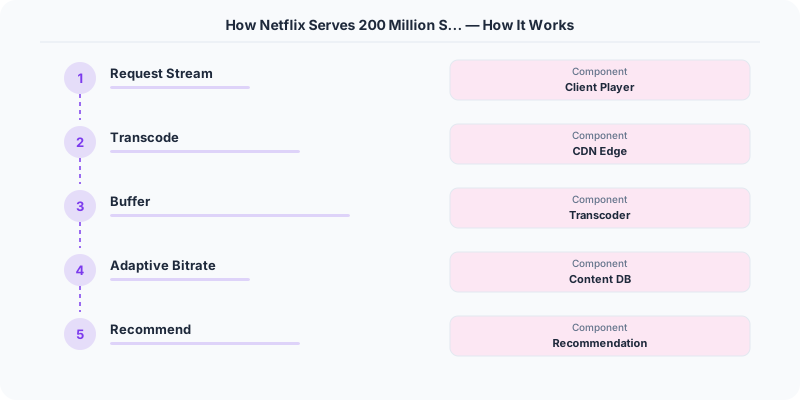
Netflix encodes each title in 10+ quality levels (from 240p to 4K HDR) and multiple codecs (H.264, VP9, AV1). The player continuously monitors bandwidth and switches quality seamlessly:
- Connection drops to 3G? Switch to 480p within 4 seconds
- WiFi recovered? Gradually step up to 1080p
- Each "chunk" (4-second segment) can be a different quality
AV1 codec delivers 20% better compression than VP9, saving Netflix $1B+ annually in bandwidth.
Chaos Engineering
Netflix invented chaos engineering — deliberately injecting failures in production to build confidence in system resilience:
- Chaos Monkey: Randomly kills EC2 instances
- Chaos Kong: Simulates an entire AWS region failure
- Latency Monkey: Introduces artificial delays between services
The philosophy: if a system has not been tested under failure, it will fail unpredictably when a real incident occurs.
Key Takeaways
- Own your CDN at scale: At Netflix's volume, a custom CDN is cheaper and better than third-party options
- Microservices enable team autonomy: 1,000+ services let 10,000+ engineers deploy independently
- Design for failure: Chaos engineering catches weaknesses before they cause outages
- Invest in encoding: Better codecs directly reduce infrastructure costs at scale
Sources
- Netflix Tech Blog: netflixtechblog.com
- System-Design-Overview
Putting This Into Practice
Understanding the theory is only half the battle. Here is how to apply these concepts in your daily work:
Start small. Pick one project or one component of your current system and apply the ideas from this article. Do not try to redesign everything at once.
Document your decisions. When you make an architectural choice, write a short ADR (Architecture Decision Record) explaining what you chose, why, and what alternatives you considered. Future you will thank present you.
Talk to your team. System design is a team sport. Share what you learn, discuss tradeoffs openly, and build shared understanding. The best architectures come from teams that communicate well, not from lone geniuses.
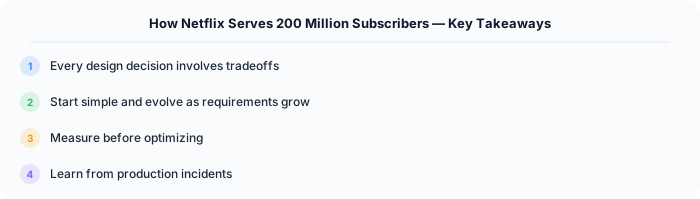
Key Takeaways
- Every design decision involves tradeoffs — there is no perfect solution
- Start simple and evolve as requirements grow
- Measure before optimizing — premature optimization wastes engineering time
- Learn from production incidents — they teach you more than any textbook
- Practice explaining your reasoning — this is what interviews test
The Recommendation Engine: 80 Percent of What You Watch
Netflix says that 80 percent of content watched on the platform comes from recommendations, not search. The recommendation system combines multiple machine learning models:
Collaborative filtering identifies patterns across users: "users who watched Stranger Things also watched Dark." This works well for popular content but struggles with new releases that have no viewing data yet.
Content-based filtering analyzes the attributes of each title: genre, director, actors, pacing, visual style. Netflix even tags content with thousands of micro-genres like "Critically-acclaimed emotional underdog movies." This helps recommend niche content that collaborative filtering might miss.
The ranking model combines these signals with contextual factors: time of day (comedies in the evening, documentaries on weekends), device (shorter content on mobile), and your recent viewing momentum. The homepage you see is unique — no two Netflix homepages are identical.
Why Netflix Builds Everything Twice
Netflix follows a philosophy of building two of everything for resilience. Two AWS regions (us-east-1 and us-west-2) run active-active. Two CDN tiers (Open Connect and a fallback). Two recommendation pipelines (real-time and batch). If any primary system fails, the backup takes over automatically.
This costs roughly twice the infrastructure budget, but Netflix calculated that one hour of global downtime costs more than a year of redundant infrastructure. At their scale, reliability is not optional — it is the product.
Practical Implementation for .NET Developers
In a .NET application, you would typically implement this pattern using the following approach:
ASP.NET Core setup: Create a service class that encapsulates the logic, register it with dependency injection, and inject it into your controllers or minimal API endpoints. The built-in DI container handles lifecycle management.
Entity Framework Core: For database interactions, EF Core provides the ORM layer. Use migrations for schema management and raw SQL for performance-critical queries. Consider Dapper for read-heavy paths where EF Core's overhead matters.
Azure integration: If deploying to Azure, leverage managed services — Azure Cache for Redis, Azure SQL, Azure Service Bus, Azure Cosmos DB. These eliminate operational overhead and provide built-in monitoring through Application Insights.
Testing: Use xUnit with Testcontainers for integration tests that spin up real databases in Docker. Mock external dependencies with NSubstitute. The WebApplicationFactory class lets you test your entire HTTP pipeline in-process.
Monitoring: Add Application Insights telemetry to track request latency, dependency calls, and custom metrics. Use structured logging with Serilog to make production debugging possible:
Log.Information("Processing order {OrderId} for {CustomerId}", orderId, customerId);
This gives you searchable, structured logs in Azure Monitor or Seq.
Explore More
What Most Articles Get Wrong
Most articles about Netflix focus on the microservices architecture and ignore the economics. The real story is cost optimization at extreme scale. Netflix spends approximately $1.5 billion per year on cloud infrastructure (AWS) for the control plane alone. Their Open Connect CDN, by contrast, costs a fraction of that — because they convinced ISPs to host Netflix hardware for free in exchange for reduced backbone traffic. The ISPs benefit because Netflix traffic (which was clogging their expensive transit links) now stays local. This is not just a technical decision — it is a business partnership model that most companies cannot replicate.
Another common misconception: Netflix does not actually stream 4K to most users. Despite advertising 4K HDR, Netflix's adaptive bitrate algorithm usually settles on 1080p because most internet connections fluctuate. The AV1 codec matters more than resolution — it delivers visually equivalent quality at 30-50% less bandwidth than the older H.264 codec. Netflix has been gradually re-encoding their entire library with AV1, saving over a billion dollars annually in bandwidth costs.
The Numbers That Matter
- 15% of all downstream internet traffic globally comes from Netflix during peak hours
- 1,000+ microservices running on AWS handle the control plane (browsing, search, recommendations, billing)
- Open Connect CDN has servers in 1,000+ ISP locations across 150+ countries
- 8 minutes is the average time Netflix says a user will spend deciding what to watch before giving up — which is why the recommendation engine is their highest-priority system
- 80% of content watched comes from algorithmic recommendations, not search or browsing
- $1 billion+ saved annually by using AV1 codec instead of H.264
- 2 AWS regions (us-east-1, us-west-2) run active-active for the control plane
- 100 million hours of A/B tests run across the platform to optimize the user experience